Sign up for Chalkbeat Philadelphia’s free newsletter to keep up with the city’s public school system.
Teacher union leaders and city officials have vehemently fought the Philadelphia school district for weeks over its proposal to close 18 schools.
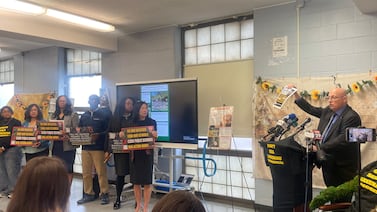
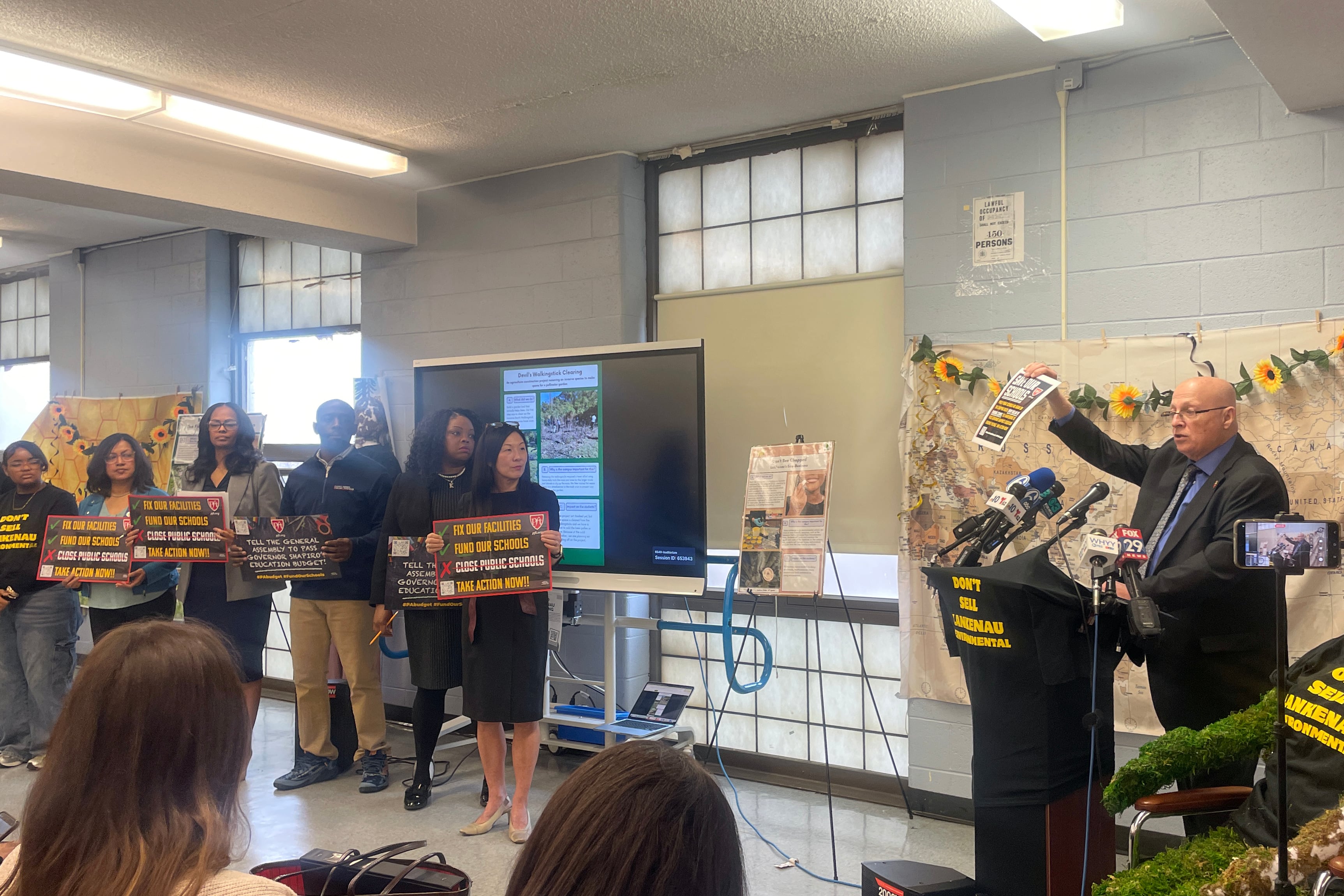
But on Wednesday, union, city, and school district officials stood side by side to call for more state funding for Pennsylvania’s largest school district. Together, they urged state lawmakers to pass Gov. Josh Shapiro’s budget proposal, released last month, which would boost funding for Philadelphia schools by $151 million.
With more state funding, “we can move beyond difficult conversations about scarcity,” said Deputy Superintendent Jermaine Dawson at the union-sponsored event at Lankenau Environmental Science High School, which is on the list of proposed closures. “And then we can focus squarely on accelerating academic achievement.”
Superintendent Tony Watlington has said he does not want to close schools. But he has said the proposed closures, which the Board of Education has not yet approved, are necessary to ensure students no longer attend class in dilapidated buildings and have more access to academic opportunities.
The district’s funding problems seem to be the one thing everyone can agree on throughout closure debates. Repairing the district’s aging buildings would cost millions the district does not have. Already, the district is projecting a $300 million budget deficit for the upcoming fiscal year.
In addition to opposing the closure plan, the Philadelphia Federation of Teachers has called for more transparency about the data the district used to determine which schools to shutter. But on Wednesday, President Arthur Steinberg had a separate priority.
“We will pick up the debate over the facilities plan another day,” said Steinberg, “Today, we are unified in saying to the General Assembly they are constitutionally obligated to fund our schools fairly and equitably.”
The Philadelphia school district is the only district in the state that cannot raise its own revenue through taxes. It has endured decades of underfunding under a state funding formula that a judge ruled was unconstitutional in 2023.
Though the legislature has boosted school funding every year since then, districts still get millions fewer dollars than what a state commission determined is needed to adequately meet all students’ needs. Last year, a months-long state budget delay also required the Philadelphia district to take out loans to stay afloat, costing it thousands in interest.
In recent years, the city has slightly increased district funding, and Mayor Cherelle Parker has promised an additional increase in 2030. But in the meantime, the cost of maintaining and fixing old buildings — many of which have flaking asbestos and lead paint — is mounting.
Even members of the City Council, who grilled school district officials last month about the closure plan, acknowledged that the state’s history of underfunding the Philadelphia school district has contributed to the building problems officials are now trying to solve.
Education Committee Chair Isaiah Thomas opposes the district’s closure plan. District officials recently removed one school he’s strongly supported, Conwell Middle School, from its closure list. Thomas is an alumnus of Conwell, although Watlington has denied playing favorites.
On Wednesday, Thomas said he stood with the Lankenau community in fighting to keep their school open. But he also pointed out that the state’s long-term disinvestment in Philly’s schools has strained both the district’s and the city’s finances.
“It’s not right, it’s not fair,” said Thomas. “It has put us in a position for well over a decade to be constantly in the red as it relates to public education.”
Rep. Morgan Cephas, who chairs the Philadelphia House delegation in the state legislature, said at Wednesday’s event she would urge her colleagues to pass a state budget that boosts funding for the city’s schools, although the issue could come down to Senate Republicans.
Rebecca Redelmeier is a reporter at Chalkbeat Philadelphia. She writes about public schools, early childhood education, and issues that affect students, families, and educators across Philadelphia. Contact Rebecca at rredelmeier@chalkbeat.org.