Sign up for Chalkbeat Philadelphia’s free newsletter to keep up with news on the city’s public school system.
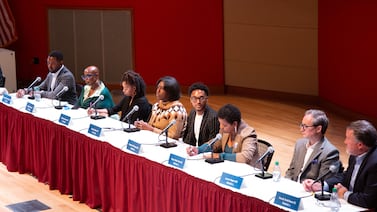
The Philadelphia Board of Education approved a $4.6 billion budget Thursday night that includes millions in cuts and will result in schools losing climate staff, teachers, counselors, and substitutes.
Superintendent Tony Watlington said cutting some $225 million is necessary to begin to plug the district’s $300 million budget deficit while balancing rising salaries, healthcare premiums, and charter school payments. No staff will be laid off, Watlington has previously said. Instead, teachers and school-based staff might be reassigned to other vacant positions across the district.
“I’m agnostic to how we get the dollars, but we desperately need additional revenue,” Watlington said.
The budget passed 8-0.
The cuts come amid a cloud of bad news for Philly schools. Ahead of the meeting, City Council members rallied outside of the district building and blasted board members for their April vote approving the district’s plan to close 17 schools starting in 2027. Enrollment declines and other funding challenges mean schools will lose more staff, advanced placement classes, and after-school programs than the district is discussing.
Board member Joyce Wilkerson blamed state and federal underfunding for the district’s financial position. Philly is the only school district in the state that can’t raise its own tax revenue and is nearly entirely dependent on state and city funding.
“It’s a national disgrace, and a disgrace to this commonwealth” that Philly schools don’t receive more public funding, Wilkerson said.
Voting to approve the budget amounts to doubling down on the closure plan, City Council member Kendra Brooks said.
City Council member Jamie Gauthier called for the six board members who voted for the closure plan to resign. “We need a school board that is actually accountable to our community,” she said.
Though elected officials are publicly fuming about the closures, no City Council member has proposed a plan to help the district close its budget deficit.
Mayor Cherelle Parker has been pushing a proposed $1 per ride tax on Ubers and Lyfts to funnel more money to the school district. But the tax has become one of the central political battles in the city, and city council members do not appear poised to approve it as is.
Thursday’s vote locks the district’s budget cuts in while negotiations around the rideshare tax continue.
City Council member and Chair of the city’s Education Committee Isaiah Thomas said at Thursday’s rally that the rideshare tax is not part of his negotiation strategy.
Also on Thursday, the board approved a $266 million amended capital budget that lays out major renovations, building additions, system replacements, and playground construction for dozens of schools to be paid for with bonds. The district’s facilities plan intends to modernize some 170 schools in addition to the closures, but there’s no guaranteed funding for that plan, so it’s unclear how realistic those projections are.
The city has a July 1 deadline to enact a budget. Thomas said if school board members and district officials don’t come back to the table to discuss changes to the closure plan, council members will continue to put them on notice.
“We’ll just keep going,” he said.
Carly Sitrin is the bureau chief for Chalkbeat Philadelphia. Contact Carly at csitrin@chalkbeat.org.