Sign up for Chalkbeat Tennessee’s free daily newsletter to keep up with the Shelby County public school system and statewide education policy.
The leadership transition at the Tennessee Department of Education accelerated this week with the resignations of two high-level officials, including a veteran manager responsible for many of the state’s biggest education programs and initiatives.
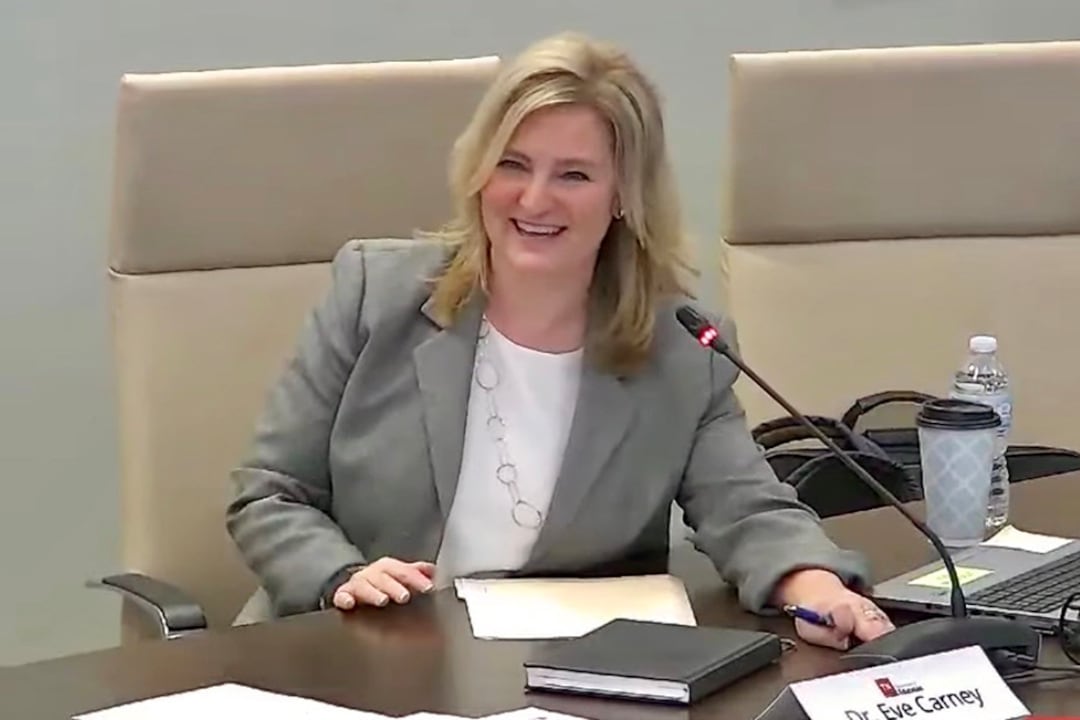
Deputy Commissioner Eve Carney will step down on June 30, a department spokesperson confirmed Monday.
The departure of Meghan McLeroy, the department’s chief officer responsible for supporting schools and districts statewide, is effective Aug. 1, the spokesperson said.
A staff member with the department since 2008, Carney currently oversees state-level work involving federal programs, school choice, testing, accountability, school improvement, and the state-run Achievement School District for low-performing schools. She is among the deepest wells of institutional knowledge within the department.
Her resignation comes at a critical time as Lizzette Gonzalez Reynolds prepares to take the helm of the department on July 1 after Penny Schwinn ended her four-year tenure as commissioner last week.
Carney — who is one of four remaining members from Schwinn’s original cabinet — was expected to play a key role in helping Reynolds as the new commissioner from Texas faces myriad challenges.
Tennessee is shifting to a new education funding formula on July 1, enforcing a controversial new third-grade retention policy for struggling readers, operating large-scale tutoring and summer learning programs to help students catch up from the pandemic, expanding its private school voucher program to a third major city, and fortifying its school buildings after a Nashville school shooting left three students and three staff members dead on March 27.
The state also is scheduled to start giving A-to-F grades to its 1,700-plus public schools this fall after delaying the new accountability policy for five years because of testing and data disruptions, most recently caused by the pandemic.
A former Tennessee high school teacher and former chief of districts and schools for the department, Carney became Schwinn’s go-to manager to oversee high-level, high-profile programs.
She often stepped in to provide oversight amid employee turnover in Schwinn’s first months on the job. And last summer, when the Tennessee Supreme Court lifted a 2-year-old order to let the state resume work on its new private school voucher program, Schwinn turned to Carney to launch the rollout in a matter of weeks.
Carney was viewed as a possible successor to Schwinn, especially after Chiefs for Change, a national network of education leaders, named her in January to its latest cohort of “future chiefs,” considered a springboard for administrators seeking top jobs.
But in May, when Schwinn announced plans to step down at the end of the school year, Gov. Bill Lee went out of state to find his new education chief. Reynolds has political and policy experience in Texas and Washington, D.C., and most recently oversaw policy for the advocacy group ExcelinEd, founded by former Florida Gov. Jeb Bush.
Lee also named Sam Pearcy, the department’s deputy commissioner of operations, to serve as interim education commissioner until Reynolds’ arrival. Pearcy was sworn in on June 2, after Schwinn’s last day on June 1, said department spokesperson Brian Blackley.
An alum of Teach for America, Pearcy joined the department in 2011 as part of the team overseeing school reform work under Tennessee’s $500 million award for the federal Race to the Top program.
McLeroy, another early member of Schwinn’s cabinet, has been with the department since 2011. She also initially helped to lead the state’s Race to the Top work.
The department plans to reassign Carney’s and McLeroy’s responsibilities to existing staff by the end of June, Blackley said.
Earlier this spring, Lisa Coons, the state’s chief academic officer, left Tennessee to become superintendent of public instruction for Virginia’s education department.
Marta Aldrich is a senior correspondent and covers the statehouse for Chalkbeat Tennessee. Contact her at maldrich@chalkbeat.org.