Sign up for Chalkbeat Tennessee’s free newsletter to keep up with statewide education policy and Memphis-Shelby County Schools.
Some Memphis parents say the local school district is failing to provide adequate resources including full-time sign language interpreters for deaf and hard of hearing students.
Four Memphis-Shelby County schools — Sea Isle Elementary and White Station Elementary, Middle, and High — have classrooms specifically designed to teach deaf and hard of hearing students. Around 100 MSCS students attend those schools for targeted support, representing close to 60% of the district’s deaf and hard of hearing population.
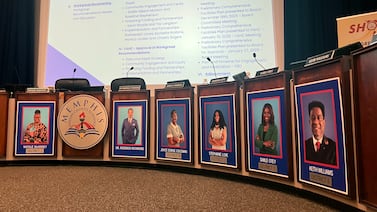
But at an Oct. 28 board meeting, a handful of Sea Isle parents and community members said the school has no full-time interpreters or teachers fluent in American Sign Language on staff, which hinders student learning. The group also said MSCS’ deaf education programs lack sufficient funding and district oversight on classroom outcomes and academic materials.
“They don’t have functional, equally equipped facilities for visual queues and closed captions, and they’re not training the staff,” Kiera McGhee Ross, an MSCS parent who is deaf and volunteers at Sea Isle, signed in an interview after the meeting with Chalkbeat Tennessee.
“It’s destroying the children the most,” she said. “They can’t write; they don’t know sign.”
MSCS leaders said in an emailed statement that there are five ASL interpreters in the district, but a lack of national and local certification opportunities makes it difficult to hire more. Barriers to certification and issues like low pay and burnout have contributed to a nationwide shortage of ASL interpreters in health care and education.
“The standard of teaching, curriculum, engagement, inclusivity, and care for students in our deaf program has not changed,” the statement said.
MSCS doesn’t track how much it spends on deaf education at individual schools. But in an emailed statement, MSCS leaders said the district invests around $1.6 million each year in deaf education services, an amount that has “remained stable” over the past decade.
Nationwide, students who are deaf or hard of hearing graduate from high school at a lower rate than their hearing peers and are less likely to pursue postsecondary education. The most effective teaching practices for deaf students are still widely unknown. But recent studies show that ASL fluency is a key predictor of academic and social emotional success.
MSCS declined to answer questions about the number of deaf and hard of hearing teachers on staff or how hearing teachers effectively communicate with students who are deaf. It’s unclear how often the five ASL interpreters are present in each school building.
McGhee Ross said that means students are also missing out on learning about deaf culture.
“The most important thing is to have language,” she said.
MSCS leaders are hosting a community meeting at 5 p.m. Monday, Nov. 17 in White Station High School to “seek growth opportunities” for students in the deaf and hard of hearing program. McGhee Ross said she and other Sea Isle parents plan to push for more answers there.
Correction: A previous version of this story stated that McGhee Ross is a parent of a student at Sea Isle.
Bri Hatch covers Memphis-Shelby County Schools for Chalkbeat Tennessee. Reach Bri at bhatch@chalkbeat.org.