Sign up for Chalkbeat Tennessee’s free newsletter to keep up with statewide education policy and Memphis-Shelby County Schools.
Memphis mom Erica Smith vividly remembers the day two years ago that her phone wouldn’t stop ringing while she was at work.
On the other end of the line were four different teachers from Ida B. Wells Academy. Her fourth grade daughter, they said, had fallen asleep and wouldn’t wake up.
The school’s teachers showed up then, when her daughter was diagnosed with a sleep disorder and needed assistance getting back on track academically. They showed up again when she struggled to cover her daughter’s basketball fee, and when some families in the South Memphis neighborhood needed help putting food on the table.
They showed up again just last week, when the school attendance specialist picked her daughters up and drove them to school when Smith had a transportation issue.
“It’s more than teaching with that school,” she said. “They really have wholehearted care about our children.”
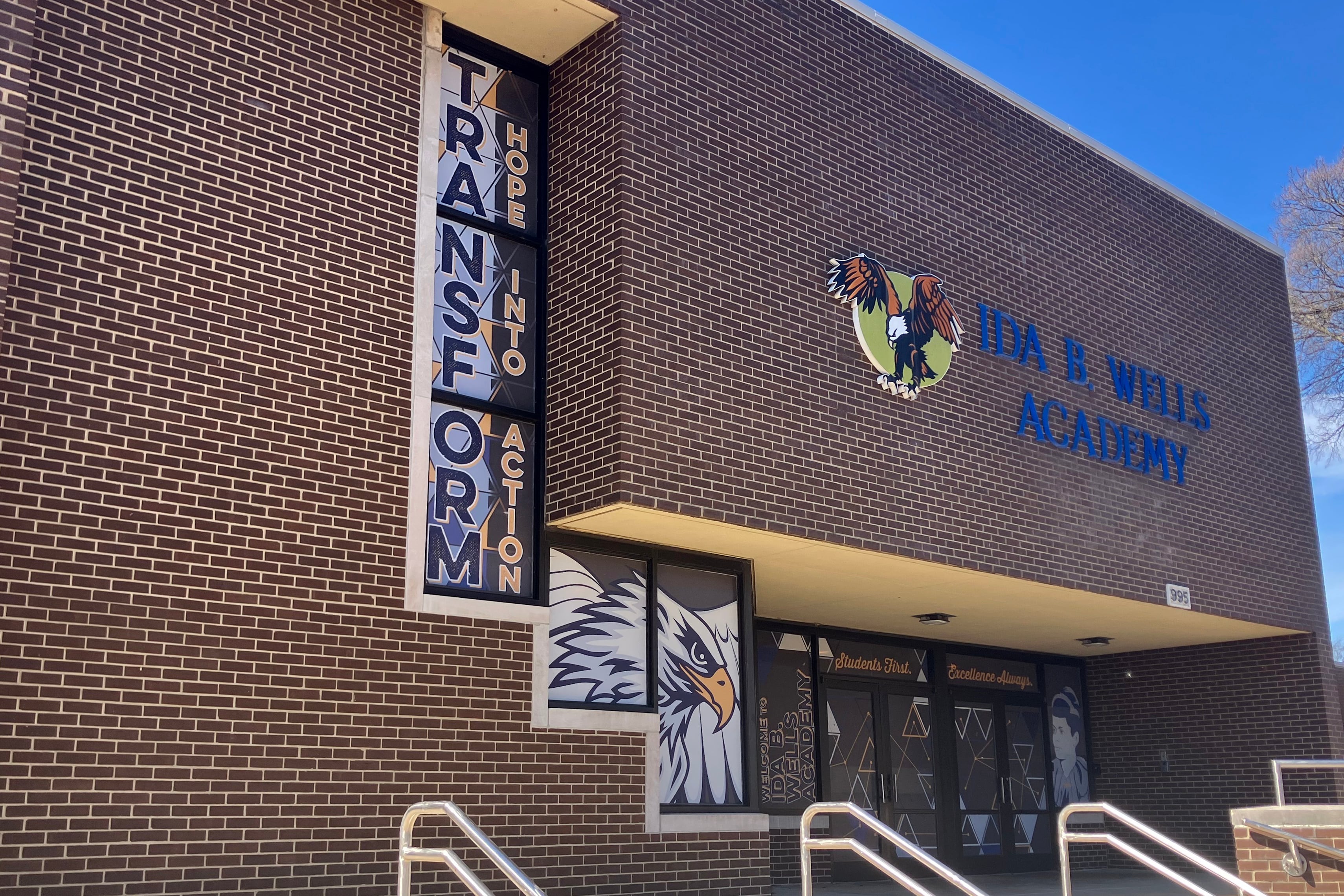
But now, the close-knit school may be shuttered. Ida B. Wells is one of the five district schools that has been targeted for closure in a larger Memphis-Shelby County Schools facilities plan.
Smith and other parents credit the small classes for serving their children better than larger neighborhood public schools. But low student enrollment is one of the main reasons the district is considering closing Ida B. Wells, which opened in 1963, at the end of this year. Only 84 students currently attend the K-8 school, which is built to hold almost 500.
Memphis-Shelby County leaders plan to close up to 15 schools in the next three years because of rising facilities costs and chronic underenrollment. The school board is expected to vote on the first five closure recommendations — including Ida B. Wells, Georgian Hills Elementary, Frayser-Corning Elementary, Lucy Elementary, and Chickasaw Middle — next Tuesday.
At a January community hearing on the closure proposal, parents questioned why a higher performing MSCS school is being targeted. Ida B. Wells students earned the highest state score for academic growth last year and slightly outperformed the district-wide average on reading and math tests.
Smith worries those results can’t be replicated at other MSCS schools, especially for students with specific needs like her daughter.
“Another teacher is going to basically learn her all over again, and it’s going to be hard,” Smith said.
But MSCS leaders say chronic underenrollment is preventing students throughout the district from receiving the highest quality resources and staff. Higher building costs means less money for what goes in the schools, facilities director Michelle Stuart said.
“Nobody wants their school to close,” Stuart said recently. “But I have recognized that people are understanding the logic of not having half-empty buildings,” she said, because the district can add more staff and programming to full schools.
Parents, staff criticize district options for Ida B. Wells students
Ida B. Wells Academy is nestled in a quiet residential neighborhood with narrow streets south of East E.H. Crump Boulevard. On a school day afternoon, laughter and chatter can be heard from outside the school walls.
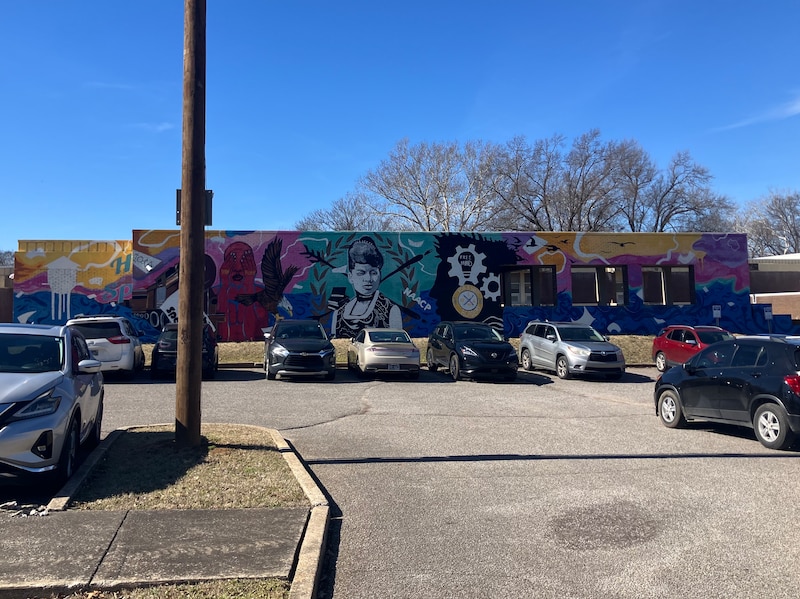
On one side of the building, there’s a vibrant mural featuring the school’s namesake, a dedicated investigative journalist and NAACP co-founder. Bright blue letters by the school’s front door spell out “vision, leadership, responsibility.”
Ida B. Wells is an open enrollment school, meaning any MSCS family can apply to attend regardless of their home address. Some current parents are wary of their neighborhood options, which is where they say their children would likely end up if the school closes.
Linda Farmer is the grandparent of a Wells sixth grader. If MSCS closes the school, her grandchild will attend Booker T. Washington next year. But she said she’s wary of moving her grandchild to a school with a larger population that combines grades 6-12.
“They never should have put the youth in there alongside the teenagers, because it made it more dangerous,” Farmer said.
MSCS parents raised similar safety concerns at the closure hearing for Chickasaw Middle School in December, as the district proposed a merger with nearby Westwood High School, and again at a hearing for closing Lucy Elementary.
In their long-term facilities plan, MSCS leaders say they want to lean more on those grade combination structures to boost building enrollment. Interim Superintendent Roderick Richmond argues that those models increase stability and continuity for students.
“I can enter school in the sixth grade, and I can establish relationships with my teachers and the leaders, so that for six years I can be in one feeder pattern and in one school,” he said. “We understand some of the parental concerns, but this is not a new way of looking at structuring schools.”
Opponents to the Ida B. Wells closure say the school has a unique culture that can’t be replicated elsewhere. Louis Morganfield has been the building engineer since June, but he’s worked in MSCS for the past six years.
“I walk those halls and I see the difference,” he said of the South Memphis school. “I haven’t seen one fight. I don’t hear any screaming and hollering at the kids. Teachers give them a look, and they get right in line.”
According to 2024-25 state education department data, fewer than 10 students were disciplined at Ida B. Wells Academy. Overall, close to 16,000 MSCS students were disciplined that year.
Morganfield is running for the District 9 seat on the local school board in May because he’s been frustrated with the closure process. And he feels more MSCS schools should be like Ida B. Wells: small and tightly run.
“It’s teaching [students] to stand up to Goliath with reading and writing,” Morganfield said. “The world is going to put obstacles in their way. But because of what they are learning at Ida B Wells, they’re going to be able to jump over, go around the obstacles, and they are going to do what they need to do to be successful.”
Farmer, the grandparent of an Ida B. Wells student, said she thinks the district hasn’t talked to families enough.
“The majority of the time they don’t listen because they already made their decision,” she said.
But district leaders say they’re taking feedback from families seriously. MSCS board members have been frequent attendees of the community listening sessions held in the past few months.
“Ida B. Wells is an amazing school,” board member Michelle McKissack said in a board meeting last week. “But there are 84 students across nine different grades. That is not serving the greater Memphis community.”
Smith says the Ida B. Wells teachers and staff are like extra parents to her two kids. And they’re reliable mentors and supporters for parents, too.
“They’ll tell me I’m doing a good job. They always stay to give me a hug,” she said. “I don’t want to lose that.”
Bri Hatch covers Memphis-Shelby County Schools for Chalkbeat Tennessee. Reach Bri at bhatch@chalkbeat.org.