Sign up for Chalkbeat Tennessee’s free newsletter to keep up with statewide education policy and Memphis-Shelby County Schools.
Memphis-Shelby County schools that have received D or F school letter grades for at least two years are heavily reliant on unlicensed teachers, district officials testified Tuesday at a state accountability hearing.
More than half of the teachers at 14 schools that have received either a D or F in Tennessee’s school grading system are working on emergency or temporary permits, mirroring an ongoing state trend showing a rapid rise in non-credentialed teachers.
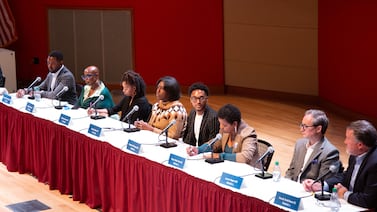
Memphis officials testified before a three-person committee of the Tennessee State Board of Education, which is holding a week of accountability hearings for 18 districts with schools that have received failing letter grades for at least two years in a row.
The committee recommended a “corrective action plan” for Memphis schools, a plan that could include state monitoring, needs assessments made by external third parties, and set performance targets. Details on the plan won’t be finalized for months as the accountability process plays out.
The district is already implementing “scripted” lesson plans and curriculum guides, in addition to deploying regional superintendents for curriculum “fidelity” checks in an effort to address student learning gaps at underperforming schools.
“The scripted lessons are particularly vital for supporting our influx of permit teachers, which are notably higher in these schools,” the district said in a strategic planning document submitted to the state board.
The hearing committee praised Memphis officials for their preparation and school-level data informing issues like chronic absenteeism and academic underperformance.
“Of all the districts we’ve interviewed so far, this district has presented its root causes better than any other we’ve heard,” State Board of Education chair Bob Eby said. “I think you understand what your challenges are.”
The MSCS schools facing a corrective plan include:
- A.B. Hill Elementary, dropped from a D to an F
- Carver College and Career Academy, two years of F grades
- Douglass K-8, two years of F grades
- Geeter School, dropped from a D to an F
- Grandview Heights Middle, dropped from a D to an F
- Hickory Ridge Middle, dropped from a D to an F
- Kate Bond Middle, dropped from a D to an F
- Kingsbury Middle, two years of F grades
- Mt. Pisgah Middle, two years of F grades
- Raleigh Egypt Middle, dropped from a D to an F
- Robert R. Church Elementary, dropped from a D to an F
- Sherwood Elementary, dropped from a D to an F
- Treadwell Elementary, two years of F grades
Though Chickasaw Middle School was also on the list, board members voted earlier this year to close the school amid a long-term facilities restructuring in the district.
If the full Tennessee State Board of Education signs off on corrective action recommendations in May, local districts will work with the Tennessee Department of Education to design and implement corrective plans.
School districts will face more severe consequences, including audits and investigations, if they are called for subsequent accountability hearings.
“These conversations are not meant to be punitive in nature, not a ‘gotcha’ conversation,” said vice-chair Darrell Cobbins. “It’s more of a conversation about how do we get these schools off the list that they’re on and on an upward trajectory ensuring the students are successful and served well.”
Cobbins on Tuesday told Memphis officials the accountability committee had one of two options, either take no action or recommend a corrective plan. He appeared satisfied with the strategies Memphis officials shared and hoped the corrective plan would guarantee they were “codified” into district plans.
“Today’s hearing was a productive and important step forward,” MSCS board chair Natalie McKinney said in a Tuesday statement. “We appreciate the State Board’s thoughtful questions, their focus on students, and their willingness to work alongside Memphis-Shelby County Schools. Our Board is committed to strong accountability, strategic investment, and ensuring that every decision we make is centered on improving outcomes for our students. We are aligned on the urgency of this work, and now, the real work continues.”
It’s the first year schools have been subject to the hearings under a 2022 law establishing a state board-level accountability mechanism tied to its student funding formula and a 2016 state law that established the school grading system, which is tied to student performance on the Tennessee Comprehensive Assessment Program.
The grading system was initially plagued by pandemic delays and systemic testing issues before it was completely revamped in 2023. In a controversial decision, state education officials chose to emphasize academic achievement, or proficiency, over academic growth.
Accountability hearings will continue through the week for Metro Nashville Public Schools, Hardeman County Schools, Fayette County Public Schools, Jackson-Madison County School System, Haywood County Schools, Robertson County Schools, Cocke County School District, Carter County Schools, Hamilton County Schools, Polk County Schools, Monroe County Schools, Knox County Schools, Sevier County School System, and Union County Public Schools.
Melissa Brown is the bureau chief for Chalkbeat Tennessee. Contact Melissa at mbrown@chalkbeat.org.