
Sign up for Chalkbeat’s free weekly newsletter to keep up with how education is changing across the U.S.
Lori Sebastian had saved up years worth of sick days when she had her first baby in 2016. Her careful planning allowed the Delaware third-grade teacher to spend time with her newborn and still pay the bills.
But after her husband Colin became a stay-at-home dad — the cost of child care would have eaten up his entire paycheck — the couple wondered how they could afford a second child. They had become dependent on Lori Sebastian’s income, and she no longer had a large bank of sick days. Without paid parental leave, they didn’t know how they would pay the bills.
Meanwhile, lawmakers in Delaware were considering a paid leave bill, but their original version excluded teachers due to cost concerns. Sebastian joined other teachers from the Delaware State Education Association, the teachers union, to share their experiences and make the case to lawmakers that paid leave was an investment in the workforce — and ultimately in students.
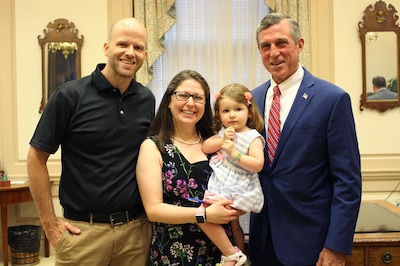
In 2018, Delaware became the first state to adopt a full 12 weeks of paid parental leave for teachers. Critically, the state also agreed to cover the cost of substitute teachers, easing the financial concerns of school district leaders. Sebastian was present and pregnant at the signing ceremony. She still has the pen then Gov. John Carney used.
But more than seven years later, Delaware remains an outlier. Just 15 states and the District of Columbia guarantee any paid leave for teachers, according to a study released Monday by the National Council on Teacher Quality. Arkansas is the only other state that picks up the cost of substitutes for the full 12 weeks.
The United States is the only developed country without a national parental leave policy, and teachers aren’t alone in having to cobble together sick days, vacation time, and short-term disability when they have a baby. But just one-third of teachers reported access to any paid parental leave in a 2024 survey by the research group Rand Corp. — 14 percentage points lower than other workers. And even among those who had access to leave, fewer than half said the benefits were adequate.
That has important implications for school districts and students, NCTQ President Heath Peske said. Among teachers who leave the profession, about 15% cite family obligations, including pregnancy and childbirth. Hiring and training new teachers can end up costing more than family leave would have.
“When we have a revolving door of teacher turnover, this leads to poorer outcomes for students,” she said. “Paid parental leave is an investment in teachers but also in their students. We see it as a really smart policy.”
Delaware and Arkansas have what NCTQ considers model policies. Teachers get 12 weeks of leave at full pay, and the state covers the cost of a substitute teacher for that time period.
Another six states — Maine, New Jersey, Maryland, Minnesota, Washington, and Oregon — offer 12 weeks with partial pay.
And seven states, most of them in the South, plus the District of Columbia, offer teachers full pay for some shorter amount of time.
Even in states without paid leave policies, some teachers have access to leave through school district policies. A 2025 NCTQ study found that the share of large districts offering some amount of paid leave had increased in recent years.
But more than half of the districts surveyed still didn’t offer any leave beyond whatever sick days the teacher accumulated.
Arkansas adopted paid leave in a very different political context. An optional paid leave program that involved cost-sharing between the state and school districts was part of a 2023 education reform package that included literacy requirements, a voucher expansion, and teacher pay increases.
When few districts participated in the voluntary program, House Minority Leader Andrew Collins introduced a bill to create a mandatory program in which the state picked up the entire cost of substitute teachers. The bill attracted support from both public education advocates and those who want people to have more children, and it passed on a bipartisan basis.
The program is new this school year.
Paid leave has benefits beyond money, advocates say
Policymakers and district leaders often worry about the financial impact of offering teachers paid parental leave. The profession is overwhelmingly female, and districts can’t just spread a teacher’s work among other employees. They need someone in the classroom.
But in Delaware, the costs have turned out to be manageable — only 3% of teachers used the benefit in 2024. NCTQ developed a cost calculator that considers the number of teachers in a state and typical daily rates for substitutes.
Taylor Hawk, director of legislative and political strategy for the Delaware State Education Association, said the union argued that employees who get paid leave are more likely to return to work after having a child.
“Educators are incredible professionals, and they are also human beings with lives,” Hawk said. “They cannot plan their lives around the school calendar. The benefit of acknowledging that they are human beings goes a long way to feeling respected.”
David Wienner found out his wife was pregnant on his first day of orientation as a new teacher back in 2016. He couldn’t take much time off when the baby was born the following April.
Even with Delaware’s paid leave policy in place for their second and third children, Wienner struggled with the idea of leaving his students and with a perceived stigma of a man taking extended leave.
But spending that time with his children turned out to be priceless, he said.
“It did take pushing from my wife because I love what I do,” he said. “But looking back, it was beyond worth it. It’s the greatest thing and I wish everyone had the opportunity. And full pay really makes it possible.”
Sebastian, the Delaware teacher, said knowing she would still have an income while she recovered from childbirth and bonded with her newborn made all the difference.
“It takes the pressure off of planning a family,” Sebastian said. “It allows teachers to breathe and enjoy the time and reset with their families.”
Correction: Jan. 12, 2025: This story has been updated to reflect that Arkansas is the only state other than Delaware that covers the cost of substitutes for 12 weeks. North Carolina and Alabama reimburse the cost of substitute teachers for a shorter period of time.
Erica Meltzer is Chalkbeat’s national editor covering education policy and politics. Contact Erica at emeltzer@chalkbeat.org.