
Sign up for Chalkbeat Chicago’s free daily newsletter to keep up with the latest education news.
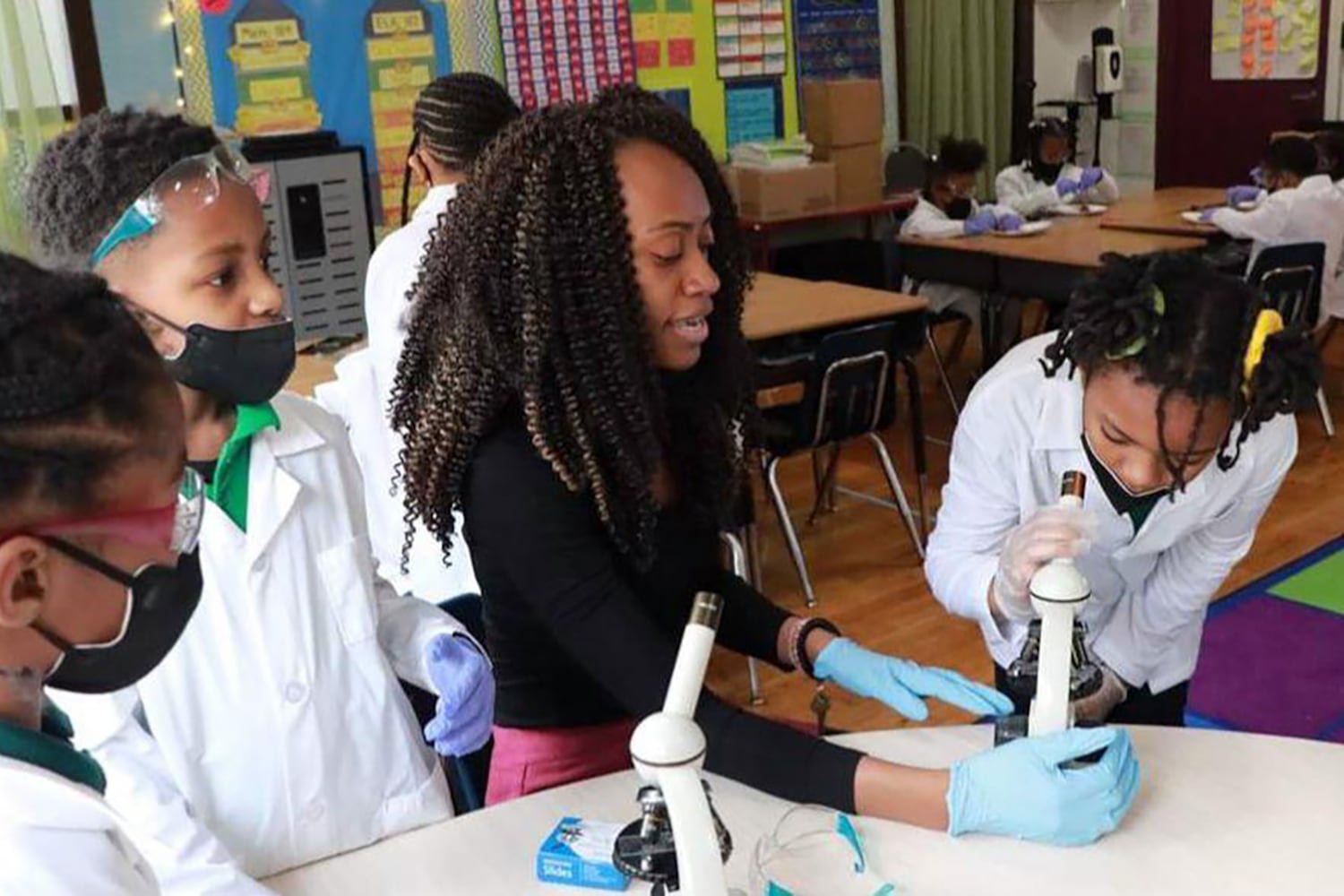
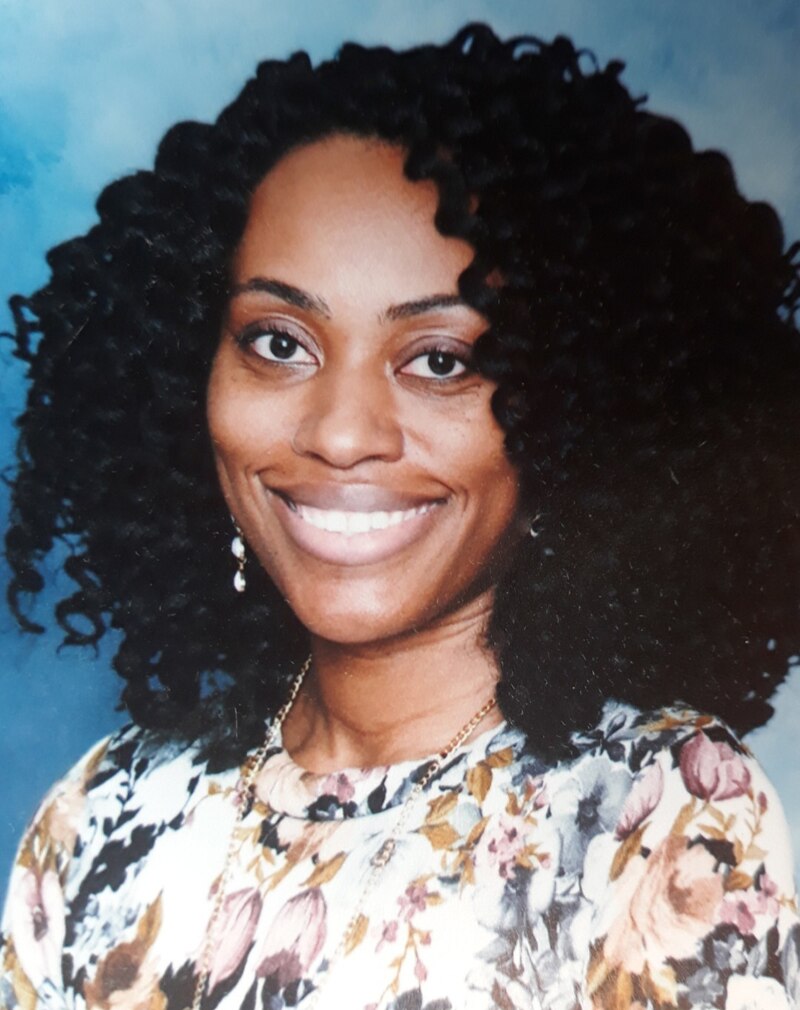
Precious Allen’s main goal as a teacher is to create more first-generation doctors and engineers. She believes that the only way to accomplish this goal is to expose children to science, engineering, math, and medicine as early as second grade.
Allen’s second grade students at Betty Shabazz Academy, a charter school in the Grand Crossing neighborhood on the city’s South Side, have already dissected frogs while wearing doctor’s outfits and gear. One might think that second graders would be squeamish when it comes to dissections, but Allen said that her students took it very seriously.
Allen, who has been teaching for 12 years, was celebrated as a finalist for Golden Apple’s Excellence in Teaching award — an honor she said was “kind of surreal.”
This interview has been lightly edited for length and clarity.
Was there a moment when you decided to become a teacher?
I wanted to be a pediatrician. But in my high school experience, I didn’t have guidance that pushed the importance of SATs or ACTs. My school counselor advised us to go to a community college, get our GPAs up, and then transfer to a four-year university. That’s what I did. I didn’t know anything about a pre-med track, and I didn’t have any guidance on scholarships. I switched majors multiple times — going from interior design to early childhood education and psychology, and eventually into elementary education.
How do you get to know your students?
There’s this activity that I found 10 years ago on Pinterest called, “I wish my teacher knew… .” It goes like “I wish my teacher knew that sometimes I don’t eat over the weekend,” or “I wish my teacher knew that in the morning time, my mom drops me off at my dad’s house and I miss my mother.” I do it every year because it really helps me see the human before the student.
Tell us about a favorite lesson to teach. Where did the idea come from?
The human body. The idea stemmed from when I had my daughter. I took her to several pediatricians because I felt like I wasn’t being listened to. When I finally found a pediatrician who was Black, I felt like she really listened to the concerns that I had. So when I first taught the human body, it was with the mindset of trying to create first-generation medical students.
What object would you be helpless without during the school day?
My clipboard. It’s where I track all of my students [and] the things that they’re doing. It is not used as a consequence; it’s used as a celebration so that parents can see all the great things that their child has accomplished throughout the day.
Tell us about a memorable time — good or bad — when contact with a student’s family changed your perspective or approach.
I had a couple of bad experiences with parents who were upset during my first few years of teaching. When I look back now, I say, “I should have practiced empathy.” Now, I’m able to see that more is going on when a parent is frustrated, and I’ve learned that there are other issues that parents are going through that are upsetting them. They could be experiencing homelessness, going through a divorce or a custody battle. I think that approach has really helped me to build relationships with parents.
What part of your job is most difficult?
I would say the most difficult part is trying to navigate a stereotype against Black children that says they’re hard to teach. I have to work extra hard in the classroom to show that my students are just as smart as a student in Japan or a student in the suburbs.
What was the biggest misconception that you initially brought to teaching?
During my first two years of teaching, I realized I was passing on my bias [against] math to my students. I taught every other subject with my heart, but with math, I taught it exactly like the book said and nothing else. I realized it was bad. For one year, I only went to math professional development courses. Now, math is my favorite subject to teach.
What advice would you give to new teachers?
Give yourself grace, and do not compare yourself to anyone else. The last thing I would say is to “check your politics at the door,” which means whatever politics is happening at school, when you’re in front of your students, enjoy them and have fun with them.
What’s a book that has helped you become a better teacher, and why?
“Yardstick” by Chip Wood. It’s about developmental changes for children ages of four to 14. I give it to my parents every year. It helps me and the parents understand what’s happening developmentally so they can grow with their child.
Samantha Smylie is the state education reporter for Chalkbeat Chicago, covering school districts across the state, legislation, special education, and the state board of education. Contact Samantha at ssmylie@chalkbeat.org.