This story was originally published by The Trace, a nonprofit newsroom covering gun violence in America. Sign up for its newsletters here.
Since “Operation Midway Blitz” began in September, federal agents have been surveilling Chicago’s Little Village, a majority Latino neighborhood. Now, when Natalia hears helicopters whirring overhead, she knows U.S. Immigration and Customs Enforcement, or ICE, is patrolling nearby. The near-constant detainment and deportation of her neighbors is putting her on edge. Natalia, who asked to be referred to by a pseudonym because she fears for her safety, is nervous that as a woman living undocumented in the United States, she may also be taken away from her family, her job, her community.
“On those days, I would go [to work] trembling,” Natalia said in Spanish. “There were some days where I wouldn’t go to work.” For Natalia, work means staffing Chicago Public Schools’ Safe Passage program, which seeks to keep students safe from threats like gun violence while walking to and from school.
In early 2025, the Trump administration revoked the protections schools had from immigration enforcement. Chicagoans like Natalia have witnessed that change in real time on the news: A pre-K teacher dragged out of a day care center; two women detained right outside a school; a man taken into custody while dropping his children off.
This revocation, paired with the increased presence of ICE and Customs and Border Protection officers, has caused multiple Safe Passage workers to call off work — and led more students to miss school. The raids came at an already vulnerable time for the program: CPS recently cut Safe Passage’s budget by nearly $6 million, the Chicago Sun-Times reported. To maintain the safety of students and program workers, the organizations that manage Safe Passage with CPS have trained additional staff to sub in; other community groups have created alternative transportation routes for families who fear encountering ICE.
“Our community has felt very unsafe, whether you’re here legally or not,” said Areli Medina, a human resource generalist at Enlace, the community organization that dispatches Natalia on her Safe Passage route. “I started to make sure that I am supporting our program and our community overall by showing up, and part of that is subbing in for some of our Safe Passage positions.”
Natalia feels that support. When she shared her fears, her managers told her she could use her paid sick days to stay home when there’s a heavy ICE presence, and that someone would fill her spot.
Keeping a vital program alive
In the U.S., an average of 57 shootings occur near a school every day, according to a Trace analysis in 2024. In the past decade, data showed that Chicago had 97 schools with at least 100 shootings in their vicinity.
The Safe Passage program dates back to 2009, when CPS sought to respond to the violence taking place around city schools. That year, a 16-year-old student was beaten to death while leaving his South Side high school. The program launched with just 35 schools, growing to 191 this year. CPS and 18 partner organizations have jointly hired and trained over 1,200 Safe Passage workers in relationship-building skills, deescalation strategies, and safety protocols.
Most of the areas the program covers face high rates of gun violence. In 2024, 115 people were shot in South Lawndale, home to Little Village, 23 of them fatally. And even though shootings there dropped by 57% over this time last year, there have still been 48 shootings in South Lawndale since last November.
“It’s really all about safety,” Medina said. “When it comes to areas where there’s heavy gun violence, it’s just making sure that we are able to see and notice if there is any suspicious activity.”
This method of keeping students safe echoes research by Jens Ludwig, a University of Chicago behavioral economist who has studied crime on Chicago’s South Side. Ludwig found that adding “eyes on the street” creates safer environments by placing people in areas where they can step in and interrupt arguments before they escalate into gunfire.
Throughout the years, organizers have said the Safe Passage program has helped prevent incidents near schools from turning deadly.
Many parents, Natalia said, have to go to work early and can’t walk their children to school. Her role, parents have told her, puts them at ease. “It’s a huge satisfaction to see how people become accustomed to the support Safe Passage provides them, and even more so during this difficult time,” Natalia said.
A new plan
The school district, a CPS spokesperson said, has not heard of any incidents in which federal agents detained a Safe Passage worker on the job. Still, after hearing workers’ concern, CPS and its partners developed a strategy to train additional staff to serve as substitutes. Enlace, one of those partners, has trained about 15 staffers to cover vacant routes.
Parents are on high alert at pickup and dropoff, Medina said. When she subs in for Safe Passage, she also acts as a lookout for ICE activity. Like all Enlace staff, she has been trained on ICE response protocols, like Know Your Rights and how to document any actions taken by federal agents.
Natalia has a plan in place if she sees ICE near school grounds. When that happens, she and other Safe Passage workers stay closer together and near the school, ready to quickly take cover inside and alert school staff to lock the doors. The option to stay home on days where there is a stronger ICE presence in the area, she said, makes her feel that her schools, community, and peers are protecting her.
“It is a privilege that I have to know that if something were to happen, I would be OK and it’s not the same feeling for everybody,” Medina said. “I want to make sure that, in that privilege that I have, I am able to help others that might be feeling insecure.”
A community looking out for one another
Throughout his patrols of Little Village, Baltazar Enriquez, the Little Village Community Council president, has seen how ICE has spread fear. In response, Enriquez created a volunteer patrol that drives around spotting federal agents and blowing a whistle to alert community members of their presence.
“They’re not coming for criminals,” Enriquez said. “They’re coming for the lady selling tamales, the gentleman taking his kids to school, the person waiting for a bus.” In one incident, Enriquez said, a father dropped off his child at an elementary school. ICE followed him, and he was detained a few blocks away.
“We gotta take care of each other right now,” he said. “Because no one’s taking care of us.”
Before ICE descended on Chicago, Enriquez said he and other community members warned CPS that it would affect student attendance because many would stay home to avoid federal agents. “They’re so afraid to leave their parents because they’re scared when they get back home, they might not be there,” he said. “They go to school all worried; they can’t even think or study.”
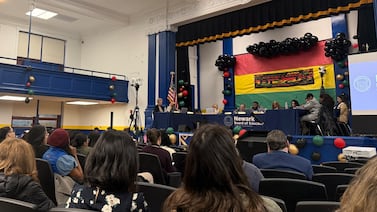
During a Chicago School Board meeting in October, many called for the schools to offer virtual learning, but leadership said they couldn’t do so without an emergency declaration from Gov. JB Pritzker. So, Enriquez said his group created its own “magic school bus.” About a dozen volunteers signed up to informally pick up and drop off kids at school. At the start of the raids, he said, they were picking up around 68 kids.
Now, even as ICE raids become less frequent, students — and their protectors — are still scared of the chaos a confrontation with a single agent might unleash. Despite her fears, Natalia tries to go to work as often as she can. Parents often text her and ask if she has seen any federal agents; she’ll tell them if the coast is clear. They thank her for taking the risk and being their trusted eyes on the ground. Many kids, she said, also ask her if everything will be OK that day; even as she worries, she often reassures them that it will be.