Sign up for Chalkbeat Chicago’s free daily newsletter to keep up with the latest news on Chicago Public Schools.
A pair of Illinois state lawmakers introduced legislation Monday that would significantly increase state education funding — an opening salvo in a push by the Chicago Teachers Union and other labor groups to boost money for schools during this spring’s legislative session amid intense financial pressures on the state.
The proposals, sponsored by state Sen. Graciela Guzmán and Rep. Will Davis, both Democrats, would require the state to fully fund its so-called evidence-based formula for schools by a 2027 deadline lawmakers set in 2017 — a goal the state is not on track to meet. It would also provide more funding for some school district services that the state mandates, such as transportation for students with disabilities and counseling.
The state has been increasing funding for K-12 schools by about $350 million a year, though it only chipped in $307 million more last year, for a total of $11.2 billion. To fully fund schools, advocates estimate the state would have to increase that amount to at least $550 million, but likely more than $1 billion, said Davis, who represents the south suburbs of Chicago.
At a Monday press conference, the lawmakers did not specify a source of the added funding, but they pointed to ongoing discussions about ways to raise progressive revenue. The teachers union has pressed for higher taxes for wealthy residents of the state. Supporters framed their proposal as a response to what they described as a Trump administration assault on public schools, including the dismantling of the federal Department of Education.
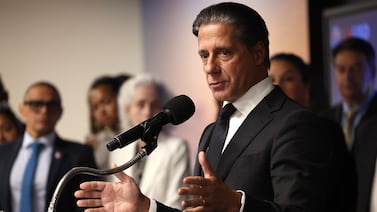
“At a moment when Donald Trump and his allies are attacking public education, this bill is a line in the sand,” said Guzmán, a former organizer for the CTU who represents a portion of Chicago’s Northwest Side.
To do everything the legislation introduced Monday requires in 2027, the state would have to spend an additional $3.9 billion a year, Ralph Martire, the executive director of the think tank Center for Tax and Budget Accountability, said in an interview. The center is proposing a package of tax measures that would raise revenue, including expanding the sales tax base to include consumer services and increasing the income tax rate while providing tax relief to low- and middle-income households. Those two measures alone would raise enough revenue to provide the additional education funding in the Lewis and Guzmán bills and to address the state’s massive structural deficit, Martire said.
However, the state also faces $4.4 billion of added costs down the road if it chooses to fully offset safety net cuts in the One Big Beautiful Bill Act that Congress passed last year, the center has estimated.
The state has increased funding for Chicago Public Schools by about $1 billion in recent years, even as enrollment shrank dramatically. But the district remains about $1.6 billion short of what the state considers adequate funding. It received $1.9 billion from the state last year.
A 2024 report from the Center for Tax and Budget Accountability found that because of inflation and flat K-12 funding in 2020 during the height of the COVID pandemic, districts would not meet the state’s definition of adequate funding until 2034 if it continues to add $350 million each year — a forecast Martire now says is out of date.
Joining the CTU in backing the bill was the Chicago Principals and Administrators Association, the union representing the district’s school leaders. Kia Banks, the principals union’s president, said tight funding in some schools has forced school leaders to delay hiring, freeze staff positions, and make other difficult decisions.
At Monday’s press conference, Samuel Thomas, a sign language interpreter for the Waukegan school district, stressed the proposal wouldn’t just help Chicago. He said his district scaled back its after-school programs and couldn’t renew some education apps this school year.
“We are asking Gov. Pritzker and lawmakers to fully fund our schools because our students can’t wait,” he said.
Mila Koumpilova is Chalkbeat Chicago’s senior reporter covering Chicago Public Schools. Contact Mila at mkoumpilova@chalkbeat.org.