Sign up for Chalkbeat Indiana’s free daily newsletter to keep up with Indianapolis Public Schools, Marion County’s township districts, and statewide education news.
The Indianapolis Local Education Alliance is considering a variety of governance options that would significantly dilute the power of the elected Indianapolis Public Schools board — potential changes that some community groups have rallied against.
Changing who oversees schools could be a key component to solving how district and charter schools could better share transportation and building resources. An authority governing both charter and district schools could set universal policy on transportation, discipline, students with disabilities, school accountability, and school closures.
The four options unveiled at Wednesday’s ILEA meeting differ when it comes to how much they would change the way schools are currently run. In addition to the elected board that runs Indianapolis Public Schools, the mayor’s Office of Education Innovation, Education One at Trine University, and the Indiana Charter School Board authorize charter schools.
The ILEA, which state lawmakers established earlier this year, does not have the power to make policy but can make recommendations to state and local officials. The group is expected to recommend one of the four options during the week of Dec. 1, although it’s also possible it could combine two or more of the options.
While the IPS school board hasn’t issued an opinion on the options, several organizations representing teachers and parents have called for an elected board to oversee both charter and district schools. Groups that support charter schools have not coalesced around support for a particular option.
The first option would keep an elected IPS school board, which would serve as the charter authorizer responsible for making policies for building usage and transportation. District and charter schools would report up to the board, and charter schools whose applications were denied could appeal to the mayor’s Office of Education Innovation.
The second option would create a “collaborative compact advisory board” consisting of appointees from the mayor, charter schools, and the IPS school board. While IPS and charter schools would retain their individual school boards, both sectors would report to the advisory board, which would serve as charter authorizer and set policy.
A third model would create an Indianapolis Education Authority, led by a secretary of education appointed by the mayor. Underneath the secretary of education would be a nine-member policymaking board — also appointed by the mayor — that would serve as the charter authorizer. The mayor would select four of these members from the current seven-member elected IPS board.
A fourth option would replace the elected IPS board with members appointed by the mayor. This appointed board would serve as the charter authorizer, although appeals could be sent to the Indianapolis Charter School Board.
Several groups supportive of both district and charter schools have previously urged the ILEA to consider various options for governance. Here are the reactions to the options unveiled Wednesday from a few major community groups, in alphabetical order:
Central Indiana Democratic Socialists of America
In a statement, the Central Indiana Democratic Socialists of America — which has run a “Fully Funded, Fully Public” campaign to support traditional IPS schools — did not select any of the four options as the best choice.
Instead, it called for a fully elected school board to serve as charter authorizer without the opportunity for denied charter schools to appeal to the OEI. The school board would operate facilities and transportation for all school types.
“Under this plan, charter students and parents will finally have an accountable board that represents them democratically without sacrificing their school choice,” the group said. “Similarly, IPS and innovation school parents will have the flexibility to exercise school choice without exiting their stable public school system.
Indianapolis Education Association
In a statement, the Indianapolis Education Association said the first option allowing IPS to serve as the charter authorizer is the best.
“This ensures that governance is responsible to the people that they serve and provides a clear structure for community engagement when the time for new programming in specific parts of the city is necessary,” the teacher’s union said. “IEA feels that any attempt to outnumber an elected body that serves IPS is harmful to the community and a board with more appointees than elected officials sends a message that the community can’t be trusted with our schools.”
IPS Parent Council
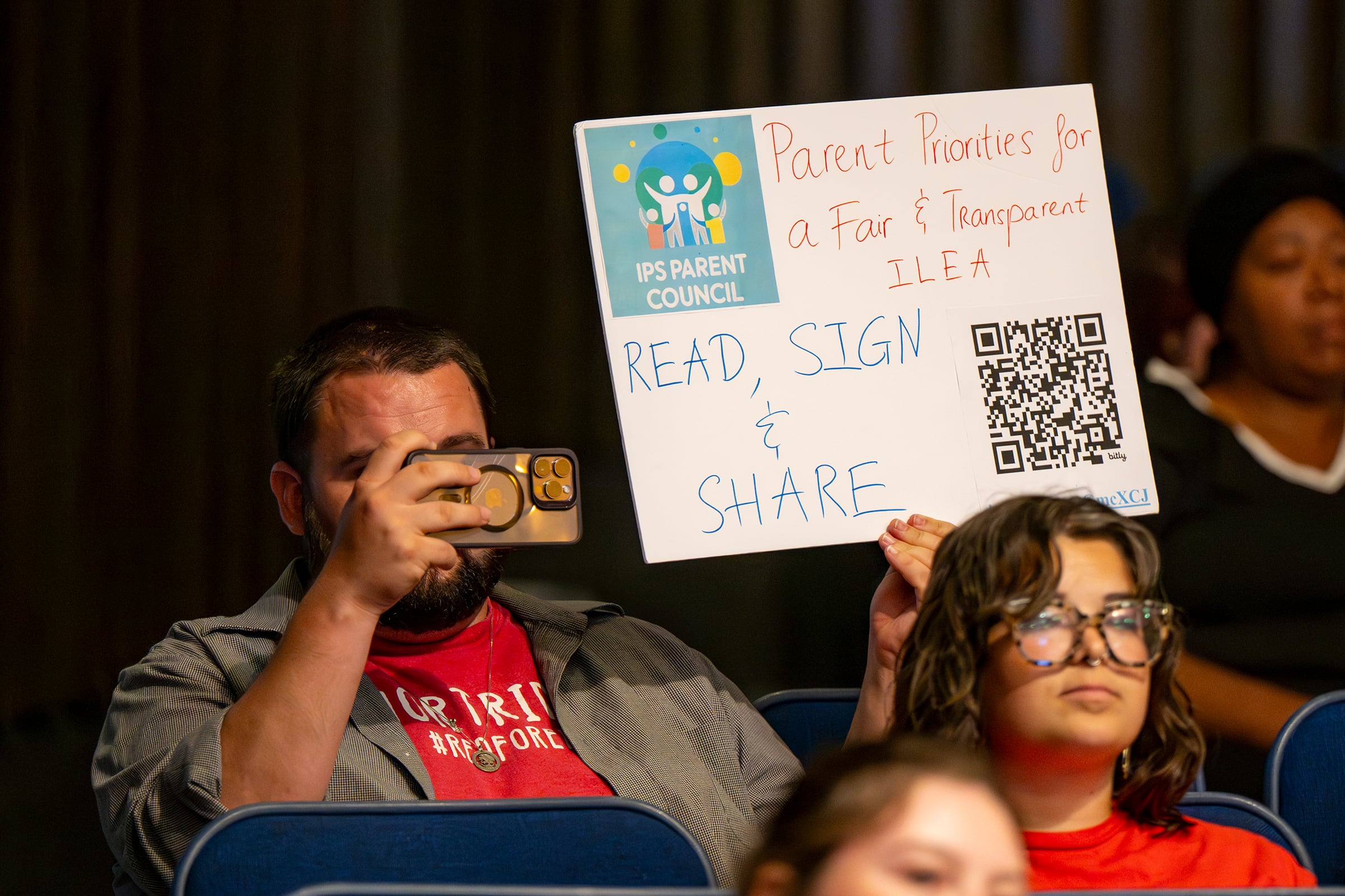
Kristen Phair of the IPS Parent Council, a roughly 400-member parent organization that formed to support IPS during the last legislative session, said the only option her group would support is the one in which IPS is the sole charter authorizer.
“We just don’t want to see local control diluted by appointees,” she said.
The council circulated an online letter signed by over 700 IPS parents this week that suggested that IPS become the sole authorizer of all charter schools within district boundaries.
IPS school board
School board president Angelia Moore said the board hasn’t had time yet to meet in executive session to discuss the governance options.
She said she is focused on a lawsuit by Attorney General Todd Rokita alleging that IPS hindered federal authorities in the deportation of a man whose son was an IPS student. The board is seeking the public’s support as it crafts a response to the lawsuit.
The Mind Trust
In a statement, the leader of the nonprofit Mind Trust that has helped launch many charter schools in Indianapolis did not give an opinion on overall governance.
“We are pleased to see discussion of an independent facilities and transportation authority, which should exist without consolidating system-level governance,” said CEO Brandon Brown.
Brown also emphasized two separate letters that charter school leaders sent to the ILEA this week.
In one, seven leaders of independent charter schools opposed limiting charter authorization to one authorizer. In the other, nine leaders of charters in the IPS Innovation Network suggested the mayor’s office and the Indiana Charter School Board serve as the only authorizers within IPS borders.
“Out of respect for the ILEA’s work, we will withhold further judgment until the final recommendations are released,” Brown said.
RISE Indy
RISE Indy, a nonprofit with ties to school choice advocates that has supported both traditional public and charter schools, did not voice explicit support for one of the four options.
Instead, the group said it supports an elected board that oversees academics and an appointed board that oversees facilities and transportation.
“An elected board allows community voice and representation to remain at the forefront of education decisions while an appointed board of local experts in facilities and transportation can allow every kid to have the resources and services they need to succeed, no matter the school model,” the group said.
Stand for Children Indiana
Stand for Children Indiana, which organizes parents who have pushed IPS to expand high-performing charter schools, said in a statement that it is in the process of sharing the details of the presentation with its advocates.
The group reiterated its call for a better transportation system and a school performance framework that holds schools of all types accountable to high standards.
Amelia Pak-Harvey covers Indianapolis and Lawrence Township schools for Chalkbeat Indiana. Contact Amelia at apak-harvey@chalkbeat.org.