Sign up for Chalkbeat Indiana’s free daily newsletter to keep up with Indianapolis Public Schools, Marion County’s township districts, and statewide education news.
When Donnessia Dancy was acting out, staff could hear her yelling clear across the halls of George Washington High School.
Now a high school senior, Dancy admits she was a “difficult child.” There were times when she lost all hope of graduating. But her teachers kept her on track.
“They gave the hope back,” she said. “Now, I start to believe that I am going to graduate — and now that they told me that I got two more credits left to graduate, I’m there.”
This year, Dancy is on track to join a cohort of graduating students that has grown at George Washington and across Indianapolis Public Schools since 2022. The overall IPS graduation rate — which includes charter schools that are part of the district’s Innovation Network — has risen in that time frame from nearly 80% for the Class of 2022 to 93% for the Class of 2025, surpassing the state’s record-setting rate of 91.8%, according to data the state released earlier this month.
The percentage of IPS students graduating without waivers from certain graduation requirements has also gone up recently. The record rates come on the eve of more changes to the state’s high school diploma, with new graduation requirements taking effect for all students in 2028-29.
IPS officials credit several district-wide initiatives for the improved rates. In 2018, Future Centers opened in each of the four district-run high schools to help students plan for life after graduation. In 2023, the district created writing centers to help with assignments and provide other academic support.
At George Washington High School, which has previously ranked lowest or second-lowest in graduation rates among the four traditional IPS high schools, the percentage of students graduating without a waiver has grown from roughly 73% for the Class of 2022 to about 89% for last year’s class.
“We had to create a culture around high expectations,” Principal Stanley Law said, referring to when he took over the school in 2018. “That you are expected to graduate in four years, and that we as a staff are going to do everything that we can to make sure that that happens.”
How an Indianapolis principal tracks student graduation info
Dozens of student names are neatly listed in color-coded columns on Law’s whiteboard. It’s a tracking tool for this year’s seniors that’s used district-wide.
Seniors must earn a minimum of 40 credits to graduate, but also must demonstrate employability skills and postsecondary readiness. They can meet these requirements by completing a work-based learning experience, for example, and by taking a standardized exam such as the ACT, SAT, or the ASVAB used for military enrollment.
The goal: to move every student over into Column A, where students have at least 30 credits and have completed the employability and postsecondary requirements.
“We track them every week in what we call a cohort meeting,” Law said. “We look at the grades, behavior, attendance, social-emotional — whatever other kind of barriers that exist for them, and we have conversations with several of these kids.”
Like the district as a whole, George Washington’s Black and Hispanic students graduated at higher rates than their peers statewide last year. The school graduated 91% of Black students and nearly 94% of Hispanic students — including those who graduated with waivers — compared with the statewide figures of roughly 87% and 90%, respectively.
IPS also graduated 97% percent of students receiving free or reduced-price meals, compared with 93% statewide.
At George Washington High School, many students come from difficult backgrounds and carry different traumas, Law said.
Dancy felt like nobody had her back before coming to the school, she said.
But she attributes her turnaround to Law’s decision to send her to Positive Supports Academy, an IPS program for students with behavioral challenges.
The experience last year prompted her to change, and over time she realized the school community was there to help. She visited the school’s Writing Center frequently to help with her schoolwork.
“They accept me for who I am and they actually want to help me,” she said. “Instead of just putting me in a classroom and telling me to sit down or something — they actually helped me go through the tough time.”
Herron-Riverside wants students to feel like they belong
Among charter high schools in the Innovation Network, Herron-Riverside High School posted the largest non-waiver rate jump since 2022, when the school graduated roughly 64% of seniors without the use of a waiver. Last year, the charter graduated 89%.
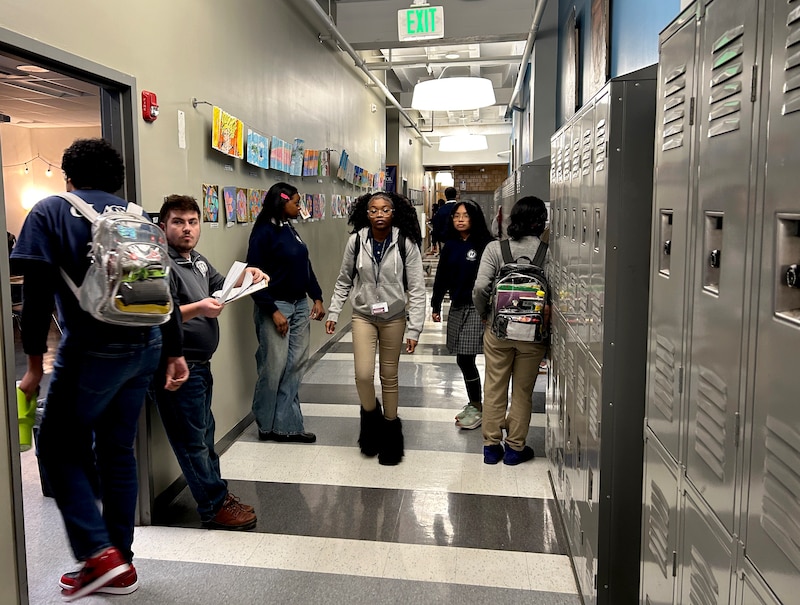
Head of School Emanuel Harper credits the jump in part to an emphasis on making school enjoyable and creating a sense of belonging.
Herron-Riverside opened in 2017 to replicate the classical education provided at Herron High School downtown — but with the goal of serving a different, more diverse body than its flagship campus in the northwest part of the city, Harper said.
Students have a daily seminar to help sharpen their academic management skills. But the school has also leaned into more fun activities to keep students engaged — such as games students play throughout the day that are connected to larger school-wide goals, Harper said.
“Over the past four years, [we were] really thinking about, ‘Okay, we can shore up our academics, but do students feel like they belong?” he said. “Do they feel known? Do they feel loved?”
Herron-Riverside senior Willinda Chapel has embraced the school’s extracurricular offerings — she is a captain for three school sports. Chapel plans to play volleyball at Grace College as a biology major.
“There’s — especially here at Riverside — so many adults who care about not just the number that you are in the school but your personality,” she said. “They care about how you’re doing.”
Amelia Pak-Harvey covers Indianapolis and Lawrence Township schools for Chalkbeat Indiana. Contact Amelia at apak-harvey@chalkbeat.org.