Sign up for Chalkbeat Indiana’s free daily newsletter to keep up with Indianapolis Public Schools, Marion County’s township districts, and statewide education news.
In the front office Washington Irving Neighborhood School 14 — home of the Hornets — a photo mural of dozens of community partners shows the “swarm of support” the school enjoys.
In the hallway, Assistant Principal Melissa Rowe stops a student before he darts into the bathroom so she can bend down to tie his shoelace.
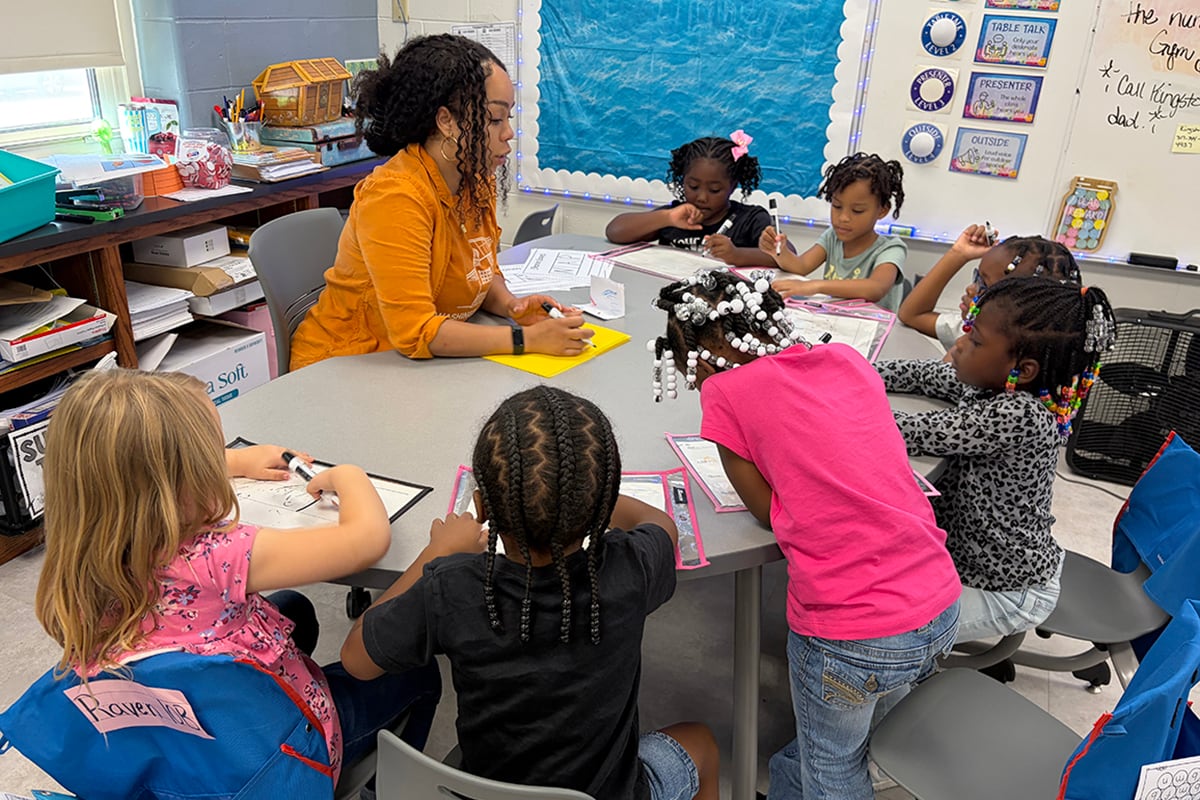
And in art teacher Terren Muhammad’s classroom, students sing along to a song about loving themselves.
Three years ago, leaders at this school on the Near Eastside sought to bring stability to a school experiencing its third change in administration in less than a decade. It’s challenging work in a community where school leaders estimate as many as 1 in 5 students experience housing instability. And for years, School 14 was among the lowest-performing schools in Indianapolis Public Schools. But the Near Eastside Innovation School Corporation tried a different approach.
Starting in the 2023-24 school year, the corporation — a nonprofit tapped by the district to turn around the school, utilized community service providers to assist students and their families outside of school, while emphasizing personalized learning, supporting students’ mental health,showing the kids compassion. It’s a model the corporation, also known as NEISC, first began using at Thomas Gregg Neighborhood School 15.
The nonprofit took over School 15 in 2017 through the district’s Innovation Network of autonomous schools that School 14 also belongs to. The organization was built on a partnership with the nearby John Boner Neighborhood Centers. Today, it also runs School 14 with the same strong community focus.
“The undertone of a lot of the staff that we were able to retain was that they wanted to support the kids in the neighborhood,” said Principal Brandon House. “They were very connected, and what we found here at Washington Irving is that relationships matter.”
The school appears to be making some improvement, particularly when it comes to reading, although its recent scores on the state test in English and math show just how far there is to go for School 14 to reach its goals.
School 14 model emphasizes academics and family needs
In 2018, IPS selected a charter operator, Urban Act Academy, to run School 14 as part of the Innovation Network. After Urban Act departed in 2023 and NEISC took over, the new school leaders embarked on staffing their new building.
House said he was also looking for teachers with grit in addition to a strong commitment to the community.
“We wanted to have teachers that were ready to focus on a certain level of instructional integrity,” he said.
The corporation ended up keeping about half the previous staff. That still left the significant and difficult work of academic improvement in key areas.
In 2023, 64.9% of the school’s third graders passed the state’s IREAD literacy exam, just above the IPS average of 60.6%. But just one student was proficient in both English and math on the state’s ILEARN assessment.
In response, the school created daily 40-minute intervention blocks in which students break into small groups to tackle areas of reading and math they are struggling with.
And in 2024, the school dropped its middle grades as part of the district’s Rebuilding Stronger plan. That allowed leaders to focus solely on helping elementary students.
Beyond academics, as the second NEISC school, School 14 families are eligible for affordable housing units provided through the Housing Stability for School Success program operated by John Boner Neighborhood Centers.
Other changes beyond school walls have taken place in the last few years.
In 2023, John Boner Neighborhood Centers and the Edna Martin Christian Center launched the Indy East Promise Neighborhood, an initiative that uses federal grants and other funding to boost resources for students and families at 11 eastside schools.
The initiative funds attendance incentives, an after-school program, and a food pantry. It also supports two staff members who help connect the school to the broader community and help families navigate assistance for rent, utilities, and similar financial challenges.
This year, roughly 82% of School 14’s third graders passed the IREAD, higher than the district-wide pass rate of nearly 74%. That improvement from 2023 also outpaced the increase in the average score in IPS.
But ILEARN results from 2025, the latest available, showed that just five of the school’s students reached proficiency in English and math. That was technically an improvement from two years before, but was still only about 5% of the school’s population.
As the corporation continues to help students and families beyond the school’s walls, those are the results staff are focused on now, House said, so that “they can go out and continue to live great adult lives.”
Corrections and clarifications: This story has been updated to reflect that roughly 82% of School 14’s third graders passed the IREAD.
Amelia Pak-Harvey covers schools for Chalkbeat Indiana. Contact Amelia at apak-harvey@chalkbeat.org.