Sign up for Chalkbeat New York’s free daily newsletter to get essential news about NYC’s public schools delivered to your inbox.
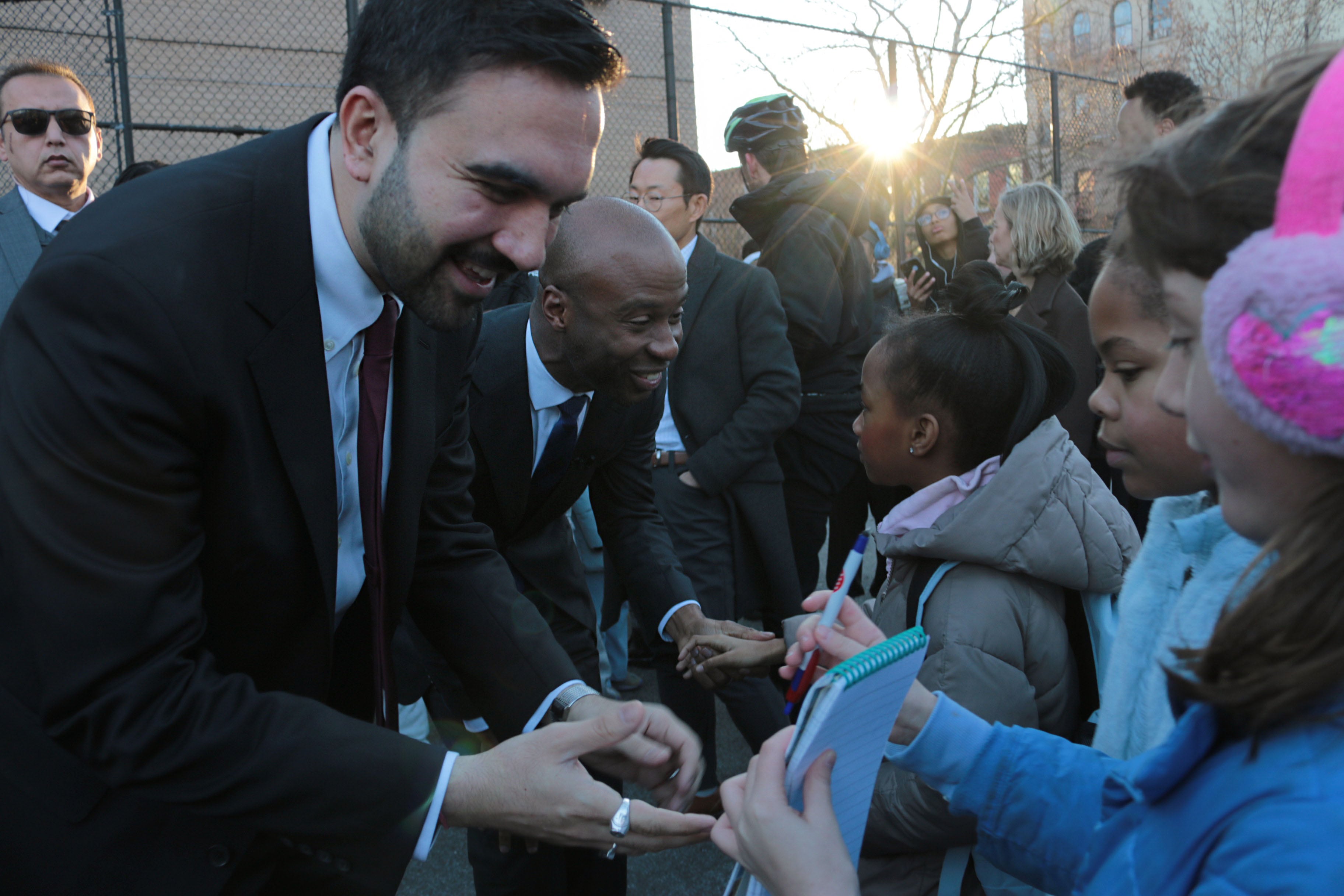
On Kamar Samuels’ fourth school day as chancellor, he brought Mayor Zohran Mamdani to a Brooklyn school he views as a blueprint for tackling two major problems: segregation and sagging enrollment.
Samuels played a leading role merging two different school communities into Arts & Letters 305 United five years ago. The move combined P.S. 305, an underenrolled majority Black campus in Bedford-Stuyvesant, with Arts & Letters, a highly coveted more affluent school in Fort Greene serving one of the district’s largest shares of white students.
“I see a model and an example for the rest of the city,” Samuels told a group of parent leaders, educators, and elected officials, vowing not to “ugly cry” during Thursday’s visit. “It’s beyond what I had dreamt about.”
Deploying school mergers with an eye toward integration has been a hallmark of Samuels’ leadership. He used the strategy from his time overseeing schools in Brooklyn’s District 13 and brought it to his next role as superintendent of Manhattan’s District 3.
In an exclusive interview with Chalkbeat, Mamdani said he selected Samuels because of his deep knowledge of the city’s public schools and his track record taking on thorny problems.
“I told him that we needed a leader who was fluent in the system,” Mamdani said. “In him, I have seen someone who has been able to tackle the challenges that we have become used to as well as deliver the results that we haven’t always seen.”
Before the opening bell, Mamdani greeted dozens of families who circled him in the schoolyard. Some parents snapped selfies while students rushed into the scrum to shake the mayor’s hand. “Have a great day at school,” Mamdani scribbled in fifth grader Rafi’s notebook before offering his autograph. “Yo, I’m crashing out,” a student shouted after recognizing the new mayor.
After Samuels toured the school, Chalkbeat caught up with the schools chief to ask how he hopes to address school segregation, boost results for students who are struggling academically in the wake of the pandemic, and whether he agrees with the mayor’s assessment that charter schools siphon resources from district schools.
The following interview has been edited for length and clarity.
You moved here when you were 15 from Jamaica. I’m curious what your schooling was like both in Jamaica and when you moved here.
I started out in school in Jamaica — in a school that was one of the first schools that integrated physically disabled students with able-bodied students.
It was an experiment that they were doing in Jamaica. There was a lot of stigma associated with physically disabled students. And my parents signed up. They believed in having an inclusive environment. It was called The Hope Valley Experimental School.
And then after that, in Jamaica, you can take a test, or you could, at the time in fifth grade, it was called the common entrance test. And then you could go to what we call high school, which essentially is from seventh grade to 12th.
I went to this high school, Jamaica College, and then I ended up graduating high school in Jamaica when I was 15 and I moved here. It was too late to apply to college, and my mom was like, ‘You’re too young to do any of that.’ So for the first semester, she sent me to Evander Childs High School in the Bronx. I was there for probably a semester after which we applied to the CUNY system. Bronx Community College was close to me. So I went there for a little bit, and then I transferred to Baruch College. I graduated college when I was 20.
My mom said, ‘You are good at math, you should go do accounting.’ So I did accounting. I absolutely hated it. I hated it so much. I said to myself, ‘If I try to get a job in sports, just to be an accountant in sports.’ I worked for the National Basketball Association for a little bit, and I said, ‘If I can’t love accounting doing this, I’m never gonna love it.’
I had tutored students with disabilities at Bronx Community College, and I really liked the connection [we had]. And so I’m going home on the train one day, and I saw [a sign] that said, ‘Do you remember your first grade teacher’s name? Who will remember yours?’ It was the New York City Teaching Fellows Program. I went home, applied the same day, and I was in the classroom probably three months or four months later.
One of the biggest challenges facing the education department right now is declining enrollment and the growing number of really small schools. You obviously have some experience as a superintendent pursuing school mergers, so I’m wondering how you’re starting to think about that systemwide. Is there a threshold below which you think a school is too small to be sustainable?
What decides for me whether a school is too small is the resources that it’s able to garner for kids. And there are schools across the city that aren’t able to have the best enrichment programs. An eighth grader might not be exposed to Algebra because they don’t have the resources. That is something we have to take a look at across the city, especially when we think about our class size mandates.
And I don’t think of class size as a mandate. I think of class size as an opportunity to meet the needs of every student in the classroom. We have to use the fact that we’re in this cycle of lower enrollment as an opportunity to think about how we utilize different spaces.
You’ve also talked about wanting to prioritize school integration. What kinds of integration efforts might you be interested in pursuing?
I really believe that a school that’s socioeconomically integrated — especially as we think about our city and the diversity that it brings culturally — is a school that I want my own children, who are in the public school system, to be a part of.
I remember my first parent-teacher conference when I realized I had the cab driver’s kids, the police detective’s kids, the home health aide’s kids. It hit me that all these people want the best for their kids, and it was my job to really make sure that their kids were seen and heard. And I think that’s the part of school integration that people often miss: We want to make sure that we have high expectations for all kids, and we want to make sure that they feel affirmed in school.
A larger share of New York City middle and high schools screen students for admission than almost any other school system in the country. Will you be looking at ways to reduce screening?
There are fewer screened schools today than they were prior to the pandemic — and the way that we’re doing screens today is different. Instead of focusing on test scores, like we used to do, we’re now focused on academic report card grades. If we’re going to do screens, [course grades are] more aligned to what I would want to support.
When we look at [District 3] where I was a superintendent, we didn’t bring screens back wholesale, except for our citywide [gifted] program under the Anderson School. It was because that was a community-driven process that I listened to folks. Not everybody was in favor of it, but certainly there was a majority of parents in favor of that, and we moved in that direction.
We’re going to continue to listen to parents. If there are places where people don’t necessarily want to do that, then we’ll listen.
New York City’s lowest performing students have been struggling to recover from the pandemic. Do you have ideas about how specifically the system should better support those students? What about schools serving mostly students below grade level?
We have invested incredibly in New York City Reads. And a part of New York City Reads is this idea of MTSS [multi-tiered system of supports], which I know is confusing for folks. What is that? It’s essentially a structure that makes sure every child gets what they need when it’s implemented well, and that during the school day. So during the school day we’ve been clearer than ever on what interventions mean, when we do them, how we create time to do them.
We’ve done so much work around that during the school day. Some schools do great work with high dosage tutoring and we’re going to have to continue that. The one thing I do think gets in the way of all of this is chronic absenteeism.
And so since the pandemic, no matter your demographics, what we’ve noticed is that you’re likely to come into school fewer days than before. And folks need to understand that if we’re not in school your child is going to miss work. I’m doing a lot of thinking about different ways to address chronic absenteeism.
During the campaign, Mayor Mamdani indicated that charter schools siphon resources away from traditional public schools, shouldn’t have space in city buildings, and also should be audited. Do you agree with that position?
Kamar Samuels believes in a great school, no matter what kind of school it is. I know there are some charter schools that do really, really good work. I think charter schools will continue to do that work, and I know that they can do that work within the cap that they have.
And I do believe that there are charter schools, like some district schools, that may not be doing as well as we want them to do, and I think those schools should be held accountable.
Alex Zimmerman is a reporter for Chalkbeat New York, covering NYC public schools. Contact Alex at azimmerman@chalkbeat.org.