Sign up for Chalkbeat New York’s free daily newsletter to get essential news about NYC’s public schools delivered to your inbox.
As Bronx social studies teacher Seth Gilman sipped his coffee and prepared to log on for a day of virtual teaching, he was met with an error message.
At first, he worried it would be a repeat of a disastrous pivot to remote learning during a 2024 snowstorm.
“Oh no, not again,” he thought to himself. But within about 20 minutes, his school had resolved the issue and he logged in to Google Classroom, the platform schools use to share schedules and Zoom links.
“Once we got the classroom up and running, it was fine,” Gilman said.
Unlike two years ago when they pivoted to remote, New York City schools did not see a systemwide meltdown, but pockets of families and educators from across the city shared instances of glitches and snafus. Many of the issues seemed to be resolved quickly. School buildings will reopen for regular instruction on Tuesday, city officials announced Monday afternoon.
The switch to remote learning on Monday in the wake of a major snowstorm represented an early logistical challenge for the nation’s largest school system under Mayor Zohran Mamdani and his schools chief, Kamar Samuels, who took office earlier this month.
About 395,000 students and their families were able to log in for virtual learning, according to preliminary figures city officials provided Monday afternoon. Officials estimated that 79% of students logged on for at least some virtual learning.
About 500,000 of the city’s nearly 900,000 students were required to report to virtual classrooms. High school students and those attending 6-12 schools had a previously scheduled day off for staff training.
“Things have gone very well this morning — it was a smooth start to the day,” Samuels told reporters during a Monday morning press conference.
Education Department spokesperson Nicole Brownstein later acknowledged there were “minor hiccups” as families logged on but emphasized the agency’s technical support line fielded a similar number of complaints as a typical school day.
Michael Mulgrew, president of the 200,000-member United Federation of Teachers, gave the mayor an ‘A’ for his handling of the snow storm. “The one glitch seemed to be Google. They had the same notice as our students, parents, and teachers, so they need to do better.”
As the storm approached, Mamdani seemed to entertain the idea of a traditional snow day, though he later admitted there is no room in the school calendar to do that without running afoul of the state’s mandated number of instructional days.
Schools snapped into gear, distributing devices to students, offering reminders about how to log on to virtual classrooms, and sending home paper worksheets in case families ran into tech problems. Some schools tried to recreate a regular day on Zoom while others emphasized independent work or review lessons.
Attendance was lower than usual in many classrooms, according to teachers and families as well as Education Department figures. Some schools built time into the schedule for students to enjoy the snow.
Gilman, who works at the High School for Teaching and the Professions, said he was impressed with how many students showed up to virtual classes. Still, he stuck to a more “discussion-based lesson” in part to avoid leaving students behind who were absent. (Though most high schools were not in session, Gilman’s school runs on a different calendar through a program that grants exceptions to the teachers union contract.)
Tech problems and tiny victories with remote learning
The Education Department may not have melted down, but some parents did.
Chris Ninman, who has a third grader at P.S. 889 in Brooklyn, tried to help his son log into Google Classroom, but said the server was down. Then he wasn’t able to sign into Zoom from his son’s school-issued Chromebook. Things worked better when he switched from the Chromebook to Ninman’s own computer.
Once he was successfully logged in, Ninman thought his son’s teachers did a good job with remote learning. There was a live, 40-minute reading instruction, with other synchronous lessons scheduled throughout the day.
“I’d rather they just called it a snow day,” Ninman said. “But if you’re going to do school, do it right.”
Liz Groeschen, a mom who took her two sons to Prospect Park Monday morning, said that getting into her second grader’s morning Zoom meeting was just the first challenge. She had to page through multiple websites that were nested in each other.
Groeschen read aloud to a reporter from this morning’s chat in her classroom parent group:
“So you search for FUN HUB inside Google Classroom?” one parent wrote. “No,” another parent replied. “We had to log in through the browser, not the app, and then search for FUN HUB in the search bar.”
“Did you disable the popup blockers?” a third parent asked.
“P.E. is a slide show? The 21st century is crap.”
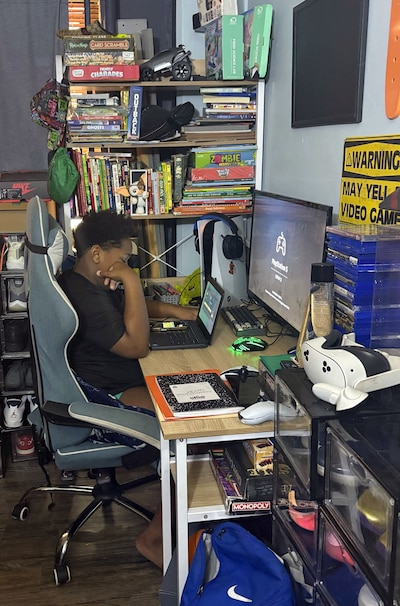
Tiffany Rodriguez-Noel, a Manhattan mother with four children in city public schools, said her sixth-grade son struggled to log into his new school-issued Chromebook for remote instruction. He wound up propping his phone up on a laptop with his PlayStation 5 screen tantalizingly close by.
Despite grumbles from her sixth grader about having to wake up early and log on for school, Rodriguez-Noel said her son’s homeroom teacher at P.S. 191 made it easy, sending out a clear schedule with links. The school also sent home hard copies of assignments, saving him from typing into his phone.
“It’s actually pretty smooth,” Rodriguez-Noel said.
She decided not to log her kindergarten twins on for remote instruction, though, because they are hyperactive and have speech delays, and she felt they wouldn’t get much out of it. Her high school child spent the day working on college applications.
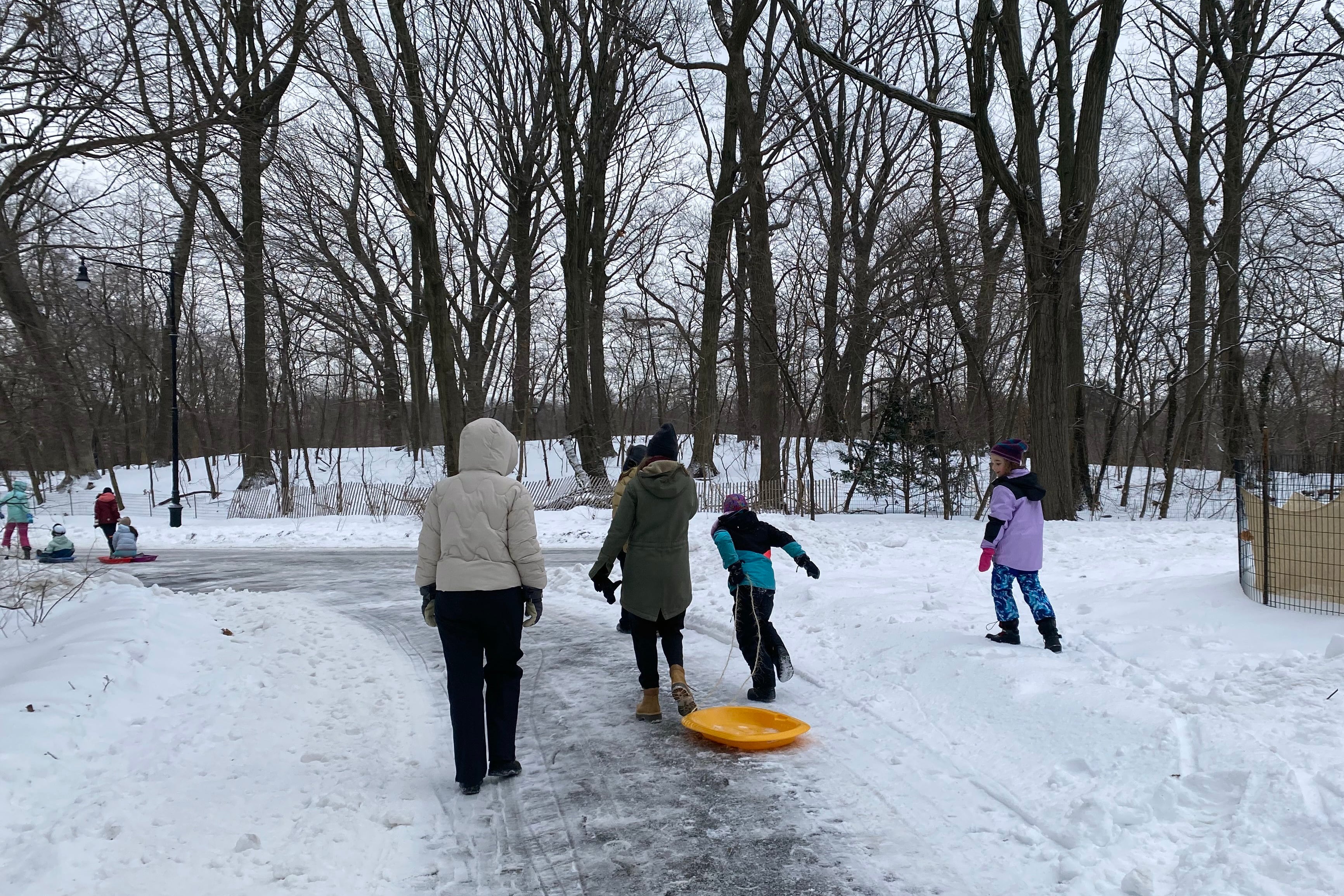
Her sixth-grade son’s school planned a half day of instruction, giving the family time to have fun outside. “I’m taking him to Central Park to sled down this rock we’ve been waiting to do since 2021,” she said.
Some families yearn for traditional snow day
Brooklyn dad Steven Mahoney, refused to log on for his 10-year-old son who is non-verbal and attends a school in District 75, which serves children with significant disabilities.
“The regression that I witnessed in my child during the remote/hybrid learning was heartbreaking,” Mahoney said of virtual instruction during the pandemic.
Since he and his wife had to work on Monday, their son’s sitter took him to a nearby park and then got hot chocolate.
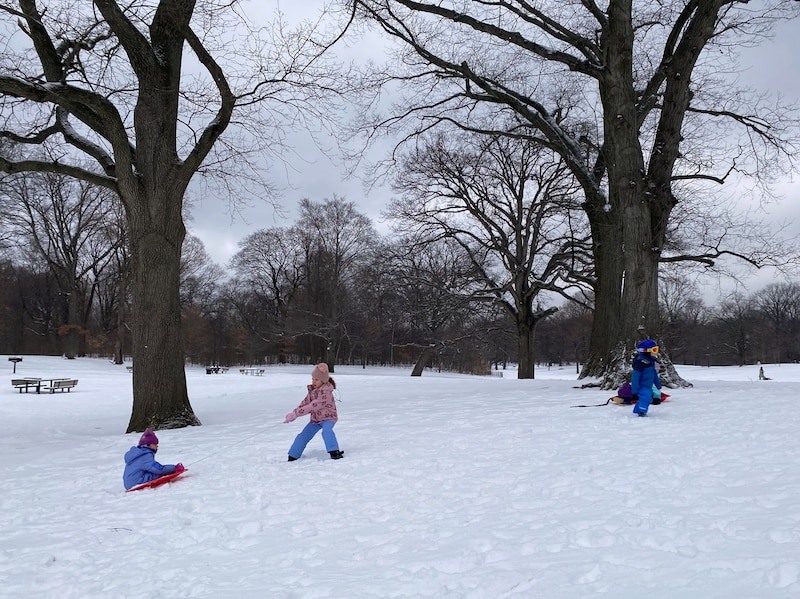
Brooke Young, a Brooklyn mom, said her son’s 3-K teachers told parents their kids didn’t need to log on, and instead they gave families suggestions of snowy day activities. Many of the suggestions, however, like dyeing snow different colors, seemed too labor intensive, she noted.
Young helped her daughter log on from 8:30 a.m. to 9:30 a.m. for her first grade class and then again from 10 a.m. to 10:30 a.m., while she herself logged onto work meetings. After that, they went to Prospect Park for sledding, with a plan to return to Zoom for an end-of-day meeting for her first grader, who attends P.S. 321.
If her kids were older and had “real attention spans” for Zoom meetings, remote learning could have been more productive, said Young, who struggled to balance her own job with having to mute and unmute her daughter on Zoom. She would have preferred just putting on an educational PBS show.
Ultimately, Young was grateful to spend time with her kids outside.
“I remember the joy myself of having a snow day,” she said.
Alex Zimmerman is a reporter for Chalkbeat New York, covering NYC public schools. Contact Alex at azimmerman@chalkbeat.org.
Abigail Kramer is a reporter in New York City. Contact Abigail at akramer@chalkbeat.org.
Amy Zimmer is the bureau chief for Chalkbeat New York. Contact Amy atazimmer@chalkbeat.org.