Sign up for Chalkbeat’s free weekly newsletter to keep up with how education is changing across the U.S.
An “explicitly Christian” charter school in Tennessee. A “public Christian school” in Colorado. A Jewish virtual charter school in Oklahoma.
A new crop of proposed religious schools are setting up legal challenges that would allow the U.S. Supreme Court to weigh in again on whether charter schools can be religious — and whether charter schools are truly public schools at all.
Last year, the Supreme Court tied 4-4 on these questions, a result of Justice Amy Coney Barrett recusing herself due to a close friendship with an adviser to the Catholic charter school at the center of the case. The deadlock meant religious charter schools are still prohibited.
Now, new cases that wouldn’t prompt Barrett to recuse herself are starting to take shape, with the help of conservative law firms that focus on religious liberty. The cases have the potential to rewrite the boundaries of church-state separation and further expand public funding of religious education. Some charter advocates also fear court victories by religious charter schools could undermine broader support for the sector, especially in Democrat-led states.
Legal experts and advocates on both sides expect the Supreme Court to be interested in revisiting the questions raised by the St. Isidore case. The prospect of multiple cases in multiple states also means there could be conflicting lower court rulings that more thoroughly explore the legal arguments involved — factors that make the Supreme Court more inclined to take a case.
“We know that four judges ruled in favor of St. Isidore, and it takes four justices to decide to take a case,” said Eric Baxter, vice president and senior counsel to the Becket Fund for Religious Liberty, a public interest law firm that’s been involved in many prominent religious freedom cases and is now representing the proposed Jewish charter school.
The National Ben Gamla Jewish Charter School Foundation told Oklahoma’s charter school board in November it wants to run a virtual high school that would combine Jewish religious education and state academic standards.
“Ben Gamla envisions Oklahoma students gaining a rigorous, values-based education that integrates general academic excellence with Jewish religious learning and ethical development,” board member Peter Deutsch wrote in the letter of intent in November.
Deutsch is a former Democratic congressman who founded the Ben Gamla charter school network in Florida, a separate organization from the foundation pitching the Oklahoma school. The Florida schools teach Hebrew language but are strictly secular, in accordance with state law there.
Deutsch told the Jewish Telegraphic Agency last year that religious charters had the “potential to be a paradigm shift for American Jews,” though he also said at the time that he had concluded Oklahoma was not a practical location for a Jewish charter school.
Deutsch declined an interview request and referred questions to the Becket Fund. Baxter said that Deutsch has had a nationwide vision for a long time, and the St. Isidore case suggested that Oklahoma charter law could accommodate religious schools — even though the state Supreme Court found the exact opposite.
The school’s founding board members include Brett Farley, who served on the board of now-abandoned St. Isidore school.
A spokesperson for the state charter school board declined to comment, noting that Ben Gamla has not yet submitted a formal application.
But Oklahoma Attorney General Gentner Drummond, a Republican, has already said he’ll oppose the school just as he opposed the opening of St. Isidore. Drummond has argued that funding any religious charter school would force taxpayers, including religious ones, to fund schools that teach tenants that violate their own faith.
“This matter has already been resolved after the state Supreme Court’s ruling to prevent taxpayer funded religious charter schools was upheld by the U.S. Supreme Court earlier this year,” Leslie Berger, a spokesperson for Drummond, said via email. “Our office will oppose any attempts to undermine the rule of law.”
Meanwhile, a proposal for another religious charter has emerged in Tennessee. Wilberforce Academy, a nonprofit with no previous educational footprint in the state, is suing the Knoxville County Board of Education for refusing to accept its letter of intent seeking to open an “explicitly Christian” charter school. State law requires charter schools to affirm they are “nonsectarian, non-religious” schools, and Wilberforce would not do so, according to court documents.
On the same day the lawsuit was filed, Tennessee Attorney General Jonathan Skrmetti, also a Republican, issued a legal opinion that the state’s ban on religious charter schools likely is unconstitutional. The state is not named in the lawsuit, but the opinion suggests Skrmetti is sympathetic to religious charters, unlike Drummond in Oklahoma.
The charter school’s lead attorney is the same person Skrmetti hired to successfully defend Tennessee’s ban on gender-affirming medical care for minors.
Meanwhile in Colorado, Riverstone Academy, which calls itself a “public Christian school,” quietly opened this fall and is waiting to see if the state education department will deny it public funds. School officials didn’t go through the charter school approval process and haven’t described Riverstone as a charter. Instead, a quasi-governmental school board cooperative group contracted with a nonprofit educational organization to run the school.
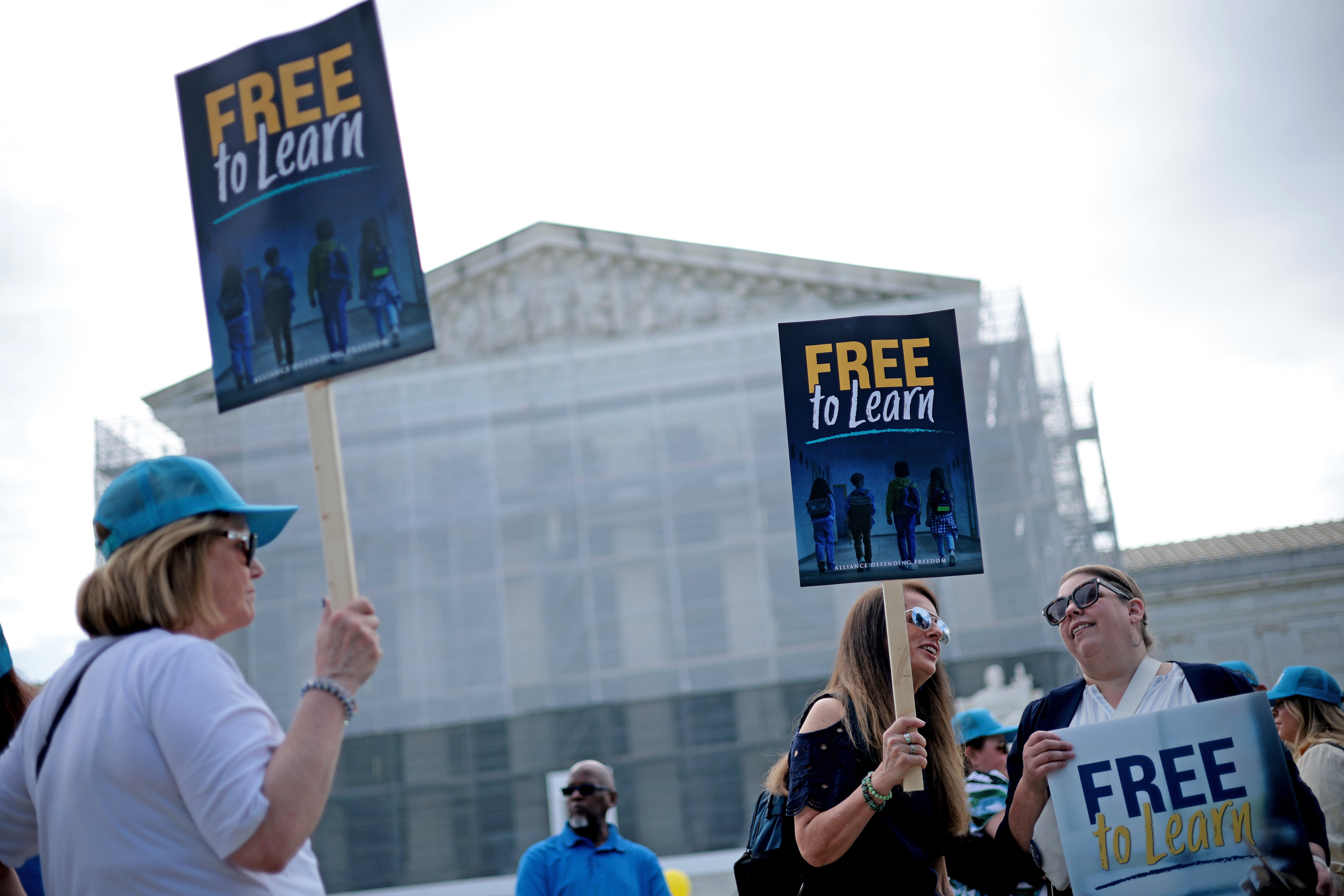
In an email obtained by Chalkbeat, a conservative school board attorney said that Alliance Defending Freedom, another prominent law firm that deals with cases involving religious liberty, approached him about finding a new test case in the aftermath of the St. Isidore decision. Riverstone was designed to be that test case, the email suggested. (ADF also represented the Oklahoma Statewide Charter School Board when Drummond challenged its approval of St. Isidore.)
“Everyone wins when families have more good options for their children’s education,” ADF Senior Counsel Mark Lippelmann said in a statement. “And the First Amendment forbids states from excluding charter school applicants just because of their religious character and activity.”
The involvement of out-of-state organizations make it “very clear that this is an agenda-driven enterprise,” said Steven Green, a law professor at Willamette University who studies church-state issues.
“This is not organic, let’s put it that way,” he said.
Religious charter school supporters eye Supreme Court rulings
It will likely take several years for cases to reach the Supreme Court. So far, only the Wilberforce case is even before the courts. That’s because the Knoxville school board’s denial created a basis for the school to sue.
Green believes Riverstone Academy will prove to be a poor test case because administrators described it as a public school. But the Oklahoma and Tennessee cases essentially would replicate the unresolved issues from the St. Isidore case, such as whether charter schools are legally more like government-run schools or more like other nonprofits that contract with the government.
That’s not an entirely settled issue, despite numerous state laws that describe charter schools as public schools. In cases dealing with teacher and student rights, courts have often — but not always — found that charter schools are what’s known as state actors.
Proponents of religious charter schools lean on a series of court cases in which the Supreme Court found that religious organizations cannot be excluded from benefits available to the general public, such as taxpayer funding for private schools.
The National Alliance for Public Charter Schools doesn’t have a position on public funding for private religious education, but the group believes it’s critical that the law recognize charter schools as public schools, which would mean they can’t be religious. Any finding to the contrary could lead to states banning charter schools or subjecting the publicly funded but independently run schools to much more government control, they said.
“We need people to understand the risks of pursuing this,” said Eric Paisner, the group’s chief operating officer.
Josh Dunn, a law professor and executive director of the Institute of American Civics at the University of Tennessee Knoxville, said recent Supreme Court precedent suggests religious charter schools have a strong case that prohibiting them amounts to religious discrimination.
“You could have two nearly identical schools,” Dunn said. “Let’s say one has an environmental focus because we want students to come out with an understanding of the dangers we’re facing, and then you could have another with the same focus because we have a duty to creation. It’s hard to see how you could allow one and deny the other.”
Erica Meltzer is Chalkbeat’s national editor covering education policy and politics. Contact Erica at emeltzer@chalkbeat.org.