Sign up for Chalkbeat’s free weekly newsletter to keep up with how education is changing across the U.S.
Republican leaders across the country are trying to limit the role teachers play in activism as part of a backlash against students protesting immigration enforcement.
Texas Attorney General Ken Paxton on Monday announced an investigation into three school districts for “facilitating and failing to keep students safe and accountable during various student protests.” They include Dallas Independent School District, the second-largest in the state. Paxton’s office launched an investigation into Austin’s school district for similar reasons, requesting documents from the district earlier this month.
In response to a wave of teacher sick-outs in Tucson, Arizona, that were part of a national immigration protest, GOP lawmakers introduced a bill that would ban teachers from engaging in any kind of organized work stoppage.
And in Oklahoma, a group of Republican lawmakers asked the state schools chief to investigate educators accused of facilitating student protests.
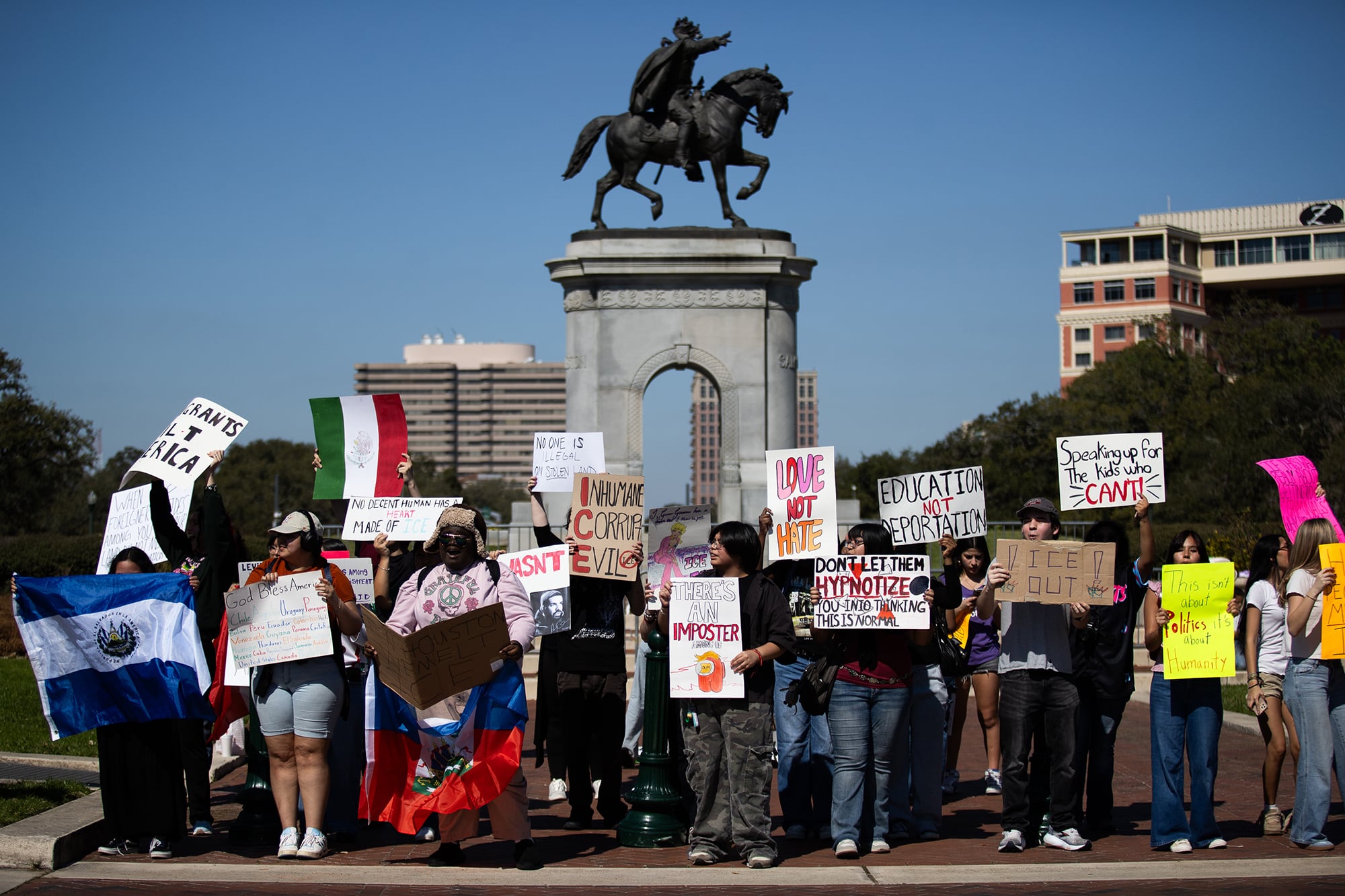
These efforts come as students and teachers have joined a wave of protests and general strikes in response to the Trump administration’s immigration policies. In some communities, tens of thousands of demonstrators have filled the streets, while in others, a few dozen students have walked out of school and held signs at nearby intersections.
Students have walked out of schools for decades, from demonstrations against the Vietnam War to calls for better gun control in the aftermath of school shootings. This round of protests appears to have struck a nerve with Republicans.
In early February, Florida’s schools chief warned that any school staff encouraging, organizing, or promoting protests could face disciplinary action.
Students have faced consequences too, from suspensions to threats of truancy court. But the rising action targeting educators has revived debate over teachers’ place in campus activism.
Greg Abbott, Texas’ governor, has condemned the protests, saying the “core responsibility” of public schools is to “educate our kids.”
That’s a common sentiment among those criticizing demonstrators. A Fox News story highlighted low standardized test scores at some schools where students protested. The piece gained traction online among conservative commentators who said schools were “prioritizing protest over math.”
Academics and teachers unions argue that teachers’ responsibilities are more complicated and sometimes entail actions to keep kids safe when they walk out.
“This is not a teacher-led issue, guaranteed,” said Zeph Capo, president of the Texas chapter of the American Federation of Teachers. “Teachers would rather be in their classroom, not outside in the street. But they have an attachment to their students, and they are concerned about them.”
Capo said he had heard of one case where a teacher may have facilitated a student protest. In other cases, teachers know students plan to walk out and want them to be safe. They might hand out brightly colored vests, for example, so students will be visible near busy streets. More often, teachers have told him they are grappling with where to draw the line.
In some instances, teachers have engaged in protests themselves. At least 20 district schools in Tucson had to cancel class on Jan. 30 because thousands of educators called out sick as part of a national shutdown protest. In response, two Republican state lawmakers introduced a bill Monday that would ban future sick-outs, cutting some funding for the district or charter school involved.
“If regular school days are moved online because of coordinated political action, funding must reflect that,” wrote Matthew Gress, a GOP member of the Arizona House of Representatives who co-sponsored the bill, in a news release.
But to Capo, Paxton’s investigations and the broader rebuke from Republicans are politically motivated.
“They’re going after school districts in an attempt to punish them for students taking a position on issues that genuinely matter to them significantly,” he said. “Many of the students in our public schools in Texas see their family members, see their story. And how would you not understand them connecting in that way?”
This moment is “particularly draining” for teachers, wrote Juan Carrillo, a professor at Arizona State University’s teaching college, in an email response to questions. Teachers fear they could face consequences for protesting, but also for sharing ideas with students.
“This context is positioning teachers as doing something wrong, and walking on political landmines can have all sorts of consequences,” Carrillo wrote.
Those consequences can even mean termination. A charter school teacher in Los Angeles was fired after he opened a locked gate for student protesters last week. He told reporters he was only looking out for student safety, not trying to foment further protest.
In an article last March in the National Review, conservative scholar Stanley Kurtz wrote that Texas teachers had thrown “political neutrality entirely out the window” by lobbying state lawmakers during field trips. He views the current round of investigations through that lens.
“Texas is absolutely right to crack down on teachers or administrators who facilitate student political walkouts,” Kurtz, a senior fellow with the Ethics and Public Policy Center, wrote in an email.
But Alan Singer, a professor of teaching at Hofstra University, dismissed the idea that teachers are recruiting students to protest.
“Educators have a responsibility to help students analyze what is taking place, so that the students can then make a decision about the kinds of things they want to be involved in,” he said.
Lily Altavena is a national reporter at Chalkbeat. Contact Lily at laltavena@chalkbeat.org.