Chalkbeat Ideas is a new section featuring reported columns on the big ideas and debates shaping American schools. Join us next month for our online event on whether higher education is still worth it.
Are American schools facing an imminent financial bubble?
More people are working in public schools, even as fewer students attend them. To some observers, this math just isn’t math-ing. Schools, some fear, are setting themselves up for disaster by spending beyond their means. This has led to broad concerns about the financial state of American public education.
“Where staffing and enrollment are diverging, something eventually has to give,” says a recent analysis from the Edunomics Lab, a school finance think tank. “Current staffing levels are unsustainable,” agrees a report from the Reason Foundation, a libertarian think tank.
The reality, though, is more complicated. Schools have been hiring additional staff for well over half a century. This is not inherently unaffordable, so long as the economy keeps growing and the public continues to support using additional tax revenue to fund schools.
Adding staff may be “more sustainable than people tend to assume for a lot of districts,” says Paul Bruno, a school finance expert at the University of Illinois. “If there are fewer students in the system, you can make the choice to spend more on each student.”
Yet there’s no guarantee that politicians will choose to keep spending more or that the economy will continue to grow. Whether staffing increases are fully sustainable will depend on a number of factors and will vary from place to place.
Here’s how to understand what’s going on.
The long-sustained staffing surge
The oft-cited graph below comes from Edunomics Lab. Based on federal data, it shows a divergence in the number of students and school employees in the last decade. Some are teachers, though most are non-teachers, including paraprofessionals, support staff, instructional coaches, counselors, assistant principals, and others.
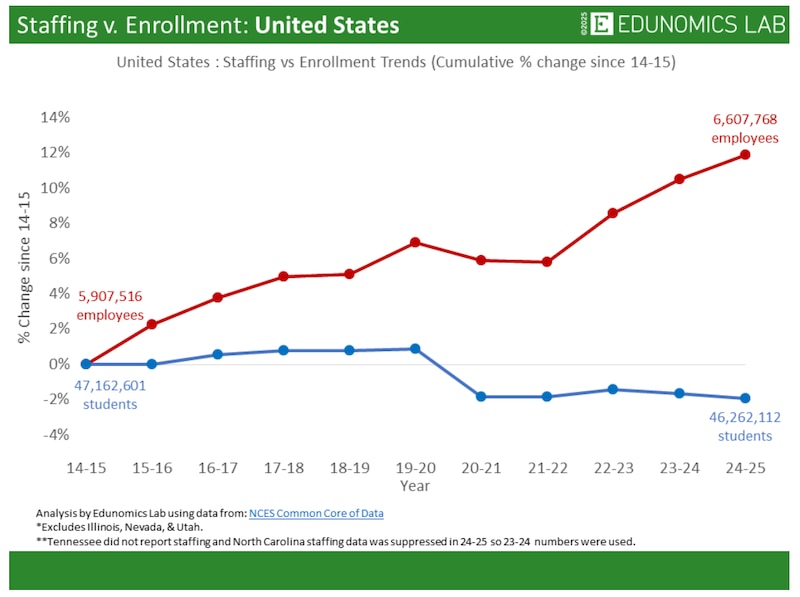
Below is another graph using essentially the same numbers but presented differently. This simply turns the student and staffing numbers into a ratio (students per staff) and extends the time horizon.
Here the recent trends look less stark. The dips in staffing ratios in the last few years may have been slightly faster than normal but not dramatically so.
In fact, American schools have been lowering staffing ratios for quite some time. Private schools have done so too. Over the years, critics have warned that such trends were not sustainable. Yet, with the exception of budget cuts in the wake of the Great Recession, they have been sustained.
How is this possible? Won’t schools eventually run out of money?
That’s not what has happened because school funding has tended to increase over time. As the U.S. economy has grown, tax revenue has gone up, and politicians have tended to give a bit more to schools each year. Taxpayers don’t usually revolt because their tax rates aren’t necessarily rising. The same tax rates on a larger economy generate more funding.
What would be alarming is if the share of the economy devoted to K-12 schooling were sharply increasing. That would be tough to maintain. But that’s not what we see.
What about the recent decline in student enrollment, which will likely continue for years? Won’t that finally mean that schools will have to make cutbacks?
Not necessarily. Lower enrollment could actually mean more money for schools on a per-student basis if the same amount of money is spread across a smaller number of students. This is possible because enrollment drops do not necessarily affect the tax revenue that goes toward funding schools.
Recent reports nationally and in California have described this phenomenon in more detail.
Uncertainty, politics, and trade-offs
Yet schools can hardly rest easy. Here are the financial risks and challenges that lie ahead.
- Some of the staffing increase may have been funded with temporary federal COVID aid that has run its course. It’s not clear precisely how many new staff were funded with this money or whether other revenue can sustain these positions.
- Losing students can add complications and costs to districts. They may keep underenrolled schools open or face added transportation costs after closing schools. In those cases, the same amount of money may buy less.
- Schools have benefited from a rising economic tide and politicians’ continued willingness to use extra revenue to fund education. Neither is guaranteed to last. Policymakers and voters may decide they don’t want to keep investing as much in school systems with dwindling numbers of students. Increasing demands for other public services, like health care, may crowd out education.
- Enrollment declines have not been evenly spread across school systems. Some places have seen much sharper drops. Those schools are facing increasing financial strain since state funding is tied to the number of students.
Even if schools can afford to continue adding staff or at least maintain staff, that doesn’t mean that they should. There is an open question about whether that’s the best use of scarce funds.
Research has found some benefits of additional teachers, counselors, paraprofessionals, and teacher coaches. One trade-off, though, is that new funding is not going toward raising teacher salaries. Adjusted for inflation, teacher pay has actually declined in recent years. Meanwhile, in part due to the growing economy, many other professionals have seen their salaries rise. This could have troubling long-run consequences for who enters and stays in teaching.
“What if instead [of adding more staff] we had really spectacular teachers in the classroom who are paid really, really well?” says Marguerite Roza, director of the Edunomics Lab. “If so, maybe we wouldn’t need so many specialists.”
Matt Barnum is Chalkbeat’s ideas editor. Reach him at mbarnum@chalkbeat.org.