Sign up for Chalkbeat Chicago’s free daily newsletter to keep up with the latest education news.
The Chicago Board of Education unanimously passed a legislative agenda Thursday that calls for more state funding and a millionaire’s tax — even though Illinois state lawmakers passed a state budget last month and have adjourned for the summer.
While some board members were happy with the items in the new agenda, they were also frustrated that it would be adopted after lawmakers had left Springfield.
“This would have been fantastic for us to have in January or even February,” said Anusha Thotakura, an appointed board member who has previously pressed CPS for a legislative plan. “There is absolutely no opportunity for this legislative agenda to result in increased state funds for the upcoming school year — zero.”
Several board members called for the agenda to be a “living document” that CPS could add ideas to. And others wanted more demands of local officials. Elected board member Che “Rhymefest” Smith said he was disappointed the agenda didn’t include anything about pressing the city to send more special taxing district dollars to the district – an amount that can vary year to year.
The agenda is a list of issues that Chicago Public Schools wants to advocate for with lawmakers, typically on the state level. But in recent years the board has not always had an agenda: It last adopted one in early 2024 under former CPS CEO Pedro Martinez, who then didn’t present one in 2025.
The district CEO is charged with creating a legislative agenda and presenting it to the board for approval in January of each year, but the board waived that requirement in January 2024 and January 2026, though not in 2025, according to board records. Those waivers say that the CEO would still be expected to present something early in the year.
Neither CPS nor the school board office explained why this legislative agenda came later in the year and after the state legislative session ended. CPS CEO Macquline King and board members have visited Springfield over the past year to meet with lawmakers, which state Rep. Ann Williams, who represents North Side neighborhoods, described as “very visible and engaging” during public comment on Thursday.
This is King’s first legislative agenda, which asks for more state funding as the district faces a $732.5 million deficit in its budget for next fiscal year, which the district is aiming to finalize by July 30. It also makes several new asks that weren’t in the 2024 list, such as a millionaire’s tax to raise more revenue for education funding and more charter school regulations.
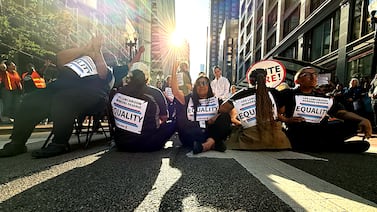
The Chicago Teachers Union is pushing lawmakers to hold a special session this summer to address funding issues.
During a union press conference Thursday morning, CTU vice president Jackson Potter said schools are slated, for now, to lose lots of staff and claimed district officials are considering cutting up to two weeks of instructional time next school year if it doesn’t get more funding to close its deficit. CTU President Stacy Davis Gates relayed a similar message to the union’s executive board in a letter earlier this week.
In a statement, CPS spokesperson Sylvia Barragan disputed that, saying “at no point has the district considered shortening the school year to alleviate financial challenges” and doing so “is not a viable option.” School districts are required to have 176 instructional days, which is the exact number of days for student attendance on CPS’s approved calendar for next school year. Cutting from that now could put the district out of compliance with the state.
The new legislative agenda includes a mix of old asks and new demands. Similar to the 2024 agenda, CPS is asking for more funding through the state’s main education funding formula in order to reach the state’s definition of “adequate funding.” It also wants heftier reimbursements for certain required services it provides, such as transportation for students with disabilities. And, it again calls for the state to help pay for Chicago teacher pensions in the way it does for other Illinois school districts, something one bill aimed, but failed, to do this year. (CPS has a special tax levy to help cover most teacher pension costs, and state money covers about a third of the costs.)
Some of the newer items include language about supporting more regulations around charter schools, in line with a resolution the board passed last year.
It also includes multiple proposals for raising progressive revenue. In its language supporting a millionaire’s tax, the district states that “by capturing a portion of ultra-high incomes, this dedicated revenue source would directly help address structural budget gaps, support classroom investments, and reduce reliance on volatile or one time revenue streams.”
Thotakura said the millionaire’s tax is a “notable” addition and could help the board avoid raising the property tax levy to the legally allowed limit, which it typically does annually.
Ed Bannon, an appointed board member, said it’s possible the agenda “just kind of didn’t get prioritized” early this year as King was still the interim CEO at the time and was navigating a host of issues. Despite the late timing, he said he’s happy a document now exists as the board gets ready to fill a long-vacant position on its intergovernmental team, which helps establish CPS’ advocacy presence in Springfield.
“The state needs to fulfill its obligation to fully fund education, and having an official legislative agenda is a step in the right direction,” Bannon said.
Reema Amin is a reporter covering Chicago Public Schools. Contact Reema at ramin@chalkbeat.org.