Did you know search engines like Google are changing the way you see news? Keep Chalkbeat’s valuable education coverage at the top of your feeds by clicking here and checking the box next to our name.
When Herron High School students put on a performance, there’s a challenge: The school doesn’t have a theater.
Instead, students create one inside the technical theater classroom, by moving stacks of costumes and props to other parts of the school, behind partition walls used to create separate classrooms.
The school has long improvised space in its historic building, a former art museum. But school leaders say they worry about how this shortchanges students.
“We have always been short on space,” said Janet McNeal, the president of Herron Schools, a charter network that includes Herron High and two other schools.
But construction is set to begin on a new theater adjacent to Herron’s main buildings. The project is funded by what school leaders describe as a once-in-a-generation $25 million donation from the Lilly Endowment.
The theater is one of several projects being funded in 19 school districts and charter schools by final phase of the endowment’s Marion County K-12 Public Schools Initiative representing $348 million in spending.
It is a historic infusion of money from a single donor to build and renovate public school buildings in Indianapolis — an undertaking that would normally require state or taxpayer approval, and would likely be out of reach. It’s provided tangible and significant benefits to schools that often struggle to fund such projects, while raising questions about oversight and the responsibility to fund schools.
The Lilly Endowment has become a key player in education funding in Indiana, putting up the bulk of the funding for the state’s shift to the science of reading in 2022. Overall, the endowment gave $1.2 billion to K-12, higher education, and youth initiatives in the state in 2025, up from $456 million the year before.
On the one hand, the endowment’s approach allows schools to fund buildings without leaning on taxpayers, especially during an election season in which schools already are seeking tax increases for basic operations, Christopher Lubienski, a professor of education policy at Indiana University and Director of the Center for Evaluation and Education Policy.
The risk, he said, is that donors “start funding things that lawmakers should — they supplant that public funding. Is that a good thing? It saves taxpayers money, but they also lose democratic control.”
In response to questions from Chalkbeat, the Endowment says it intends for its “funding to be complementary to the support that schools receive from other sources, including public funding.”
(The Lilly Endowment is a Chalkbeat funder. Learn more about our funding here.)
Unclear if Lilly Endowment will fund IPS projects
Indiana has turned to donors to support education programs before. After cutting state funding for the Dolly Parton Imagination Library in 2025, Gov. Mike Braun announced the program would be donor-funded. The fundraising campaign reached 90% of its goal earlier this year, but Braun’s office has not disclosed how much it has raised.
One notable absence from the list of districts receiving the initiative’s funding, at least so far, is Indianapolis Public Schools.
Late last year, the endowment said it was delaying a decision about paying for IPS projects until after an Indianapolis-based task force released its recommendations about changing control over local public schools, including their buildings. Those recommendations led to the creation of the Indianapolis Public Education Corporation, which has the power to take control of some school buildings, including those funded by private donors, although the process behind that is still in the works.
Indianapolis Public Schools must share its facilities under the facilities plan IPEC will eventually create.
It’s unclear if IPS said in its application for endowment funding that it would use the money for buildings. But the changes in governance create ongoing uncertainty about whether the Lilly Endowment would be willing to fund buildings for IPS that are subject to IPEC’s rules and could be shared with other entities.
The endowment said last month it still has not made a final decision about IPS projects. (Private schools in Marion County are also receiving endowment funding through a separate initiative.)
Charter schools are not required to participate in IPEC’s facilities sharing plan, and Herron likely won’t. McNeal, who also sits on the IPEC board, said the school is not counting on IPEC to provide a building for its growing enrollment.
As part of this latest grant, Herron will need to match about 20% of the project’s costs costs of the project — or around $5 million — through fundraising.
With 961 students, Herron High School in 2026 enrolled more than twice as many students as it projected when it first opened in the basement of the Harrison Center in 2006. That’s led to a squeeze on space beyond theater productions.
The school uses every classroom every class period, said Katie Dorsey, senior vice president for academic affairs. A handful of Advanced Placement classes have spilled over to the administrative building across the street. Students also take a four-minute walk to the Harrison Center for gym and dance classes.
Even after the expansion, the school will not have a gym. But it will have a larger kitchen, new science labs built to be labs rather than art galleries, and the new theater, which will double as a gathering space — something the school has long needed, McNeal said.
“We weren’t able to be a community in the way that we wanted to be, and this is going to allow that,” McNeal said.
School districts use funding for career-focused facilities
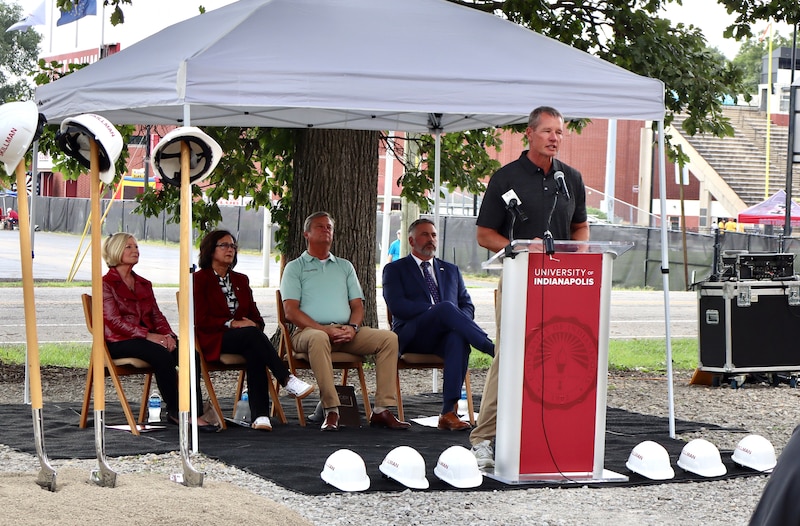
The Metropolitan School District of Perry Township received the largest grant from the Lily Endowment’s public schools initiative: $40 million. The bulk of that funding, $30 million, will pay for a new building earmarked for the district’s entrepreneurship pathway that will teach broadly applicable business skills.
Construction began on the building last month on the University of Indianapolis campus. When it opens in the 2028-29 school year, it will be the first high school career center located on a college campus in Indiana.
“The secret sauce to this is that when we focus on entrepreneurship and innovation, it crosses so many different industries and careers,” Perry schools Superintendent Patrick Spray said. “Kids will have a lot of different opportunities to pursue their passions.”
A dedicated building for the pathway would not have been possible without the grant, Spray said.
Similarly, the Metropolitan School District of Warren Township is using its $30 million Lilly Endowment grant to expand its middle school career education offerings from one career preparedness class to new career classrooms on every middle school campus.
Although the funding doesn’t come from a tax measure approved by voters, the centers address feedback from the community that the district should give students more opportunities to explore careers and graduate with credentials and certificates, said Ryan Russell, associate superintendent of academics, assessment, and achievement.
The grant is unique in the district’s history, Russell said.
Through the grant, Warren will renovate old career technical education spaces — clearing out drill presses and bandsaws that have sat inactive for years — into new more-flexible career classrooms called Journey of a Graduate Centers, Russell said.
“Career paths will change, and middle schoolers will work in fields that haven’t been created yet,” he said.
Aleksandra Appleton covers Indiana education policy and writes about K-12 schools across the state. Contact her at aappleton@chalkbeat.org.