Did you know search engines like Google are changing the way you see news? Keep Chalkbeat’s valuable education coverage at the top of your feeds by clicking here and checking the box next to our name.
Pushback on the use of artificial intelligence in the classroom is seeing renewed fervor after tensions flared this month between some U.S. school districts and one of the biggest tech giants in the world.
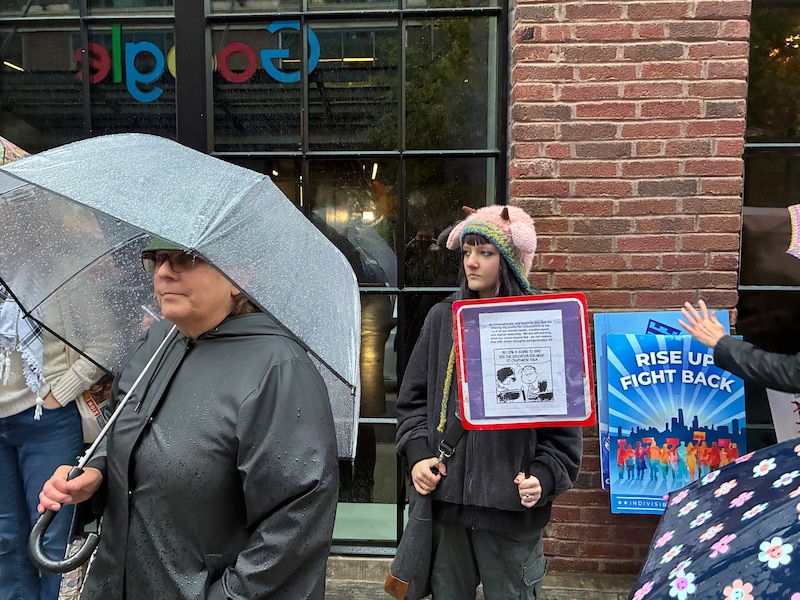
Protests popped up Wednesday in Cambridge, Massachusetts and in Chicago, where the city’s school district recently blocked student access to generative AI, which includes ChatGPT, Claude and Google Gemini. The backlash comes at a critical flashpoint for the future of AI in education. Google sparked an uproar earlier this month when it said that schools that ban AI won’t be able to use search because AI is so embedded in the technology.
Chicago Public Schools has yet to plan its response to Google’s announcement, but a CPS spokesperson said in a statement that the district was “actively exploring all options to independently suppress” the AI overview that appears at the top of Google searches. If CPS cannot provide students access to the search engine without its AI feature, the district will “look to other search solutions,” the spokesperson said.
The question of whether, and how, CPS could turn off Google’s AI features points to a dilemma at the core of Wednesday’s protests: determining the extent to which tech companies should be involved in public education.
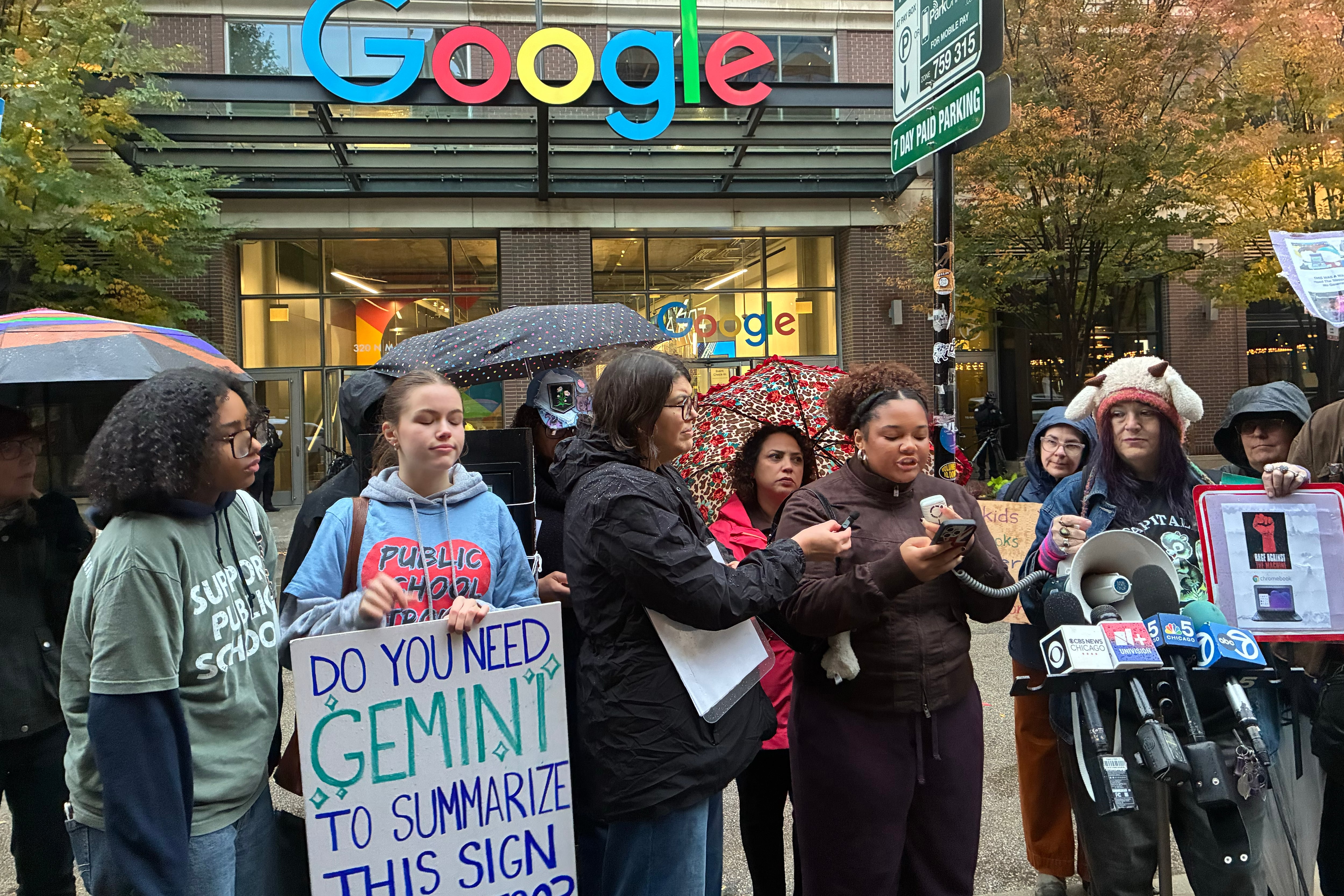
About 30 people huddled together outside Google’s office in Chicago’s West Loop, shouting chants such as “Hey Google, nice try. We don’t want your Gemini.” Most of the protesters were parents and educators, but the demonstration included some students who voiced their own skepticism about whether AI is beneficial for themselves and their peers.
“We are owed lessons and feedback from the people CPS hired, people who are passionate and dedicated to making learning fun,” Reese Mackey, a 16-year-old Kenwood Academy High School junior said at the protest. “Not by a bot whose only job is to be a yes man and compile random sources from the internet for a nonsensical answer.”
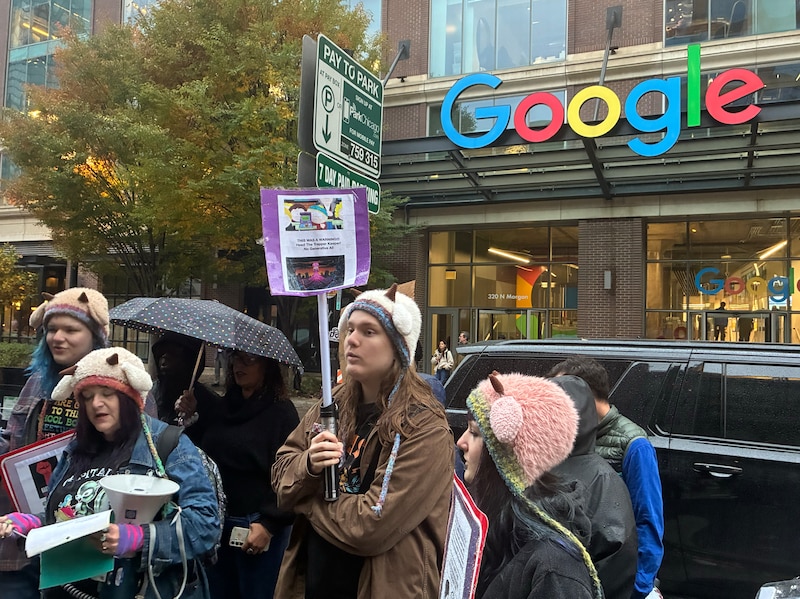
If AI is so embedded into Google’s search engine, then it might be time for schools to step back and reassess whether to use Google at all, said Cassie Creswell, executive director of Illinois Families for Public Schools, which led the rally in Chicago.
“That really shouldn’t be our gateway to human knowledge, and so we need to draw a line there,” Creswell said.
In a statement to Chalkbeat, a Google spokesperson wrote that the company was taking steps to improve its search functions for classrooms, such as through piloting its “Guided Learning” feature that uses AI to walk students through a problem step-by-step rather than providing quick answers.
The conflict with Google is just the latest in a growing movement of parents, educators, and school administrators concerned about how students’ AI usage — as well as screen time generally — may negatively impact learning. Those worries have ramped up under the Trump administration, which has largely been friendly with the AI industry. The proliferation of the ever-evolving technology, in turn, has left schools scrambling to place guardrails on its usage.
“We really need real policy…not just a guidebook with suggestions that dump the burden on teachers and kids,” Creswell told reporters.
Some cities are putting stringent AI policies in place, most notably New York City under Mayor Zohran Mamdani. Just before this school year started, the city banned the use of student-facing AI, which includes chatbots, from preschool through eighth grade. Then, at the end of October, Chalkbeat obtained a list of nearly 40 products flagged by the city’s Education Department for their AI usage, such as Grammarly and Kahoot.
Restrictions on AI haven’t been as swift or aggressive in Chicago. CPS approved at least three generative AI tools — Google Gemini, Microsoft Copilot, and Gemini Notebook — after accepting contracts that bar the companies from using student data to train their AI models, according to CPS’ AI Tools page. The district also backtracked on its planned rollout of implementing Google Gemini in high schools for the 2026-2027 school year after community pushback, according to CPS’ AI Access Overview.
More broadly in Illinois, the state’s education board introduced guidance earlier this year on how schools can use AI responsibly, though its suggestions are non-binding.
Wednesday’s protest also builds on existing demands from Illinois Families for Public Schools, which has positioned itself as one of the most vocal organizations opposed to generative AI in CPS classrooms. The advocacy group wants CPS to place a three-year moratorium on the technology in schools and opt for what it calls “human-centered education” and urged school board candidates to sign on in the recent election. About half of the incoming Chicago Board of Education members, including President-elect Jessica Biggs, did so.
Michilla Blaise, current school board member for District 5b who was just reelected, said she believes AI is creating larger gaps in learning in the communities she represents on Chicago’s West Side.
The Illinois Families for Public Schools pledge also calls for three other actions: installing a chief privacy officer at the district to protect student data, limiting screen time across all grade levels, and barring the collection of biometric data such as face scans and fingerprints.
Sweeping Democratic wins in last week’s midterm elections could shake up the political environment for AI companies, with potential for reverberations throughout the education sector. Data centers, the controversial facilities that power AI, proved to be a key issue this election cycle, with nearly 40 jurisdictions across the country approving ballot measures to limit their expansion. Creswell is hopeful that pushback is a signal for what’s to come in education.
“I hope that we have swept people into office who are not beholden to the tech industry and they’re beholden to their constituents,” Creswell said.
Makiya Seminera is a reporter covering how the state and federal government affect education in Chicago and across Illinois. Contact Makiya at mseminera@chalkbeat.org.