Sign up for Chalkbeat New York’s free daily newsletter to get essential news about NYC’s public schools delivered to your inbox.
After months of waiting, Mayor Zohran Mamdani on Wednesday released the outlines of New York City’s approach to dealing with artificial intelligence and screen time in schools next year.
But just eight days before the start of the school year, there are still many details to be worked out.
The city will ban student-facing generative AI tools, like chatbots and tutors that respond to prompts, in preschool- through eighth-grade classrooms, while allowing limited AI use in high school. It will also limit screen time for younger kids.
Officials said they’re “disabling” AI features on 38 software programs already in use in city schools, but haven’t shared what those products are. Officials posted the written guidance online Wednesday evening.
The policy opens up a host of thorny new questions, including how the city will determine what level of AI is acceptable in tech products, what happens to existing programs that violate the policy, and how the guidelines will be enforced.
And city officials have admitted they have little hard data on how much AI is currently in use across the 1,600 schools. They declined to release the results of a survey asking schools about AI use, despite repeated requests.
The new policy, which Mamdani described as the “broadest generative AI moratorium in the nation,” has already drawn a mix of reactions.
A coalition of advocates pushing for a two-year moratorium on AI use said the new policy is a “step in the right direction,” but raised concerns about pilot programs that will allow tens of thousands of high school students to use tools involving generative AI.
Others said the new policy will be disruptive for schools. Richard Buery, a former deputy mayor and CEO of the Robin Hood Foundation, said educators are already using tech tools to quickly generate lessons that parents can use for their children at home or get faster feedback on their students’ classroom assignments.
“While well-intentioned, a blanket one-year AI ban, without exceptions, on all uses through middle school is not the right call,” he said in a statement.
Here’s what we know so far, and what we’re still waiting to learn.
How long will the AI moratorium last?
The prohibition on student-facing AI tools from preschool through eighth grade will run for at least this coming school year. City officials vowed to convene a coalition of educators, students, parents, union officials, and experts to help assess the policy and whether to change it in the future.
Which specific products are being banned, and who decides?
New York City principals can buy education technology in two basic ways: For smaller purchases, they can contract directly with a vendor. For larger ones, they generally have to use a vendor that already has a citywide contract with the Education Department.
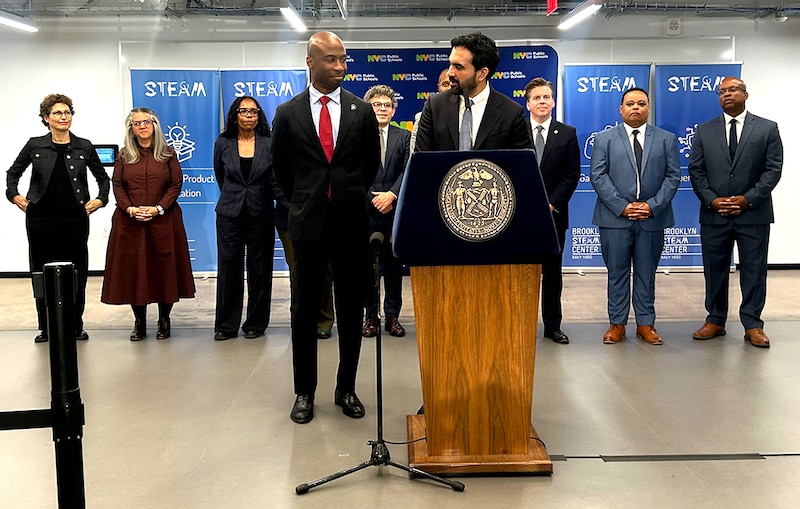
Mamdani said Wednesday that the Education Department is “disabling” AI features in 38 existing citywide ed tech contracts. Officials haven’t provided a list of those companies. But Mamdani’s education adviser Ailish Brady said that the widely used digital tutor Amira and the digital version of the Houghton Mifflin Harcourt reading curriculum — the most popular of the three mandated NYC Reads literacy programs — will both “turn off” their AI components.
A spokesperson for HMH said “there is no student-facing AI in Into Reading,” the company’s elementary school reading curriculum.
An Amira spokesperson said the product is currently used in 222 schools, and that the company has reached out to the Education Department for clarity on what the new AI policy will mean for the product.
Brady didn’t directly respond to a question about whether Google’s AI chatbot Gemini, which comes pre-loaded on many students’ Chromebook laptops, would be disabled. But advocates who met with city officials said they were told that Gemini would be shut off.
In cases where a company can’t simply turn off the AI features of a product, the city will no longer use that product, Brady added.
How city officials will determine whether AI has been sufficiently scrubbed from a product isn’t clear.
After freezing all new education purchases for nearly two months, officials gave principals the green light Wednesday to resume buying software, with a big caveat. Any new request for ed tech under $25,000 will now undergo an extra layer of review from the Education Department’s IT, legal, and contracts teams, Deputy Chancellor Lindsey Oates told principals in a Monday webinar. Oates warned the reviews will “take some time,” potentially creating an additional bottleneck in a contracting process that can already be slow.
Who will be exempt from the ban?
Technology that supports students with disabilities and English language learners with specific educational needs will be exempt, officials said. Brady offered examples: an eye-tracking technology that helps students with cerebral palsy type and an Education Department-created program called Hello App that helps students learning English communicate with teachers.
There will also be exceptions for required reading and math assessments that students take on computers to track their progress throughout the year.
How is AI being used in high schools?
High schools have the most leeway with AI tools and are allowed to use them in career and technical education programs. There are also five AI pilot programs involving generative tools that city officials have already approved, ranging from platforms that help students conduct close analysis of texts to a math program that prompts students to explain their thinking. The five programs are: Quill, Edia, Brisk Teaching, Playlab, and Intel AI-Ready Schools.
Officials said a maximum of 50,000 high school students would participate in those pilot programs, or roughly 17% of all high school students.
How will students learn AI literacy?
All high school students across the city will be required to complete two 45-minute AI literacy modules every year that cover the basics of AI, as well as issues related to bias and misinformation.
Which students do the new screen time recommendations apply to?
The city’s youngest students — from preschool to second grade — are not supposed to use individual laptops and other devices under the new policy. In grades 3-5, students are allowed to use individual devices but for no more than 30 minutes a day, officials recommend. In middle school, the recommended limit is 45 minutes. There are no screen time guidelines for high school.
As school districts across the nation are moving to limit screens, one reason some are allowing devices beginning in third grade: It’s the year state testing begins, and exams are increasingly administered digitally, including in New York.
How will teachers be allowed to use AI?
Teachers are allowed to use AI tools to help plan lessons, translate materials, or draft communications, according to an Education Department summary of the policy. They may not use AI tools to grade student work, monitor behavior, develop special education plans, or assist with student mental health challenges.
How will this be enforced?
Officials didn’t spell out any clear enforcement mechanism for ensuring schools adhere to the AI policy.
Mamdani conceded much of the enforcement will have to happen at the classroom and school level. “Whenever there’s been a shift, teachers have had to be at the forefront,” he said during the press conference. “And so we trust that teachers, principals, superintendents will be there.”
He added that central Education Department officials will subject all new ed tech purchase requests to a “rigorous” review process.
United Federation of Teachers President Michael Mulgrew, who has recently clashed with Mamdani on several major policy priorities, expressed concern that it will largely fall on “school communities or individual educators to figure out after the fact if what their school uses fits the new policy.”
What about students using AI outside of school?
One of the big critiques of the Education Department’s first draft of the AI guidance from March was that it completely dodged the biggest question on many teachers’ minds: how to respond to students using AI outside of school, including to cheat on writing assignments.
So far, the new guidance doesn’t seem to offer any more specifics on that front. Samuels noted that teachers have been dealing with the AI cheating issue for years (many schools developed their own AI policies while waiting for citywide guidance) and emphasized that schools will need to enlist parents for support.
Michael Elsen-Rooney is a reporter for Chalkbeat New York, covering NYC public schools. Contact Michael at melsen-rooney@chalkbeat.org
Alex Zimmerman is a reporter for Chalkbeat New York, covering NYC public schools. Contact Alex at azimmerman@chalkbeat.org.