Sign up for Chalkbeat New York’s free daily newsletter to get essential news about NYC’s public schools delivered to your inbox.
The nation’s media industry might be shrinking, but high school journalism is making a comeback in New York City.
In the 2025-26 school year, 135 schools across the five boroughs offered at least one journalism course, up from about 90 the year before, according to newly released city data. Nearly 5,700 students completed a journalism course, up 76% from the previous school year.
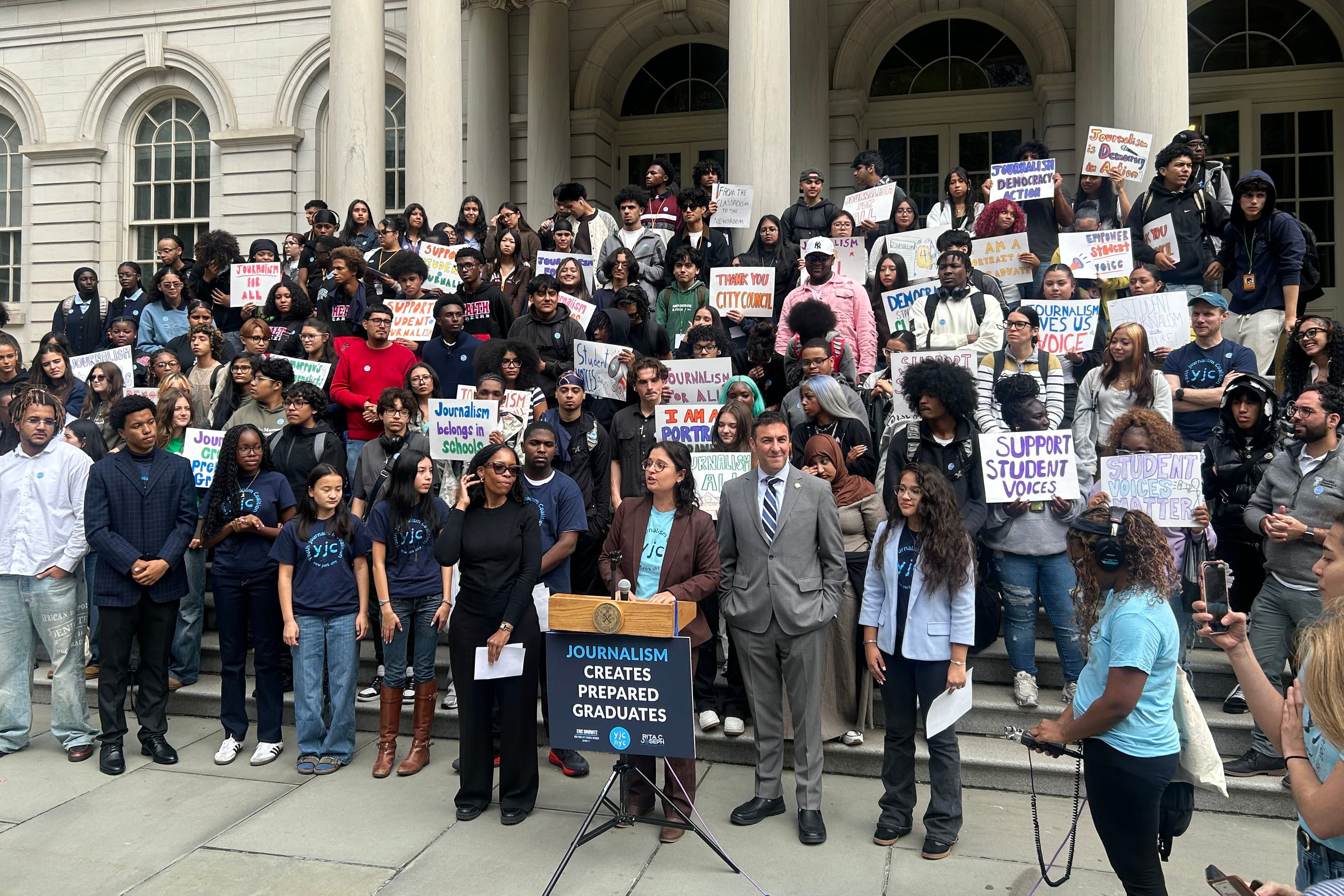
That’s largely due to the NYC Youth Journalism Coalition’s “Journalism for All” push, which got a $280,000 boost Tuesday from the City Council. The funding is expected to be ratified Thursday.
“When a student picks up a notebook or a microphone and starts asking questions, they learn to think critically, communicate clearly, and hold power accountable, skills serving them well beyond the classroom,” Bronx City Council Member and Education Committee Chair Eric Dinowitz said in a statement.
Dinowitz, a former teacher, announced the investment just before holding an oversight hearing on the state’s plan to overhaul graduation requirements, including replacing Regents exam requirements with other ways for students to demonstrate the knowledge and skills needed to earn a diploma.
Many students and teachers in the coalition believe that taking journalism courses and working on school media outlets could help schools meet the demands of the state’s shift toward a “portrait of a graduate,” which includes six qualities students must demonstrate, including being effective communicators, critical thinkers, and global citizens. Through high school journalism, they said, students produce portfolios of work demonstrating those skills.
Madison James, a junior at Edward R. Murrow High School in Brooklyn, connected the dots for City Council members at the hearing, mentioning a story she worked on last year for her student paper, The Murrow Network, looking at how policies limiting class sizes affected her school.
“I spoke with teachers and students living with those decisions, researching complicated information, listening to different perspectives, and communicating accurately,” James said. “That is critical thinking. That is effective communication. That is civic engagement. And journalism makes students practice those skills for real purpose, not just for another grade on a transcript.”
The reporting process inspired her to pursue a career in public policy, which hadn’t been on her radar before, she added.
The Youth Journalism Coalition has focused on expanding equitable access to high school journalism, and the recent city data — which is now required because of the coalition’s advocacy — reveals that some students who had been previously shut out of journalism now have more access. In particular, the number of students with disabilities taking journalism courses jumped 101% to nearly 1,140 students in the 2025-26 school year, while participation among English language learners rose 107% to about 470 students, the latest figures show.
As part of that effort, the coalition also partnered with CUNY’s Craig Newmark Graduate School of Journalism to create a curriculum and teacher training for schools that have historically lacked such programs. Its Journalism for All initiative piloted journalism courses in 30 public high schools across the city.
The largest chunk of the City Council funding — $150,000 — will go directly to the 30 schools in the Journalism for All pilot. Each school will get $5,000 to launch or improve student news outlets. Another $90,000 will go to the city’s Education Department to support the expansion of high school journalism. The remaining $40,000 will go to The Bell, the coalition’s nonprofit parent organization, to help it continue to administer the program. (Chalkbeat New York partners with The Bell on a student-led podcast.)
Correction: Sept. 23, 2026: This article initially said City Council funding would to go to Supervising Superintendent Alan Cheng’s office. His office doesn’t oversee the journalism program.
Amy Zimmer is the bureau chief for Chalkbeat New York. Contact Amy at azimmer@chalkbeat.org.