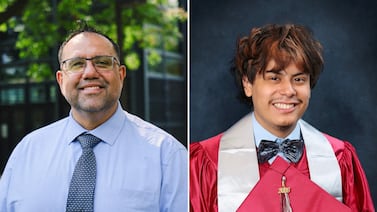
The former head of the Colorado Association of School Executives and a retired data analyst and accountability manager with the Colorado Department of Education are competing to represent Denver on the State Board of Education.
Both women have long careers in education and extensive experience with the accountability system the board oversees. Lisa Escárcega previously served as chief accountability officer for Aurora Public Schools. Donna Morganstern helped Douglas County School District set up a new accountability system under the federal No Child Left Behind legislation, before going to work for the state.
The incumbent District 1 board member, Val Flores, failed to make the ballot this spring.
The Colorado Education Association, the state’s largest teachers union, endorsed Escárcega after previously endorsing Flores in 2014.
District 1 corresponds to the First Congressional District and includes Glendale, Englewood, Sheridan, and Cherry Hills Village, as well as Denver. Due to the Democratic advantage in Denver, the winner of the June 30 primary will almost certainly win the general election.
Whoever wins will face the job of shepherding Colorado schools through unprecedented challenges related to teaching during a pandemic, including school closures and hybrid learning models.
State board members serve six-year terms. The state board appoints the commissioner of education, sets state standards, and handles charter school appeals, requests for waivers from state regulations, teacher licensure, and the administration of many grants approved by the legislature.
The state board also oversees improvement efforts in districts and schools that have struggled to raise student achievement for years.
The contest is expensive. Each candidate spent about $50,000 through June 10. By comparison, six years ago the two candidates for the seat spent a combined $58,000. Both are spending significant amounts of their own money.
Morganstern has put more than $50,000 into her campaign, including $10,000 on Tuesday. Morganstern said that with Escárcega’s greater institutional connections, she felt she had to spend more to get her message out.
Escárcega loaned her campaign more than $12,000 and spent another $7,400 of her own money directly.
The Democratic Party donated access to voter files valued at $4,500 to each of the candidates. Teachers unions are supporting Escárcega, who received $5,350 each from the DCTA Fund and the Public Education Committee.
Escárcega raised more than $16,000 from other individuals, compared with half that for Morganstern, as of the most recent filing deadline.
#FollowtheMoneyCO contributed to this story. #FollowtheMoneyCO is a project of the Colorado News Collaborative (COLab), with support from The Colorado Sun and Colorado Media Project.