Sign up for Chalkbeat Colorado’s free daily newsletter to get the latest reporting from us, plus curated news from other Colorado outlets, delivered to your inbox.
Most Colorado school board members are elected by voters across the entire school district. So voters who live in the south part of a district often get to decide who represents the north part of the district, a setup that some state lawmakers said makes little sense.
But an attempt to change that system failed on Tuesday.
Senate Bill 57 would have required elections to be more localized. Instead of electing school board members at large, as it’s called, the bill would have restricted the pool of voters to those who live in the cities or neighborhoods that the candidate would represent, similar to how Colorado elects its state representatives and congresspeople.
“It kind of doesn’t make sense to me that we have elections at large when we have candidates geographically distributed,” state Sen. Mark Baisley, a Woodland Park Republican, told a legislative committee Tuesday. “Let’s have them elected locally where they can actually focus their time and their resources for their elections.”
Baisley is one of the most conservative members of the state legislature. He quipped at the hearing that he found himself “in the unusual position” of agreeing on this issue with the American Civil Liberties Union, which often champions progressive causes. The co-sponsor of the bill was state Rep. Bob Marshall, a Democrat from Highlands Ranch.
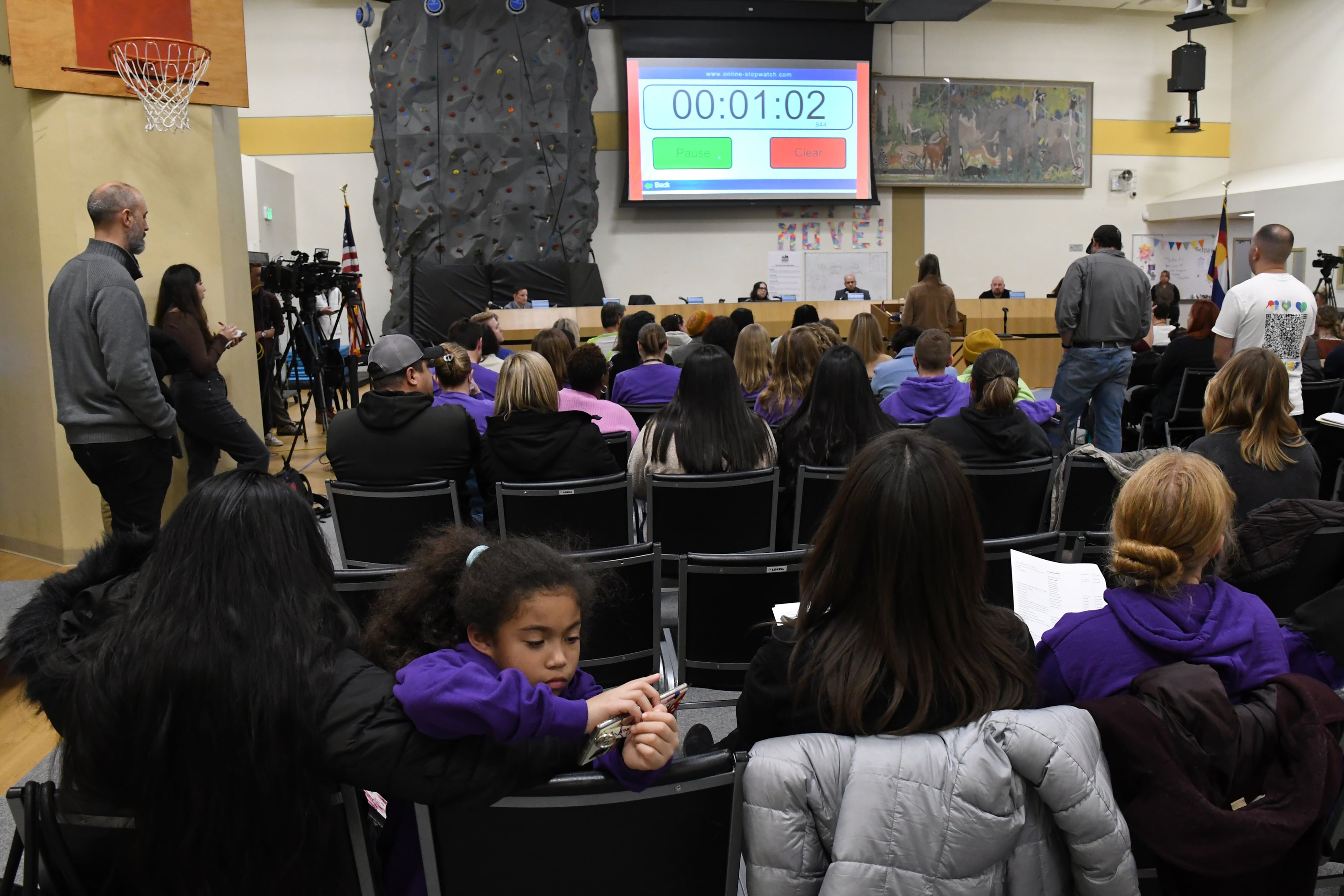
Colorado Common Cause, a liberal-leaning nonprofit, testified in favor of the bill at a short hearing before the Senate State, Veterans, & Military Affairs Committee. The committee has a reputation as a “kill committee” because most bills don’t make it out.
Dillon Rankin, an intern for Colorado Common Cause, said at-large elections can lead to unrepresentative and discriminatory results. A majority of seats are often won by candidates who agree with a majority of voters, leaving no room for minority opinions, he said.
The powerful Colorado Association of School Boards opposed the bill. Matt Cook, the organization’s director of public policy and advocacy, said state law already allows school districts to change the way they elect school board members if voters agree to it.
But Cook said he didn’t know how many districts had. The Colorado Secretary of State’s Office said it doesn’t track it either. The bill would have only applied to school districts with 6,500 students or more. That’s just 28 of Colorado’s 186 districts.
Of the 10 largest districts, only the very biggest — the 89,000-student Denver Public Schools — uses a different system. Two of Denver’s school board members are elected at-large. The other five are elected only by the voters who live in the neighborhoods the members represent.
Teachers unions were also opposed to the bill.
Rob Gould, president of the Denver Classroom Teachers Association, said Denver’s system leads to politicized and costly elections. In last November’s election, candidates and outside groups spent $2.35 million on ads, mailers, consultants, and other expenses, according to Chalkbeat’s tally, making it the most expensive Denver school board election ever.
“This dynamic discourages everyday educators, parents, and community members from running because they feel they cannot match the financial and political scale of these campaigns,” Gould said.
Colorado’s second-largest school district, the 74,000-student Jeffco Public Schools, has at-large elections. Brooke Williams, the president of the Jeffco teachers union, said it’s already hard to recruit candidates. Changing how they’re elected would make it harder, she said.
Two members of the Senate State, Veterans, & Military Affairs Committee said they agreed with the idea behind the bill, noting that more localized elections lead to more political and racial diversity among elected officials. But they said they were worried about the details, including how some school districts might draw the voting maps.
“We might see gerrymandering as a result of this proposal,” said state Sen. Katie Wallace, a Democrat from Longmont and chair of the committee.
The kill committee quickly dispatched the bill, voting it down along party lines. The two Republicans voted yes and the three Democrats voted no.
Melanie Asmar is the bureau chief for Chalkbeat Colorado. Contact Melanie at masmar@chalkbeat.org.