Did you know search engines like Google are changing the way you see news? Keep Chalkbeat’s valuable education coverage at the top of your feeds by clicking here and checking the box next to our name.
This story is part of a collaboration between Chalkbeat Detroit and the Detroit Free Press to cover key education issues in the race for Michigan’s next governor.
The candidates running to be Michigan’s next governor — Democrat Jocelyn Benson and Republican John James — have both promised an education turnaround. But a big problem that has received little attention during their campaigns lurks behind the state’s dismal test scores.
Too many students miss too much school.
During the previous school year, about 27% of K-12 students were chronically absent (defined as missing 10% of school days or more). In some urban and rural districts, the rate was much higher. For instance, Detroit Public Schools Community District’s (DPSCD) chronic absenteeism rate for the previous school year was 60% while it stood at 44% in Alpena Public Schools.
State Sen. Dayna Polehanki, a Democrat from Livonia, a former teacher who chairs the Michigan Senate’s Education Committee, summed up the problem succinctly: “You can’t teach a kid who’s not in the classroom,” she said.
Michigan’s chronic absenteeism rate is significantly higher than it was before the COVID-19 pandemic when it spiked nationally (it was about 20% during the 2018-19 school year). Michigan’s rate is among the highest nationally, and it has consistently stood out as the worst in the Midwest, according to data compiled by FutureEd, a think tank at Georgetown University.
Chronic absenteeism is associated with lower achievement and likelihood of graduation, said Sarah Winchell Lenhoff, a professor at Wayne State University’s College of Education and the director of the Detroit Partnership for Education Equity & Research.
But poor attendance doesn’t just hold back the students missing school, it hurts their classmates too, said Lenhoff. When a lot of students don’t attend class, the teacher needs to catch them up when they return, diverting the focus from planned lessons, she said.
Education is a centerpiece of governor’s race
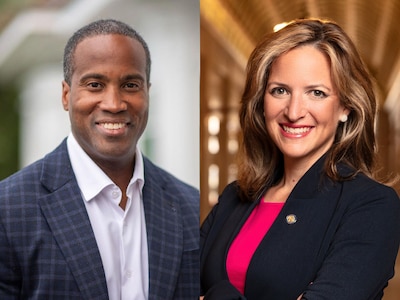
Benson and James have offered competing education plans. James wants to hold back third graders who fail a reading proficiency test and opt into a federal tax credit that unlocks funds for education expenses such as private school tuition and tutoring. Benson wants to expand free pre-K to all 3-year-olds and increase starting pay for teachers.
But both have named absenteeism as a problem they would tackle if elected.
Benson, the sitting secretary of state from Detroit, promises on her campaign website to create “a Statewide Absenteeism Strategy along with Local Implementation Plans to help local communities address chronic absenteeism.”
“At the core of Jocelyn’s education plan is the Michigan education guarantee: a promise that every kid who graduates from a public school in Michigan is prepared to succeed, whether they’re heading to college, a skilled trade, or the workforce,” said Benson campaign Press Secretary Rajan Srinivasan. “She knows tackling chronic absenteeism is critical to delivering on that promise.”
Benson, if elected, will “work with educators, experts, and community leaders” to improve attendance and “invest in wraparound services for students and families,” Srinivasan said.
James, the Shelby Township Republican who represents Oakland and Macomb County suburbs, vows on his campaign website to “partner with parents and teachers to address absenteeism from class.” He elaborated in a statement, calling for a statewide standard, citing Indiana’s new truancy law as a model. The law, which deals with unexcused absences, triggers an initial parent conference to address attendance problems before escalating to prosecution. James called for “earlier intervention and stronger accountability” in Michigan.
Education experts and leaders say there is no silver bullet or one-size-fits-all solution to chronic absenteeism. Different root causes underlie a problem that merits a variety of approaches, they say. But they agree that Michigan’s attendance problem holds back the state and deserves more attention. Bob McCann, executive director of the K-12 Alliance of Michigan, said there aren’t clear partisan lines on the issue.
The Michigan Department of Education (MDE) has celebrated a consistent decline in the chronic absenteeism rate since its peak during the 2021-22 school year. But more work is needed, the department writes in recent guidance on attendance and engagement.
MDE declined to make someone available for an interview. In a statement, department spokesperson Ken Coleman said, “The Michigan Department of Education remains committed to collaborating with state government officials to put students first.”
MDE has set a target goal of reaching a chronic absenteeism rate of about 26% for the 2031-32 school year (about one percentage point lower than it was in the 2025-26 school year and about 6.5 points higher than where it stood pre-COVID).
Meanwhile, other states have made a much more aggressive pledge to cut their chronic absenteeism rates by half over five years.
James blasted MDE’s target. “More than one in four Michigan students are chronically absent, yet Lansing’s goal is to barely improve that number by 2032? This is exactly the kind of low expectation that has left our schools ranked 45th in the nation. We should be raising the bar, not settling for the bare minimum,” he said.
Srinivasan said Benson will “set ambitious goals to get more kids back into the classroom.”
Barriers to attendance include housing issues, work schedules
Education experts and leaders listed many barriers to attendance: transportation challenges, mental health, unpredictable work schedules and housing instability.They also talked about what brings students in the door: free meals, engaging lessons and a general feeling that they belong there. And they have floated a variety of ideas to reduce chronic absenteeism.
Polehanki has previously introduced legislation to make kindergarten mandatory, saying it would set the expectation that children attend school regularly at the beginning of the educational journey.
McCann emphasized transportation funding. “We know that kids learn better when they’re in class earlier, and kindergarten is a good thing, but we’re not going to solve this problem without making sure that kids have reliable access to and from school,” he said.
DPSCD Superintendent Nikolai Vitti called for Lansing to address education funding inequities that create disparities between the city and wealthier districts in the suburbs, saying “that just gives us more resources to attack the concentration of poverty that you see in the city that holds back our families.”
To address chronic absenteeism, DPSCD has experimented with attendance agents, health hubs, paying students for perfect attendance, and school buses for high schoolers. DPSCD has seen a significant drop in its chronic absenteeism rate: During the 2021-22 school year, it stood at 77% compared with 60% during 2025-26 school year.
While Vitti said problem solving with families whose children are chronically absent should be the first step, he said there needs to be greater accountability measures for parents whose children regularly miss school though some reject penalizing parents.
Lenhoff pointed to Minnesota, where the state Legislature created a study group to identify policy recommendations for addressing chronic absenteeism, and funded a pilot program for school district initiatives to improve attendance such as a teacher-student mentor program and student-led attendance teams.
State Rep. Nancy DeBoer, a Republican from Holland who chairs the Michigan House of Representatives’ Committee on Education and Workforce, called for sharing ideas that work to improve attendance across districts.
“Everybody has to come together on this,” she said.
Contact Clara Hendrickson at chendrickson@freepress.com or 313-296-5743.