Sign up for Chalkbeat New York’s free daily newsletter to get essential news about NYC’s public schools delivered to your inbox.
Every morning, all of the roughly 100 seniors at Kingsborough Early College Secondary school start their day taking classes together at CUNY Kingsborough Community College.
In the afternoon, they hop on a yellow school bus and head back to their school on the Lafayette educational campus about 15 minutes away.
Kingsborough juniors make the reverse trek. They start their morning at the Lafayette campus then take the bus to the community college for afternoon classes.
By the time the students graduate high school, most have earned associate degrees from CUNY Kingsborough. In fact, the majority — 57% — of CUNY Kingsborough students are not stereotypical college students. They’re high schoolers, according to a new analysis released Tuesday from a New York coalition of advocates and education institutions.
CUNY Kingsborough is one of six community colleges across the state where high schoolers make up the majority of students. It could be the harbinger of something bigger. As community college enrollment has declined nationwide in recent years, dual enrollment programs — where high school students take college courses and earn college-level credit — are expanding in New York state and elsewhere.
The state Education Department is making these programs a priority. It recently proposed new reporting regulations requiring institutions to not only report their dual enrollment partnership agreements but also to provide data on enrollment and outcomes. The idea is to help officials and educators get a better grasp on the variety of dual enrollment programs and find ways to ensure the programs reach more students who are underrepresented in higher education.
The stakes are high: According to a 2024 report from Georgetown University’s Center on Education and the Workforce, workers will need a bachelor’s degree for 66% of “good jobs” in 2031 — defined as one that pays a minimum of $43,000 a year nationally to workers ages 25-44.
The state’s proposed rules, which it’s expected to adopt early next year, will mark the state’s first consistent policy governing these programs. Additionally, the state recently created a $9.1 million College in High School Opportunity Fund to support dual enrollment and other early college programs to focus on enrolling more students from low-income families.
Several studies have celebrated dual enrollment programs for helping put students on a path to college by exposing them to high-level coursework.
At Kingsborough, the program has proven so successful that many of its students not only complete higher education degrees, they eventually return to work at the school. Of the school’s 80 staffers, 16 are graduates, its principal, Tracee Murren, said.
And there’s one other very obvious benefit dual enrollment programs frequently offer: Students can save money by earning college credits, often for free, before they finish high school.
Early college programs help families save on average $13,000 on the cost of a bachelor’s degree, said Alexandra Wilcox, deputy director of the New York Alliance for Early College Pathways, the group that studied the state’s dual enrollment expansion.
Research has found students in these programs are also more likely to attend school regularly, avoid suspension, graduate high school, and earn a college degree within six years.
“It really is a game changer in terms of being able to save time and money to a degree,” Wilcox said.
But a deeper understanding of the types of programs, who they’re serving, and what their outcomes are — the things the state is proposing to capture — will ultimately strengthen dual enrollment programs, said Wilcox.
Though New York pioneered dual enrollment programs, launching them more than 50 years ago, the state’s approach in terms of policy and funding has been “inconsistent and unpredictable,” Wilcox said.
NYC has range of early college programs
Across New York state, dual enrollment jumped 15% year-over-year, the alliance report found. It now has the nation’s third largest number of students in dual enrollment with more than 176,000, behind California and Texas.
In New York City, the majority of dual enrollment students are in College Now, where they take college-level courses at CUNY for free, generally as an add-on to their regular high school courses. But there’s rising interest in the early college approach, which integrates college courses more deeply into the curriculum. About 30,000 students take College Now courses while roughly 3,500 students take CUNY classes through early college courses, a CUNY spokesperson said.
Nearly 45 out of the city’s 400 high schools offer early college programs, according to the city’s MySchools lookup tool.
The early college model traces its roots to Middle College High School, which opened in 1974 to provide students who struggled in traditional schools with an opportunity to take courses at LaGuardia Community College in Queens, where the school is still located.
Some early college programs do not screen students based on their academic records, like Pathways in Technology Early College High School, known as P-TECH. That school launched in Brooklyn in 2011 and spawned eight other high schools across the boroughs that offer a six-year program, grades 9-14, each affiliated with different CUNY institutions. Students at these schools can graduate with an associate degree in a STEM field at no cost.
Other programs are highly selective. Bard College, a liberal arts school in Annandale-on-Hudson, has four New York City Bard Early College campuses, where Bard professors teach students, who go through a rigorous admissions process involving a test and interview. The newly opened HBCU Early College Prep in Queens — which partners with Delaware State University, a historically Black institution — also admits students based on GPAs, a writing exercise, and a video submission. The HBCU Early College students take online classes through Delaware State.
Access to dual enrollment programs shifts
At Kingsborough Early College, which opened in 2006, the school targets students who are underserved in higher education — those “not typically selected for gifted and talented,” Murren said.
The school starts in sixth grade, admitting students through a lottery. Demand for it is high: Roughly 1,000 students apply for 100 seats every year.
Roughly 40 to 50% enter the program reading below grade level, Murren said, and the school takes an intensive approach to ensure they’re ready to read dense college-level material as they reach the upper grades. Middle schoolers also have an advisory class every day to ensure they have the “mental fortitude” to take on college-level work, she said.
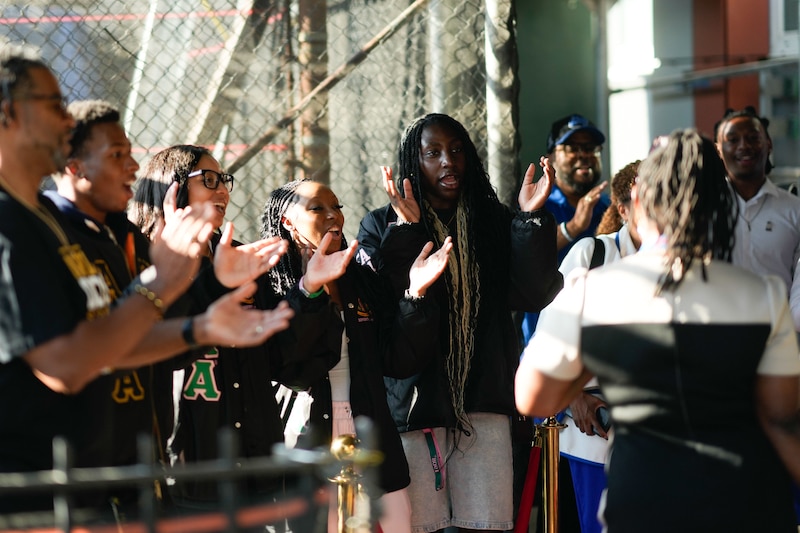
The students take their first college class in ninth grade, a Spanish course, stretching it from one semester to the entire year to make it slower and more digestible, Murren said. The school intentionally starts with a foreign language since it’s a course that many four-year colleges require and has no prerequisites.
Professors from CUNY Kingsborough Community College come to the Lafayette campus to teach the freshman and sophomores in the afternoon, and the school has an extended day to accommodate these courses.
Balancing high school and the more advanced college courses simultaneously isn’t easy, Murren acknowledged. But her staff is committed. There’s low teacher turnover, and they get to know most students from the age of 10.
The students, for the most part, take their college classes together once they start attending the CUNY campus, maintaining a sense of community.
Murren said the students also support each other, characterizing their approach in this way: “‘We’ve been going through this together, and I don’t want you to fall off, so I’m going to make sure that you don’t.’”
She added: “We should never doubt what our students are capable of, their abilities, and their tenacity really shines through when given the opportunity.”
Historically, many high schools have used dual enrollment programs as an acceleration strategy instead of also a strategy to promote college access, said John Fink, a researcher at the Community College Research Center at Teachers College, Columbia University.
But that’s changing. Research into dual enrollment is also shifting away from addressing whether it works and instead trying to understand how to make it work better — and for more students, not just the top students who are “already acing everything,” he said.
The key question, Fink believes, is how to make sure that families know there’s free college available to New York City high schoolers.
“Even though you think that word would get out, it doesn’t,” he said, “[but] when it’s implemented as a purposeful path to debt-free college … that marketing also helps sell the high school.”
Amy Zimmer is the bureau chief for Chalkbeat New York. Contact Amy atazimmer@chalkbeat.org.