This article was originally published by Documented, an independent, non-profit newsroom dedicated to reporting with and for immigrant communities in New York City. The original article can be accessed here.
For the last few months, Margarita and her husband have been waking up at 4 a.m. most days. While their children slept, she lovingly brewed him coffee and packed him breakfast and lunch — bread, fruit and a sandwich — before sending him off to his job working construction.
But last week, that peaceful cadence changed.
On the first day of school, Margarita’s three children were up and buzzing by 7 a.m. in their rooms, putting on their first-day outfits and packing their backpacks.
With only 20 minutes left before they had to rush out the door, Margarita quick-stepped around the house and the kitchen, handing off lunch boxes — one with vegetables and one without — for her 12-year-old daughter and 14-year-old son. She also asked her daughter to help her prepare food for their spunky, white-furred dog Max.
At just before 7:30 a.m., Juan, her eldest — who is set to start college next week — emerged from his room to help.
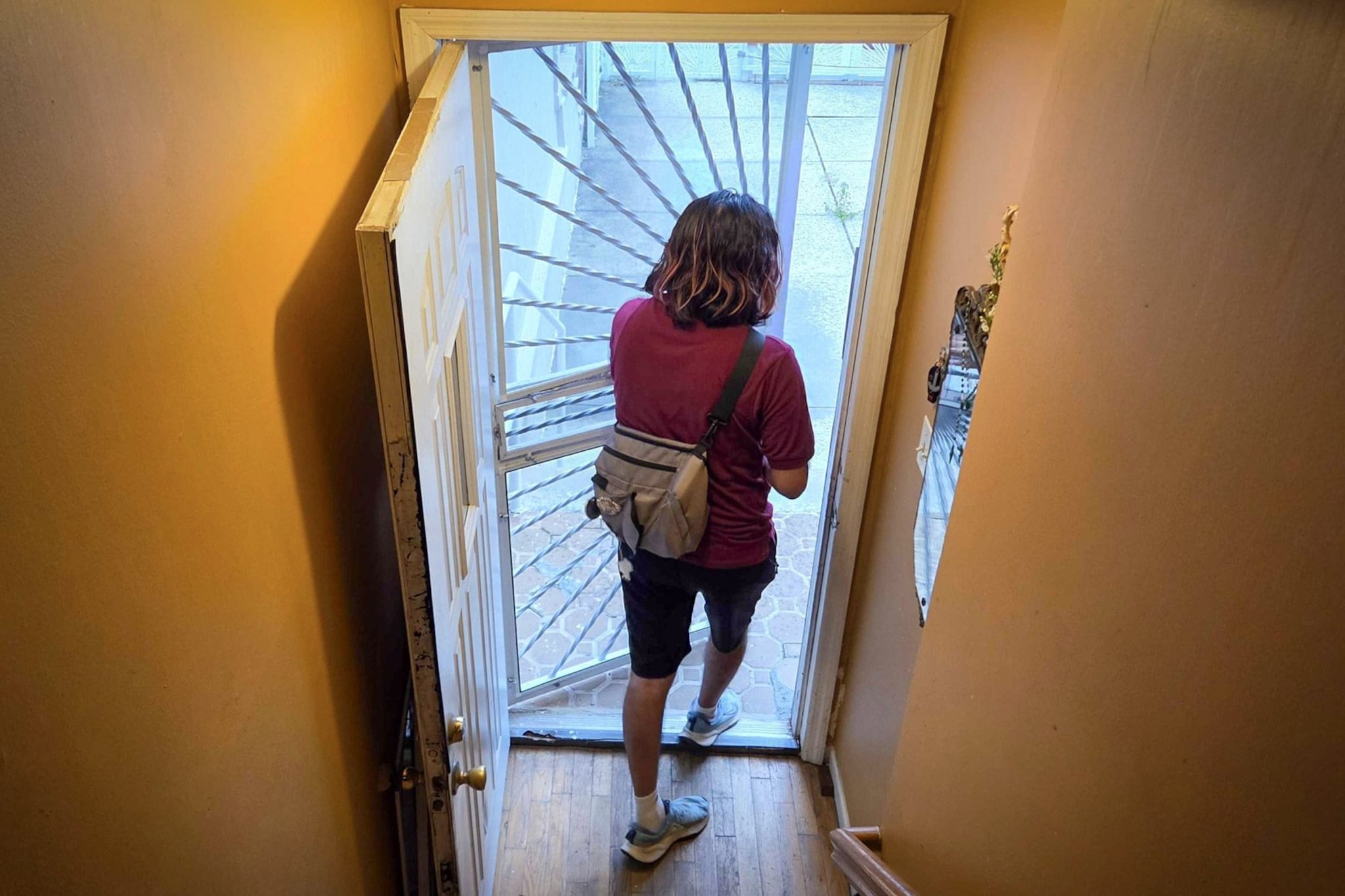
With that, the family was out the door, spilling into the driveway and onto the street before climbing into the family’s black SUV. As she made her way to the car, Margarita waved to their neighbor, who was sitting on a nearby stoop.
“I’ll drive,” Juan, her 18-year-old, declared.
The 40-minute drive to school was largely uneventful. They battled the usual traffic as Margarita directed Juan on the fastest route to take. Meanwhile, after a missed left turn, her 14-year-old noted that his little sister may be late for class.
Margarita and her family requested that Documented only use their first names due to concerns about immigration enforcement.
As they rolled across Queens headed west, they passed many families and excited children on the street who seemed to be swallowed by enormous backpacks saddled on their shoulders.
When they finally pulled up in front of her children’s school in Long Island City, Margarita kissed her two youngest on their foreheads before sending them off into their 7th and 9th grade lines, respectively.
But when she returned to her car, Margarita took a sharp breath when a notification popped up on her phone:
“🚨ICE in Corona” it exclaimed in Spanish.
The message was shared in a group chat for women like Margarita who are members of Las Doñas, an immigrant women’s organization.
A father, running morning errands, was detained by ICE before he could get home to drive his own son to school.
“The boy was at home and called [his mom] saying that he was ready to go to school. [His mother] cried and just said she was coming,” recalled Tony Alarcón, executive director for Las Doñas, who responded to the incident and spoke with the mother.
A video of the arrest, reviewed by Documented, shows a terrified woman fast-walking a child wearing a backpack past the scene, as another woman in sweats collapsed against a car, sobbing in front of the immigration agents.
While the first day of school is a largely a happy occasion for city families, for some immigrant New Yorkers, getting to and from the school building marks an added risk.
ICE arrests peaked in New York City in July, the highest number of arrests since the beginning of the second Trump administration. Queens, which is often called the world’s borough for its heavily-immigrant neighborhoods, was particularly hard hit — with at least 2,153 people arrested since last January.
In a four-block radius of Margarita’s home, ICE sightings and arrests have been reported nearly two dozen times since January 2025, according to website ICEout.org.
While some in her community say they’ve been overwhelmed by fear — often refusing to leave their homes — Margarita told Documented that she won’t let herself become paralyzed. Instead, that afternoon, she planned to attend a rally and pass out Know Your Rights information to parents during pick up time at a school in Corona, only three blocks from the arrest.
“Don’t be afraid to drive your children to school,” she told Documented in Spanish, adding that when she feels scared, she tries to keep herself in check.
“If I live with fear I’m not going to live well. I’m going to get sick and I won’t be well for my children,” she said. “I ask God to bring me home.”
What schools have done
Since the beginning of the second Trump administration, schools across the country — including in New York City — have faced a drop in attendance due to deportation fears. Adding to immigrant families’ concerns, the Trump administration quickly dropped a Biden-era guidance treating schools as protected from immigration enforcement.
In New York City, the Department of Education does not permit school staff to allow federal agents, including ICE, to enter schools without a judicial warrant. And the state recently passed laws affirming schools as sensitive locations under state law.But danger exists for immigrants before they ever reach the school doors — it also lies on the journey to school.
Margarita’s son, Juan, a recent high school graduate, says that these days parents are asked to take one of two risks.
“If you go with the kid, there might be the chance that they might catch you, they might not, or nothing happens,” said Juan. “And then there’s the other one that we let your kid go by yourself, which has the risk of leaving the kid unattended, and who knows what will happen during that time.”
Advocates question whether schools could go further, suggesting that a walking bus and safe corridors patrolled by ICE watchers could become official policy, which would help families feel safer attending school.
“The vulnerability is when they’re out in public,” said Mabel Tso, a senior strategist at the New York Civil Liberties Union, which developed model policies for New York schools to follow in order to protect immigrant students and their families.
“Having a mayor who is pro-immigrant and a chancellor who comes from an immigrant background helps, but you know we need to see … the action of going beyond these model procedures,” said Tso.
The city’s Education Department did not respond to a request for comment on protections outside school grounds, but sent a link to their guidance for immigrant families.
Protesting at a Pickup Line
Later that afternoon, a pickup line of parents speaking multiple languages stretched around the corner in front of P.S. 19, an elementary school in Queens, carrying an array of patterned umbrellas to protect against the intense sun.
As they waited to reunite with their kids, they peeked down the block as an electric speaker boomed and a small crowd gathered around local elected officials and pro-immigrant organizations. Many gave speeches denouncing ICE arrests and its impact on parents. Margarita stood among them, joining in chants of “ICE Fuera!”
Soon, the school doors swung up and kids streamed out, with some children holding their parents hands. Nearby, volunteers — including Juan — handed out information on constitutional rights, whistles, and flyers from local immigrant rights organizations.
Children wearing handmade paper headbands giggled and playfully blew whistles.
“Today is the first day of school. Instead of this being filled with joy for parents and students, it has now become a day when parents and their children feel panic and anxiety,” Amador Rivas, a local member of Make the Road New York in Corona, said in Spanish.
”A simple walk to school can lead to a family being separated or the parents and children being detained by ICE,” he continued. “This is not right. All children deserve to feel safe in their neighborhoods and in their schools, but how can a child focus on learning when their minds are worrying about ICE agents lurking outside of their schools or whether their parents will be targeted next?”
Margarita said that the arrest, which had occurred a 5-minute walk from the school where she was standing, was disheartening.
“They took someone who is likely a father, and now his family doesn’t know where he is, and his children are waiting for him to come home,” said Margarita, standing on the sidewalk as families finished filing out of the area.
Despite her efforts to remain stoic and create a sense of normalcy at home, Margarita says that her daughter is extremely attentive when her parents return home, even going so far as scolding her father any time he’s late, and reminding him to come home quickly.
Still, Margarita finds strength in taking action — and noted that her community is large and resilient.
“I’m happy because I feel like I’m helping the community, and that at least is my grain of sand so people support [us] and see that they aren’t alone.”
Sign up for Early Arrival, Documented’s newsletter, here, and get your immigration and policy news from New York, Washington, and nationwide in your inbox 3x per week.