Sign up forChalkbeat Philadelphia’s free newsletterto keep up with the city’s public school system.
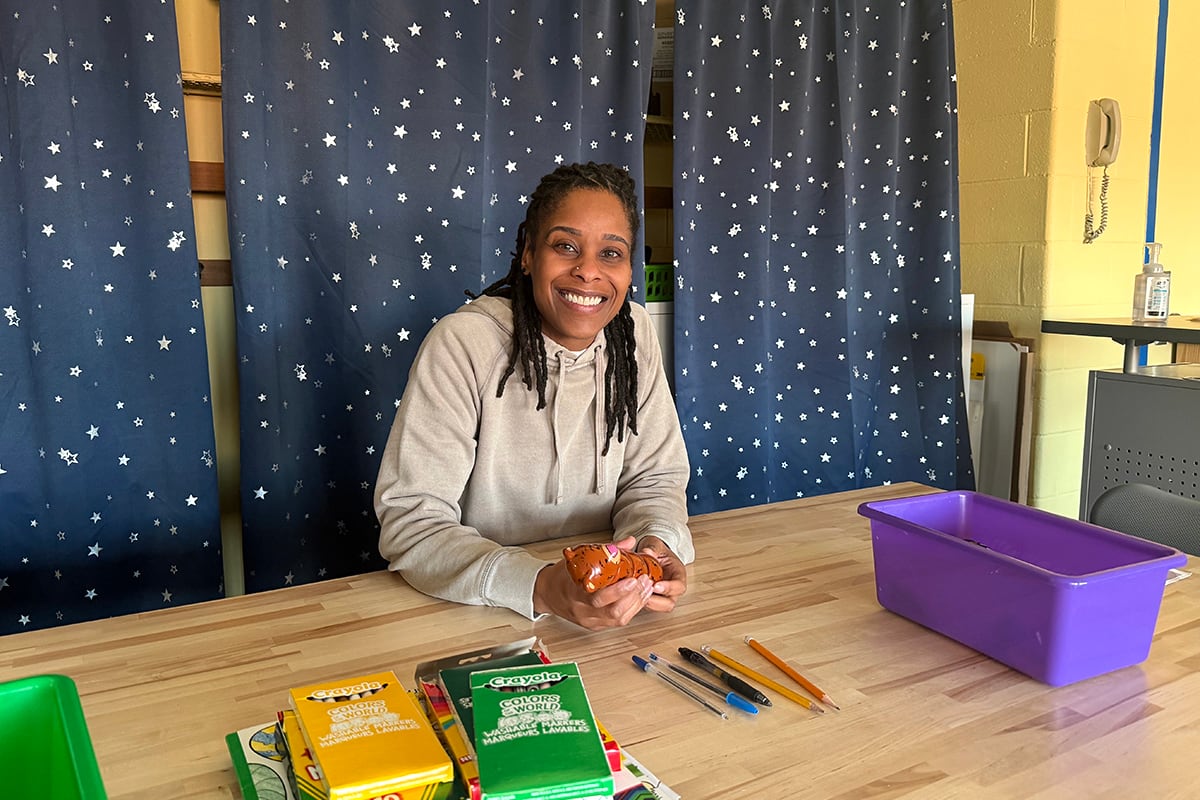
On a regular day in the “reflection room” at North Philadelphia’s W.D. Kelley School, trauma specialist Meah Carruth might facilitate a mediation between students in conflict, a naptime for a group of tired teachers, or a lunch break round of musical chairs.
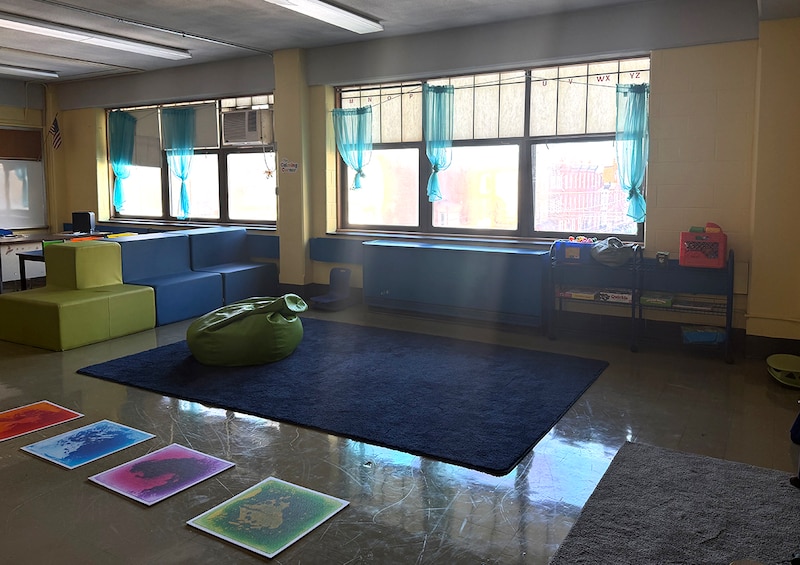
The dimly lit space contains sofas, interactive playmats, and other items intended to help calm students and staff. It’s part of the Philadelphia Healthy and Safe Schools program, a “trauma-informed schools” initiative facilitated and partially funded by Temple University on five School District of Philadelphia campuses.
The idea behind the program, known by the shorthand “PHASeS,” is to create places where all students and teachers can take a “brain break” when they feel overly stressed. Most classrooms in PHASeS schools have a “calming corner,” and each building has a PHASeS room where students can visit with an adult’s permission. Most of those rooms are staffed by a trauma specialist like Carruth, who is trained to help people understand and regulate their emotions.
“Maybe you need to pick up a beanbag and throw it at a target and let out some steam, maybe you do need to scream,” Carruth said, rolling a blue rubber fidget toy in one hand. “Let’s assess what you need, and if we can offer it and provide it, and you’re safe, let’s do it.”
The PHASeS team from Temple University’s Lewis Katz School of Medicine also provides regular staff training. It helps teachers better understand the chronic trauma students see at home and in the neighborhood, often related to housing insecurity, gun violence, and domestic abuse.
“When you think about some of the things that they have experienced, you kind of handle them better,” said Sherese Knights, an English language arts educator at W.D. Kelley who has received the training. “We are more inclined now to focus on their most basic needs before providing learning.”
A soon-to-be-released evaluation by Temple’s College of Education and Human Development surveyed educators in PHASeS schools. More than three-quarters said the program improved classroom learning, and 85% said the training improved their own well-being.
The data also showed that PHASeS has reduced fights, harassment, and disorderly conduct on two of the three campuses where it was studied.
Kelley Principal Crystal Edwards said teaching kids to take a breath makes it less likely that they’ll act out. She also credits the program with the fact that 98% of the student body has never been suspended, a substantial improvement from a decade ago.
“Learning how to regulate and learning how to calm has a natural effect, to shut down anything that comes behind it,” she said. “So that’s why we don’t have those fights. That’s why we don’t have that verbal assault, and that’s why the hallways are quiet.”
‘The conversations weren’t happening’
A growing body of research supports programs like this as a way to improve academic achievement in neighborhoods with high levels of poverty and violence. More than one-fifth of Philadelphia residents live below the federal poverty line, according to the latest Census data. While gun violence is down from a record-high number of shootings in 2022, the problem persists. There were 979 shootings citywide, 206 of them fatal, in 2025.
Tyrique Glasgow, director of an after-school mentorship program called the Young Chances Foundation in Philadelphia’s Grays Ferry neighborhood, said the environment has a profound effect on how children behave at school.
“If at night you look out your window and there’s still the blur of police lights and sirens, are you having a good night’s sleep?” he said. “When they get into the school and someone says, ‘Sit down,’ or ‘Why you not paying attention?’, do you think the child could articulate, ‘Hey, you know, it was a shooting on my block last night?’
He noted a lot of kids he serves also get to school late and often skip breakfast because of stressors at home. The elementary schools in Glasgow’s neighborhood do not have the PHASeS program.
As a result of the PHASeS curriculum, Kelley staff extended breakfast service by about two hours, so students arriving late wouldn’t be hungry and irritable during their morning classes.
Knights, the English teacher, said after the training she started having lunch with students she suspected were struggling. It was during those breaks that heavy topics started to come up.
“The conversations weren’t happening,” she said. “It literally just changed everything. You went from not being able to connect to developing deep connections.”
Making trauma approaches sustainable
Exposure to trauma, and particularly violence, “has an impact on everything from memory to the ability of children to concentrate,” said Pedro Noguera, dean of the Rossier School of Education at the University of Southern California. “When it’s not addressed, it manifests itself as disruptive behavior.”
Noguera has been watching the movement for trauma-informed schools slowly gain momentum across the country in recent years. He’s also seen opposition from people who want more discipline and fewer wellness resources. And he’s noticed school districts spending funds on lockdown drills rather than counselors.
“We have schools that are preparing for school shootings, which can itself traumatize children,” he said. “We’re preparing ourselves for violence, rather than finding ways to reduce the likelihood of violence, which is kind of crazy.”
PHASeS is funded by Temple, the school district, the state, and the federal Department of Justice. Currently all five PHASeS schools have a trauma specialist or another PHASeS staffer on site regularly. There is also a mindfulness coach in two of the schools.
The level of staffing, and how often schools can order new furniture and fidget toys, fluctuates based on availability of district and state funds, program staff said.
“Funding is challenging right now,” said Mary Beth Hays, an assistant professor in Temple’s Lewis Katz School of Medicine and director of the program. “In some ways, what we’re doing is really getting to a place of health and strength within each of these buildings. But it really takes time. We’re in the middle of a conversation that shouldn’t be interrupted by resources or lack of funds.”
The School District of Philadelphia started providing trauma training to teachers in 2017. That same year they launched the STEP program in 21 schools, which connects students to therapists, case managers, and family peer specialists. And some public schools have built “calming rooms” over the years.
But a comprehensive program like PHASeS can change the culture of an entire building, said Hays.
“We’re hoping to create a relational safety that then begets classroom safety, hallway safety, playground safety, cafeteria safety,” she said. “And so when I think about the ways that we are interfacing with gun violence, it is in both prevention and in response”
Edwards, the principal, says it comes down to a simple idea — students having someone to talk to.
“There’s an expectation that someone is listening to how they feel,” she said. “There’s an expectation that they are cared for and concerned for in this building. And that we, all together, have learned and continuously learn about how to work through trauma.”
This story is part of a collaboration between Chalkbeat Philadelphia and The New York Times’s Headway Initiative, supported by the Stavros Niarchos Foundation (SNF) via the Local Media Foundation.
Sammy Caiola covers solutions to gun violence in and around Philadelphia schools. Have ideas for her? Get in touch at scaiola@chalkbeat.org.