Sign up for Chalkbeat Philadelphia’s free newsletter to keep up with news on the city’s public school system.
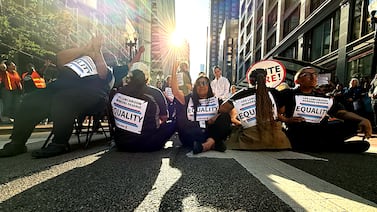
Philadelphia students and community members want to know how schools will prevent fights, bullying, and other conflicts that could stem from the district’s proposal to close 18 schools.
Experts say there are ways to prevent such violence — if planning begins now.
People have brought up safety at many of the roughly 40 community meetings the school district has hosted at schools that would close beginning in 2027. Usually it’s parents and students at smaller, specialized schools who would be moved into bigger neighborhood high schools with violent reputations.
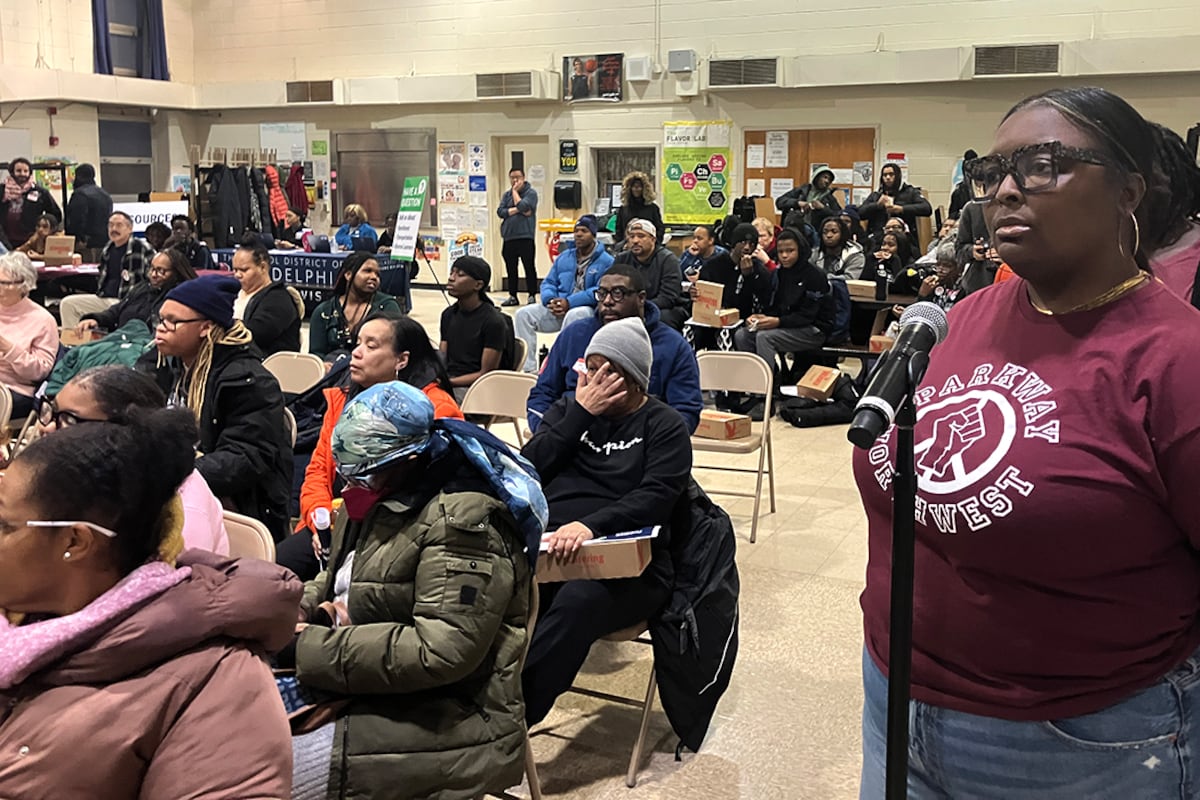
April Anderson voiced concern at a February community meeting about plans to close Parkway Northwest High School, which her child attends, and move those students to Martin Luther King High School, which is about a half-mile away and happens to be Anderson’s own alma mater.
“There are fights at King,” she said. “If you put kids from Parkway in King you don’t think that’s going to start issues?”
Several Parkway Northwest students who attended the meeting echoed that sentiment, including freshman Dane McFarland, who runs on MLK’s track and said he gets bullied there.
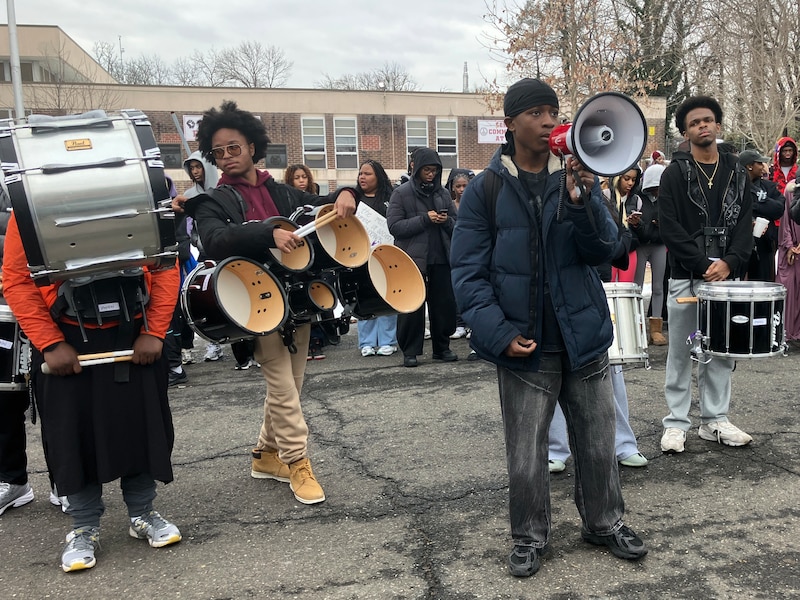
A rough reputation can stick with a school, even when data about student conflicts doesn’t tell a simple story. MLK High School does have a higher rate of group assaults than Parkway or Building 21, another school that would also merge into MLK under the district’s closure plan.
But Parkway has higher rates of fights between students, according to the district’s data on serious incidents from 2021 to 2025.
At a City Council hearing about the closures on Feb. 17, Council President Kenyatta Johnson asked district Superintendent Tony Watlington to ensure “that we have a game plan to make sure our young people are safe.”
Watlington answered by pointing to Safe Path, which stations trained adults around the perimeters of campuses to break up dismissal-time fighting and escort children home as needed. But that program was delayed at some schools this year, and moreover doesn’t directly address the climate inside buildings.
At a recent school board meeting, the president of the School Police Association of Philadelphia, Bernadette Ambrose-Smith, requested that the district do a safety analysis of the closure plan, due to concerns about students losing “safe havens.”
Officials said every school receiving new students would have a “transition team” but have not specified how those teams would help defuse tensions and prevent violence stemming from closures and displacement.
Asked about the issue, district spokesperson Monique Braxton contended that the district already has adequate resources in place, writing in an email: “We don’t anticipate violence between existing students and incoming students at receiving schools.”
But combining student groups and their social hierarchies means the first few months of mergers and co-locations would be an adjustment for kids, and that schools should “plan ahead for the social aspects of the transition,” said Tracy Waasdorp, director of research, school-based bullying, and social-emotional learning at the Children’s Hospital of Philadelphia’s Center for Violence Prevention.
Waasdorp said that before schools merge or co-locate, one initial step could include gathering school staff, parents, and community members to discuss existing dynamics and tensions.
She also recommends starting with adult-led and supervised summer activities that require kids from different schools to interact, a strategy that she calls a “no-brainer.”
And once the school year starts, administrations should point out to students which adults they can talk to if they are experiencing bullying, conflict, or other stressors, Waasdorp said.
“Some of these children already have been struggling, and they may continue to struggle once they get to this new setting,” she said. “Make sure that whoever that one person is is available and known to the kids, like, ‘I’m the social-emotional person. I’m here for you.’”
Prioritizing the role of trusted adults is also one of several strategies being used by Bartram High School, which until recently was a hot spot for violence, including an average of five students who were shot each school year from 2017 to 2022.
Since implementing a pilot of the Youth Violence Reduction Initiative about three years ago, shootings are down 80% and fights not involving guns are down 31%. It could serve as a strong model for schools confronting mergers under the closure plan to consider, in part because of its focus on gangs.
Students worry about crowded hallways making fights worse
The pilot at Bartram could have been seriously tested by the district’s initial school closure plan.
The district’s original plan, which it released in January, would have closed Motivation High School and relocated its students to Bartram. When he heard the news, Bartram ninth grader Hanaij Fulton was concerned that hallways would become hot spots. He doubted school safety officers would be able to control crowds if more students packed in.
“It’s like nothing they can really do when they fight, because the whole hallway is just full of people,” Fulton said. “They’d have to push past people. People wouldn’t be moving.”
After criticism about the plans for Motivation High, the district scrapped the proposal to merge students there into Bartram. It also nixed plans to close Paul Robeson High School and merge students there into William L. Sayre High School. But other schools will still have to deal with increased student traffic and related concerns if the Board of Education approves the closure plan.
Before the district backtracked, Tenneh Conteh had similar concerns about Sayre High School, where she is a senior.
She said school safety officers there already struggle to maintain order at the metal detectors, where kids try to sneak in vapes and sometimes guns.
“If they can barely handle the students who do come to school, they can’t handle new kids,” she said.
She feels funding related to the closures should be spent on extra security guards and additional training at the receiving schools.
But Waasdorp said neighborhood volunteers, not just extra security staff, can play a helpful role in and around buildings in such situations.
“It’ll be really important for schools to increase adult supervision in unstructured areas as the school year begins,” she said. “It’s showing all of your adults around you care about how you guys get along, and we intend to make sure everyone feels connected.”
How violence plummeted at a Philadelphia high school
The district believes the Youth Violence Reduction Initiative — or YVRI — contributed to an 80% decrease in firearm assaults by students at Bartram. In addition, there have been no shooting deaths and far fewer fights at the school since it began using the initiative in 2023. Shootings also went down citywide at that time.
“Most of the people that was really starting stuff with a lot of people, either they calmed down or they not here no more,” said Jamer Heard, a Bartram senior.
The initiative is designed for students who are part of, or are at risk of being part of, group-on-group violence. In addition to building relationships with trusted adults, it relies on a combination of conflict deescalation strategies and cross-agency collaboration.
Since the program started, there’s been a 67% drop in student-on-staff assaults, a 62% decrease in incidents involving police, and a 92% decrease in gang-involved group assaults at Bartram High.
Such declines were “much larger than we expected,” said Dr. Brandy Blasko, a senior research associate in the Office of School Safety. “We’re seeing that the model we chose is actually working.”
Caterina Roman, a criminologist at Temple University who helped design the initiative, said the program could “be perfect for” mitigating violence at high schools that are receiving new students after the closures.
“Because YVRI was designed on the principles of the Comprehensive Anti-Gang Model, prevention gets built right in,” she said in an e-mail.
The district recently expanded the program to Olney High School.
The Bartram program is currently funded by a $1 million grant from the federal Office of Juvenile Justice and Delinquency Prevention that will expire this year. When that funding is up, administrators plan to ask Pennsylvania for additional support.
“I think given the success of the program, we’ll figure it out,” Blasko said.
Carly Sitrin and Rebecca Redelmeier contributed reporting.
This story is part of a collaboration between Chalkbeat Philadelphia and The New York Times’s Headway Initiative, supported by the Stavros Niarchos Foundation (SNF) via the Local Media Foundation.
Sammy Caiola covers solutions to gun violence in and around Philadelphia schools. Have ideas for her? Get in touch at scaiola@chalkbeat.org.