Sign up for Chalkbeat Philadelphia’s free newsletter to keep up with the city’s public school system.
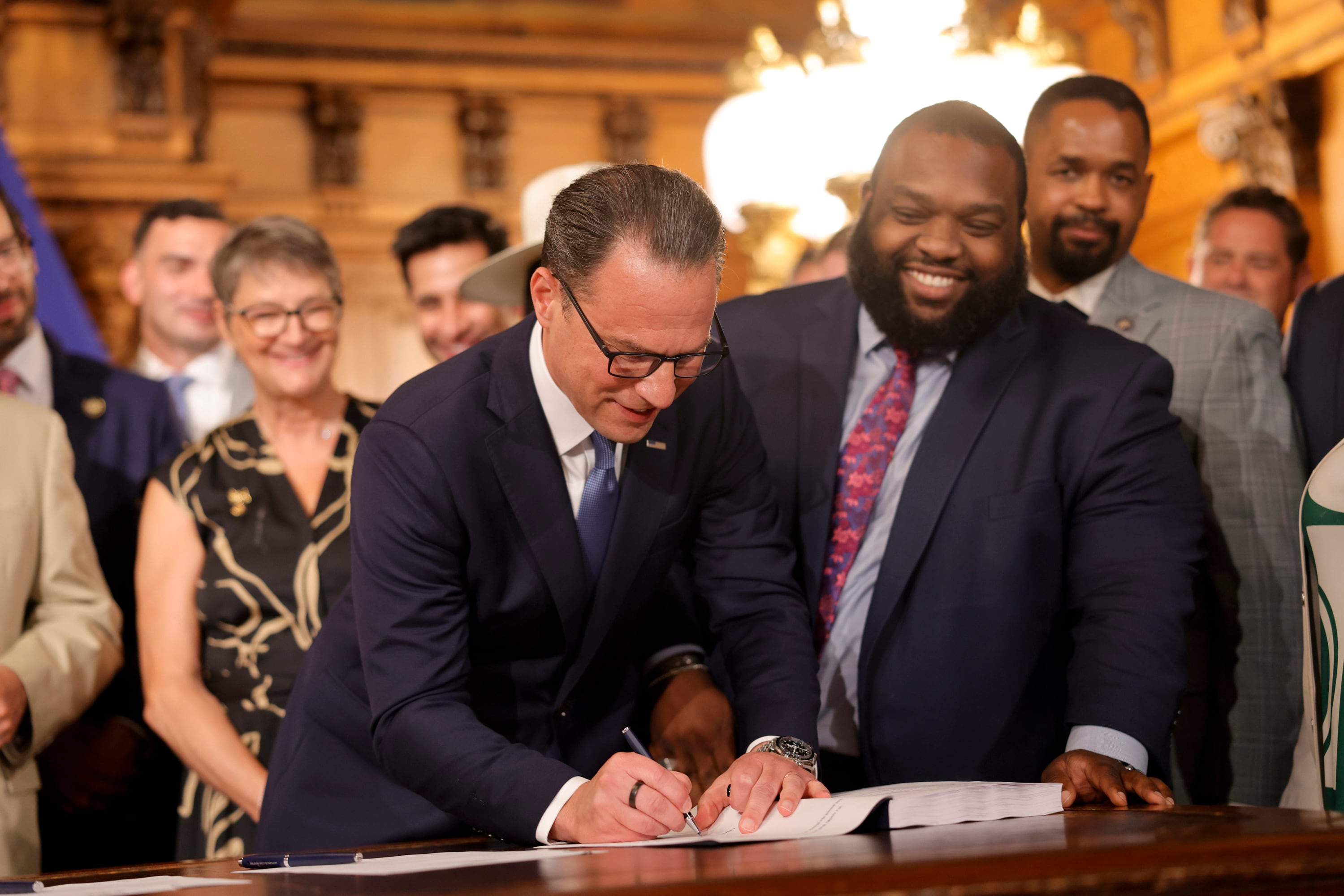
Pennsylvania school districts will receive $11.8 billion next year in the state budget Gov. Josh Shapiro signed over the weekend, a $670 million increase from last year.
The $50.8 billion budget includes an infusion of money for career training programs and special education, along with more funding for teacher training stipends and additional requirements for cyber charter schools to monitor students’ wellbeing.
But the budget, which often includes major education legislation, does not have the school cellphone ban Shapiro wanted, and less money for early childhood education than the governor sought.
The budget puts $157 million more towards Philadelphia’s schools, the state’s largest district.
In response to a 2023 court ruling that found the state’s school funding system was unconstitutional, the budget provides a $565 million increase to districts in what’s commonly known as “adequacy funding.” It also puts $58 million more towards basic education funding and $47 million more towards special education funding.
While the overall budget is some $2 billion less than Shapiro had proposed, the final amounts for education are greater than what he initially put forward.
“To me, a quality education doesn’t just require dollars and cents, it also requires common sense,” Shapiro said during his budget address Sunday. He said that’s why he pushed to require schools to give all K-5 students 30 minutes of recess each day, a mandate that’s in the budget. Philly schools guaranteed daily recess for all district students back in February.
Mai Miksic, executive director of the Pennsylvania-based advocacy group Children First, said in a statement the budget will help schools “maintain and build on the academic progress made possible by increased adequacy funds.”
But she was disappointed that the budget “did not go far enough to support early learning.” Shapiro had initially proposed a $10 million increase to a program meant to recruit and retain childcare workers, and a $7.5 million increase to the state’s free pre-Kindergarten program, Pre-K Counts. But the final budget only included half those increases.
Laura Boyce, the Pennsylvania executive director of the advocacy group Teach Plus, said the boost to adequacy funding and teacher stipends was “something to celebrate.”
But she had hoped the budget would increase early literacy funding rather than hold it steady at $10 million. That’s a “good down payment,” Boyce said, but “not close to what we will ultimately need” to help schools meet the literacy requirements slated to kick in during the 2027-28 school year, like implementing professional development and screenings.
Over the past two years, Philadelphia students’ English language arts and literature test scores have fallen. Around one-third of students in grades 3-8 scored proficient or above in ELA on the most recent state assessments.
Some conservatives were hoping the budget would include more investment in the state’s existing school choice tax credit programs, while the deadline looms for Shapiro to say whether Pennsylvania will opt into the federal tax credit program. “Unfortunately, the budget deal does not meaningfully expand educational choice,” said Nathan Benefield, chief policy officer at the Commonwealth Foundation, a conservative think tank.
The Philadelphia Federation of Teachers President Arthur Steinberg said in a statement that he was disappointed the budget bill did not include a statewide cellphone ban. But he welcomed the additional overall funding for schools.
“We are, as ever, impatient for a faster schedule to close the adequacy gap between wealthy and non-wealthy districts once and for all,” Steinberg said.
Pennsylvania boosts funding for career training, student teachers
This year’s budget includes a $10 million increase for career and technical education programs as part of a $193 million total annual investment in workforce development. It also slightly changes testing requirements for those programs by allowing career training centers to administer the competency exams before students are in 12th grade, and therefore help them complete the programs.
Rep. Peter Schweyer, a Democrat and chair of the House Education Committee, applauded the changes, saying they would enable programs to enroll more students.
The budget also puts $10 million more towards the popular student-teacher stipend program, for a total of $40 million. The program has been oversubscribed in past years.
The increase means some 700 more student teachers and their cooperating teachers will receive stipends next year, according to a statement from the Pennsylvania State Education Association.
The budget also increased funding to the state’s childcare staff retention and recruitment program by $5 million for a total of $30 million.
Budget directs $120 million to K-12 mental health, safety
This year’s budget also includes $120 million for mental health and school safety improvements in K-12 schools. Last year, Shapiro’s administration approved the same amount for this category for school security updates, security personnel training, and mental health resources such as calming spaces inside schools.
Organizations that help prevent gun violence in Philadelphia and statewide will get $62.2 million from the new state budget, a similar amount to what was allocated last year. Violence prevention advocacy groups hailed the move, especially since those and similar efforts face threats on the federal level.
Last year, this funding also supported out-of-school-time activities that help children stay connected to trusted adults and reduce the risk of being exposed to violence.
The Shapiro administration credits the investment for a 35% decrease in homicides and a 40% decrease in firearm-related crimes statewide, according to Uniform Crime Reporting data cited on the state’s website.
Rebecca Redelmeier is a reporter at Chalkbeat Philadelphia. She writes about public schools, early childhood education, and issues that affect students, families, and educators across Philadelphia. Contact Rebecca at rredelmeier@chalkbeat.org.
Sammy Caiola covers solutions to gun violence in and around Philadelphia schools. Have ideas for her? Get in touch at scaiola@chalkbeat.org.
Carly Sitrin is the bureau chief for Chalkbeat Philadelphia. Contact Carly at csitrin@chalkbeat.org.