Sign up for Chalkbeat’s free weekly newsletter to keep up with how education is changing across the U.S.
The future of special education remains up in the air, but the Trump administration is feeling pressure to assuage the concerns of parents of students with disabilities that efforts to dismantle the U.S. Department of Education could put their children at risk.
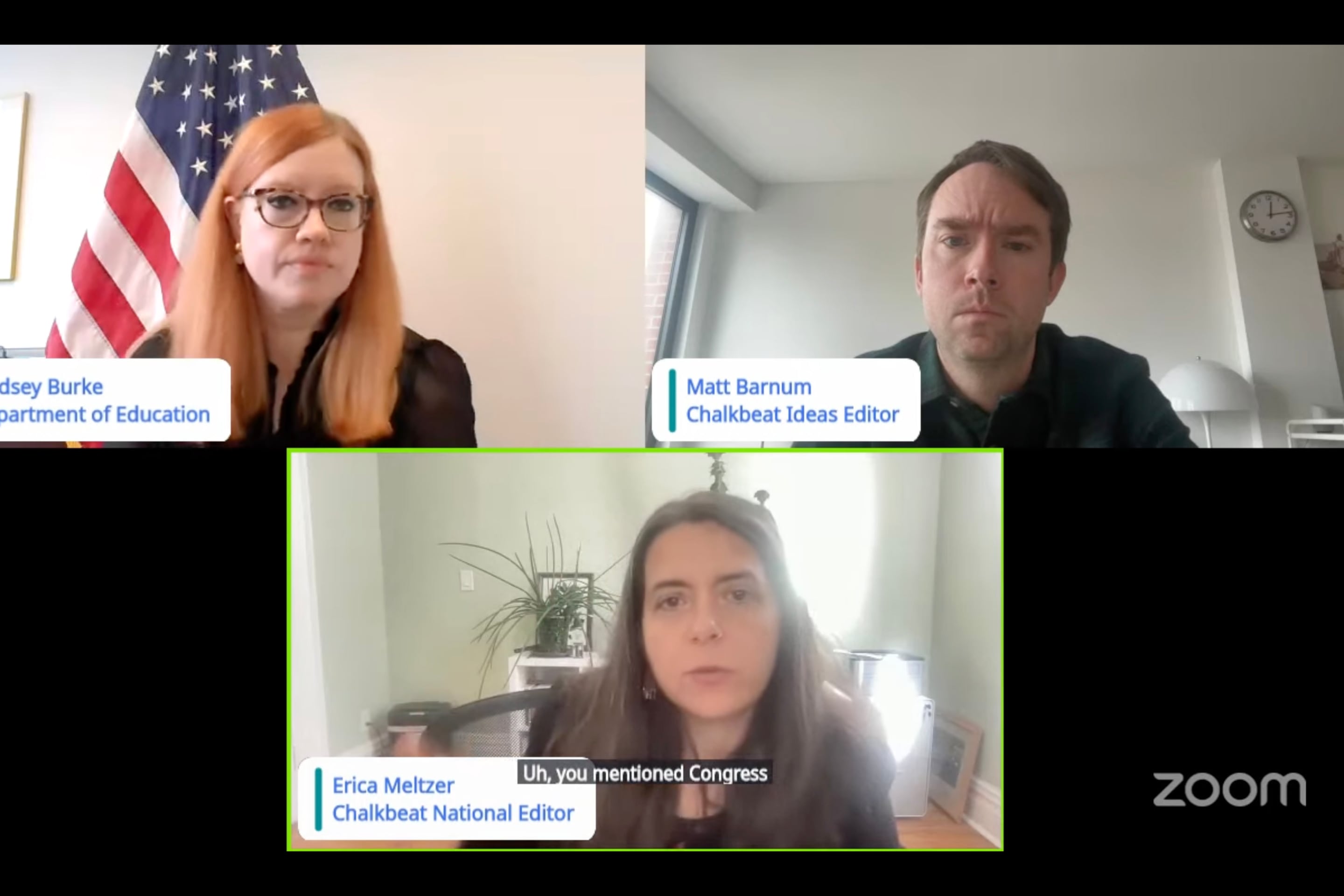
That was one of the key takeaways from Chalkbeat’s conversation with Lindsey Burke, a Department of Education official and author of the education chapter of the conservative blueprint Project 2025.
Burke, though, said that some of Project 2025’s most controversial ideas, including deep budget cuts to schools, aren’t currently on the table. She also said there’s “no reason to anticipate” funding freezes similar to the temporary withholding of $7 billion that threw school districts into chaos last summer.
But the Education Department is just one “decision point” on federal spending, and the department remains committed to ending grants it deems wasteful or not aligned with their priorities, Burke said. In her confirmation hearing, Secretary of Education Linda McMahon indicated the department would not cut funding to schools, but is currently seeking cuts to a number of programs and has already cancelled $2 billion in funds, according to Burke.
A year in, the Trump administration has surprised many observers with its far-reaching efforts to close the Department of Education, often a conservative hope but rarely a presidential priority. Late last year, the administration moved a number of education programs to the Labor Department. These efforts face ongoing legal challenges and sharp criticism from congressional Democrats.
The administration has also invited state leaders to seek waivers from federal requirements. It recently approved a waiver in Iowa, though the changes were relatively modest. At the same time, Trump’s Education Department has aggressively used its civil rights arm to target left-leaning education policies related to race and gender.
Burke, the department’s deputy chief of staff for policy and programs, acknowledged that the administration’s efforts to move education functions to the Labor Department might seem like a “blunt instrument.” Ensuring that education supports the development of a strong workforce is an important federal role, she said, but it’s not the only purpose of education.
“Education really is about forming human souls,” Burke said in response to an audience question, “and about really preparing individuals, preparing students to inherit the blessings and liberties of a free society.”
Here are some of the most interesting things we heard in our conversation with Burke.
The administration wants parents of students with disabilities not to worry
The administration has no plans to cut federal funding for special education and may even increase spending, Burke said.
“Fully funding IDEA has been of interest to many people on both sides of the aisle over the decades,” Burke said.
Burke said she didn’t want to preempt budget negotiations, but the administration plans to fund IDEA at “the current levels that are out there now, and potentially additional support moving forward.” She strongly disavowed the idea of cuts: “There is no world in which anybody’s talking about any reductions in support for IDEA.”
The federal government provides about $15 billion a year to help districts cover special education costs. Under the 50-year-old Individuals with Disabilities Education Act, or IDEA, school districts are required to educate all students, regardless of disability, but the federal government has never lived up to its obligation to pay 40% of the cost. Trump’s most recent budget proposal called for flat funding for IDEA.
Money is just one concern for advocates for students with disabilities, who also oppose any plan to move oversight out of the Education Department. The administration’s reorganization push has not affected special education yet — though most of the staff who work on special education were fired during the government shutdown only to be brought back later in response to a lawsuit.
“We are still evaluating the future of things like special education programs,” Burke said. “We do not have an answer yet.”
Regardless of what happens, current protections for students will remain in place, she said.
Burke tacks away from some controversial Project 2025 ideas
Burke said there are no current plans to convert federal special education money into vouchers or to do away with Title I funding that supports schools serving low-income communities. Both those ideas appear in Project 2025, a flashpoint for critics of the administration.
“I’ve written on many ed policy areas over the years, and that’s not something that we are currently contemplating here at the agency,” she said of converting IDEA dollars into education savings accounts. “And of course, anything like that is something that would have to go through Congress.”
And asked whether, in her ideal world, Title I would be phased out, Burke said “no.”
That money currently provides about $18 billion in Title I money that funds extended school days, teacher training, reading tutoring and more.
“Speaking on behalf of the department, what our priority is right now is making sure that these grants are serving families well,” she said.
Nor, Burke said, has the administration taken any steps to prevent children who are undocumented immigrants from attending public school at no cost to their parents. Back in 2024, Burke was the co-author of a separate Heritage Foundation memo that proposed that states charge immigrant parents tuition — a step that would set up a challenge to the landmark Plyler v. Doe Supreme Court decision.
Burke is still hoping to persuade Congress to fully dismantle the department
Congress created the Education Department and Congress would need to approve its elimination. Burke acknowledged as much, and said the hope is that the administration can provide “proof of concept” by moving key functions to other agencies.
“Congress does have to codify this,” she said. “And so we’re hoping they look at what has transpired so far and see that it’s been effective.”
Yet Burke did not point to any concrete engagement with Congress and demurred when asked to name any Democrats who supported the effort. Some bipartisan support would be needed to overcome a Senate filibuster.
The administration has leveraged robust interpretations of executive authority to go around Congress. Litigation about the department remains pending, but the U.S. Supreme Court allowed initial cutbacks at the Education Department to move forward.
It’s unclear if department officials will follow recommendations to re-envision its research arm
Last year, the department temporarily brought on Thomas B. Fordham Institute Senior Vice President for research Amber Northern to help reimagine the department’s research arm, known as the Institute for Education Sciences. IES was decimated by early cuts from DOGE.
Northern, who has returned to her prior role at Fordham, recently delivered the recommendations to department officials, Burke indicated.
Burke said there have not been any decisions made on the future of IES. She also would not say what the recommendations were or whether Northern’s report would be publicly released. Burke did praise Northern’s work and the value of IES generally. It’s “the gem in the crown” of the Department, Burke said. Northern declined to comment.
Watch the full event here or in the recording below.
National editor Erica Meltzer covers education policy and politics and oversees Chalkbeat Colorado’s education coverage. Contact Erica at emeltzer@chalkbeat.org.
Matt Barnum is Chalkbeat’s ideas editor. Reach him at mbarnum@chalkbeat.org.