Sign up for Chalkbeat’s free weekly newsletter to keep up with how education is changing across the U.S.
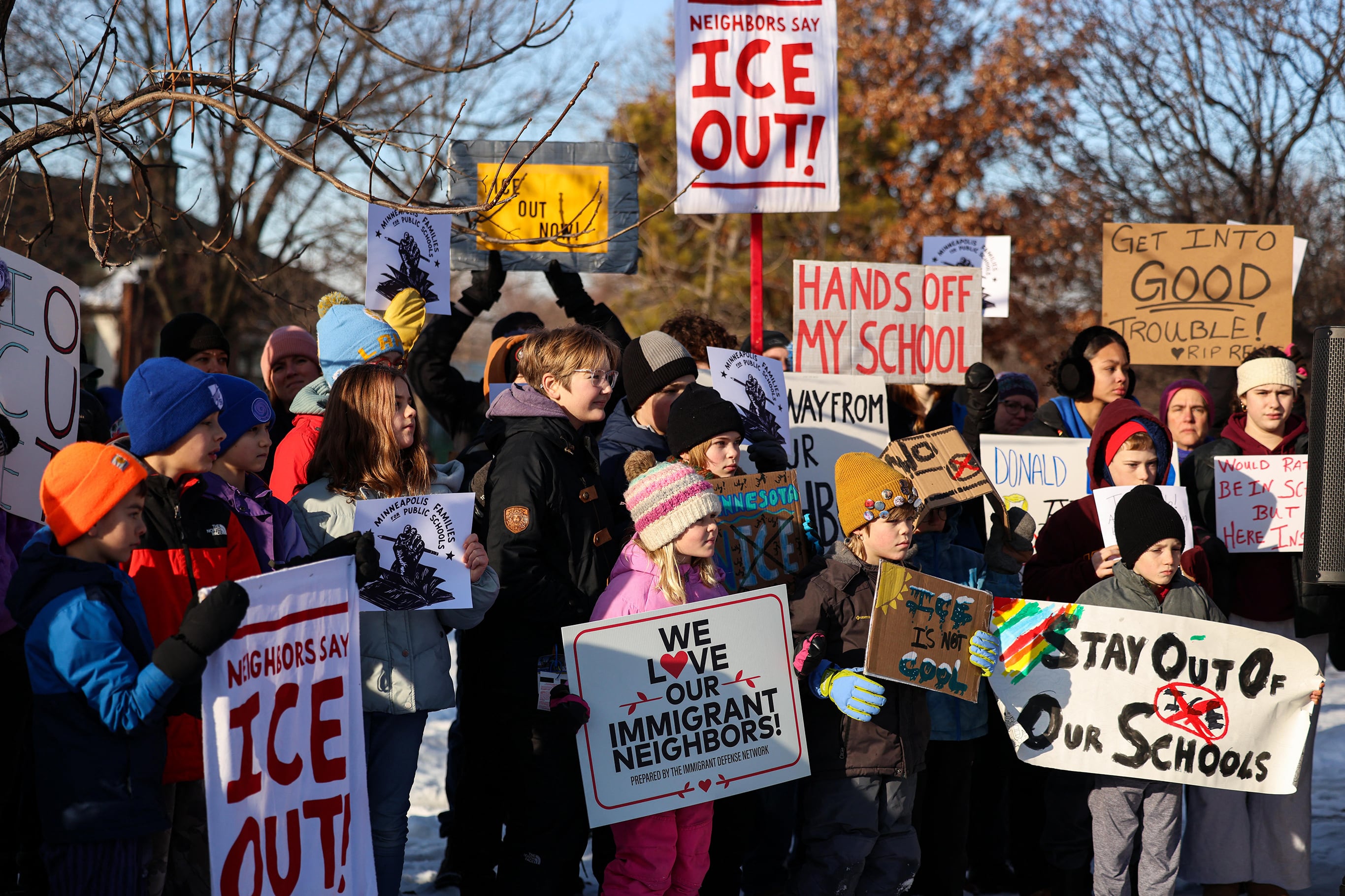
Tear gas fired outside preschools. Parents and children detained on their way to and from school. Federal agents circling schools or parked near bus stops. Parents keeping their children home as absences and learning loss mount.
A growing number of education advocacy groups say aggressive immigration enforcement tactics are having a devastating impact on students’ access to education. They are calling on Congress to make funding for the Department of Homeland Security conditional on a less-disruptive approach to enforcement than what agents from Customs and Border Protection and Immigration and Customs Enforcement have used.
Keri Rodrigues of the National Parents Union, who visited Minneapolis this week, said Congress should condition further DHS funding on the restoration of the sensitive locations policy, which for decades limited immigration enforcement near schools, child care centers, churches, and hospitals.
“You can see ICE circling around elementary schools so they may not actually be physically in the building, but it’s quite clear and it’s sending a very strong message to parents and families that it’s not safe to take your kids to school,” she said.
The Council of the Great City Schools, which represents urban superintendents, said immigration enforcement is being carried out in ways that destabilize entire communities and interfere with schools’ ability to serve students.
“The Council of the Great City Schools calls on federal leaders—including the Trump Administration, Congress, and the courts—to immediately halt actions that endanger children, disrupt schooling, and erode trust in public institutions,” the group said in a statement Wednesday. “Our nation has a responsibility to ensure that policies are carried out in a manner that upholds human rights and dignity, protects children, and preserves schools as places of safety, stability, and opportunity.”
In an interview, executive director Ray Hart said that restoring the sensitive locations policy is important, but city superintendents are also concerned about the widespread fear of arrest that is leading families to keep their children home. He also noted that Congress has previously considered but failed to pass legislation in the past to codify the policy.
Some say the issue is critical enough that it’s worth shutting down the government if that’s what it takes to use the appropriations process to put guardrails around immigration enforcement.
The Senate this week had been expected to approve a bipartisan package of spending bills, including an education spending bill that avoided cuts proposed by the Trump administration. The package already has been approved by the House, which is in recess this week. The spending bills must be approved by midnight Friday to avoid another government shutdown.
But in the aftermath of the killings of Renee Good and Alex Pretti in Minneapolis, Democrats have said they want to separate the Department of Homeland Security funding measure from the other funding bills to require more oversight.
“People are living in fear, which means that many children are not going to school, and children who are going to school are worrying that when they come home something will have happened to their families,” said Amy Loyd, CEO of the advocacy group All4Ed. “Children are going to school and wondering what happened to their classmates. All the things we want kids to be able to do in school to learn and grow are being impacted.”
Having previously served as an Education Department official in the Biden administration, Loyd said she doesn’t take the prospect of a shutdown lightly. But if the current approach to immigration enforcement continues, she said, it endangers all the work to close achievement gaps, raise graduation rates, and ensure students are prepared for life and the workforce.
“All4Ed is taking a stand that if we cannot unbundle the DHS funding, we are in support of a partial shutdown until Congress can best figure out how to address the impacts on our children.”
And First Focus on Children, which advocates for issues related to children’s welfare, called on Congress to protect schools and other sensitive locations and end child detention and separate the DHS funding bill to avoid a shutdown.
Many of the groups weighing in are on the progressive side of the political spectrum, but more often focus their advocacy on parents’ rights, student achievement, and school choice.
The national teachers unions took slightly different tacks. National Education Association President Becky Pringle called for freezing DHS funding. American Federation of Teachers President Randi Weingarten said in an emailed statement that immigration enforcement needs reform “immediately,” including more protections for schools, and urged lawmakers to work together to avoid a shutdown.
The conservative parents’ rights group Defending Education, meanwhile, accused teachers of indoctrinating students to join anti-ICE protests and publicized a list of districts that had adopted sanctuary policies related to protecting immigrant students.
“The materials we uncovered show that students are being offered walkout guides, ‘day of action’ strategies, and training on how to respond to federal agents on school property,” President Nicole Neily said in an email to supporters.
Democrats’ demands, released Wednesday afternoon, include that ICE and Border Patrol agents not wear masks, display identification, and follow more conventional law enforcement practices around use of force, including cooperating with independent investigations.
The provisions as reported by multiple news outlets do not specifically address sensitive locations or enforcement near schools. But they do call for an end to “roving patrols” that have spread fear among legal immigrants, naturalized citizens, and communities of color more broadly.
While some Republicans have also been critical of federal agents’ actions, they still broadly support the president’s immigration crackdown.
Any changes to the spending bills would require that the House vote again, and conservative Republicans closely allied with the president could balk at restrictions on enforcement.
Updated: This story has been updated with comments from the National Education Association and the American Federation of Teachers.
Chalkbeat national reporter Lily Altavena contributed reporting.
Erica Meltzer is Chalkbeat’s national editor covering education policy and politics. Contact Erica at emeltzer@chalkbeat.org.