Chalkbeat Ideas is a new section featuring reported columns on the big ideas and debates shaping American schools. Sign up for the Ideas newsletter to follow our work.
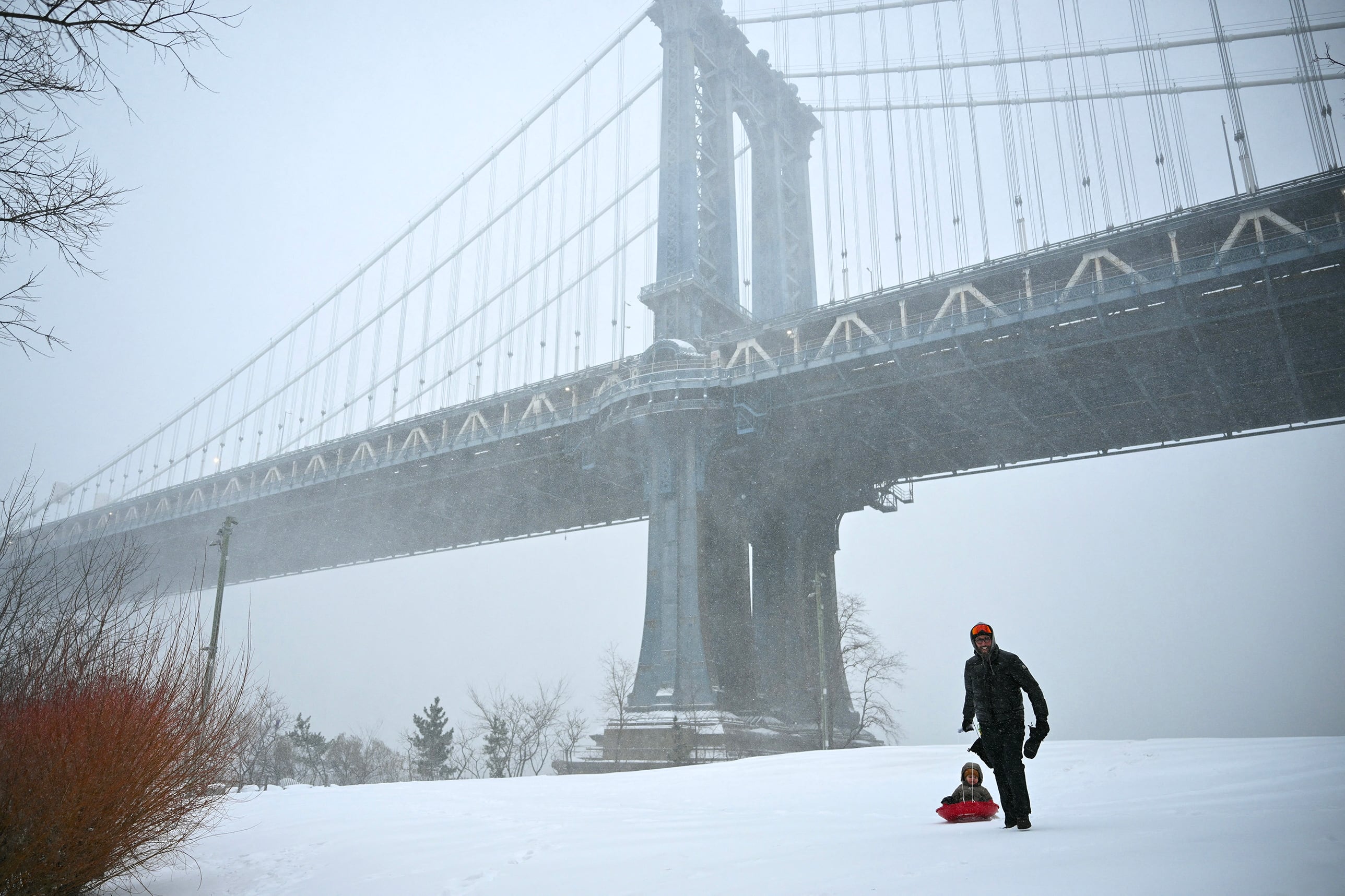
In New York City, and some other parts of the country, snow days are turning into a relic of the past. As snow buried New York over the weekend, the country’s largest school system shifted to remote learning on Monday rather than calling off school altogether.
Kate Gutwillig, a fifth grade teacher at P.S. 134 in Manhattan, said about 70% of her students showed up for virtual instruction. It proved challenging to quickly pivot to remote learning.
“You can’t teach these kids all these social norms on Zoom today,” she said. About half the students who logged in to her virtual classroom kept their cameras off. Gutwillig noted it has been years since the pandemic, when students were consistently on Zoom for school.
She largely did not cover new material since attendance was lower than usual. Instead, Gutwillig made time for her students to read independently, then delivered brief review lessons on how to write a conclusion to a literary essay and how to find the area of a rectangle with fractions. All things considered, she said, the day went well.
Research suggests that Gutwillig’s decision not to cover new topics was a wise one. A major 2014 study found that a small number of snow days did not have any noticeable effect on test scores. On the other hand, keeping schools open on snowy days when attendance was low did seem to harm learning.
This research points to the limits of replacing snow days with virtual instruction. At worst, doing so could backfire if teachers spend time covering new material when student engagement is low, as was the case in New York City. At best, it might be an opportunity for teachers to review prior topics, but not move forward with regular instruction.
The New York City Department of Education gave schools discretion over how to approach remote instruction, including introducing new content or focusing on review, according to teachers and principals. A spokesperson for the district said that teachers “thoughtfully adjusted content to meet the needs of their students in a remote environment.”
To study the effects of snow days, Joshua Goodman, now a professor at Boston University, examined a rich set of data on weather, attendance, and test scores in Massachusetts from 2003 to 2010.
Goodman compared test scores in years where there was more or less snow. A year with lots of heavy snow (days with more than 10 inches) had no effect. Yet math scores were lower in years with more days of moderate (4-10 inches) snow.
These counterintuitive results can be explained by how schools responded to different levels of snow. Heavy snow meant more snow days. Moderate snow meant more days when schools stayed open but attendance was sharply down, particularly among low-income students.
In other words, snow days did not seem to set students back much; missing regular school days due to snowy conditions did.
The takeaway is not that schools can close indefinitely without consequence, and Goodman did find some small negative effects of closures for high-poverty schools. But the study suggests that a few snow days won’t be terribly harmful because teachers figure out ways to adapt.
Yet when schools are open and a big chunk of students are missing, teachers are in a tough spot. Some may continue teaching new material, and then try to help students who missed the original lesson catch up. This creates a dual challenge, though: The makeup work isn’t quite as effective, and teachers’ time and energy is diverted from moving everyone else forward.
“Snow days, maybe surprisingly, are less disruptive than other forms of lost instructional time,” said Goodman. “Coordinating everyone being absent at once is actually easier to deal with than the messiness of other kinds of lost instructional time.”
Other studies have broadly backed up these findings. Individual student absences affect achievement more than schoolwide calendar changes. Some research has found that students also learn less when their peers are frequently absent, perhaps because that makes whole-class teaching less effective. (This could help explain some of America’s current achievement challenges at a moment when student absences have spiked.)
Although there doesn’t appear to be much or any research on the relatively new phenomenon of virtual snow days, the pandemic showed that remote learning was challenging for many students.
In New York City, parents, teachers, and students also reported technical glitches and disengagement on Monday. About 1 in 5 students didn’t sign on for virtual instruction at all. (Attendance was similarly low on Tuesday when schools reopened.) Manhattan mom Tiffany Rodriguez-Noel elected not to log her kindergarten twins on for remote learning due to their hyperactivity and speech delays.
“I wish they could just let a snow day be a snow day,” Rodriguez-Noel said. But she noted the experience was relatively smooth for her sixth grade son and she understands the desire to avoid missing an entire day of instruction.
With engagement and attendance sporadic, the research suggests that teachers shouldn’t feel bad about focusing on review during virtual learning days. This also offers guidance to state policymakers as they consider what should count toward instructional-day minimums. Virtual school days may be an opportunity to help a subset of students review old material, but they’re unlikely to move instruction forward in many cases.
Matt Barnum is Chalkbeat’s ideas editor. Reach him at mbarnum@chalkbeat.org.
Alex Zimmerman is a reporter for Chalkbeat New York, covering NYC public schools. Contact Alex at azimmerman@chalkbeat.org.