Sign up for Chalkbeat Chicago’s free daily newsletter to keep up with the latest news on Chicago Public Schools.
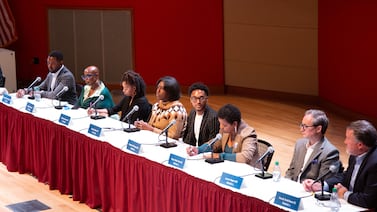
The Illinois State Board of Education is holding the first of three budget hearings on Tuesday to find out what educators, school leaders, advocates, parents, and students think the state board should ask lawmakers to fund for fiscal year 2027, which will cover the 2026-27 school year.
The hearing will take place in Springfield at 4 p.m. and two additional hearings will be held virtually on Oct. 16 from 1 p.m. to 4 p.m and Oct. 21 from 4 p.m. to 7 p.m. Written testimony can also be submitted online.
Illinois has increased spending on education by $2.8 billion since 2017 when lawmakers overhauled the formula it uses to distribute money to school districts.
Last fiscal year, the General Assembly allocated almost $11.2 billion to education out of the state’s overall $55.1 billion budget. The education budget included an additional $307 million to the evidence-based funding formula for K-12 schools, slightly less than previous year increases of $350 million. Illinois education officials said the state paused a roughly $50 million Property Tax Relief Grant program that school districts apply for to receive assistance from the state.
Education advocates have requested that the state increase K-12 spending by $550 million per year in order to more quickly get every district to adequate funding, by the formula’s definition. Currently, 222 of Illinois’ 866 districts are considered adequately funded, according to a budget presentation by the state board.
In recent months, the federal government has threatened to withhold funds from school districts, and in Chicago’s case, officials have already done so. Last week, the Trump administration said it would hold back $5.8 million this year from Chicago Public Schools for the Magnet School Assistance Program and would not award $17.5 million for the remainder of the grant award. Chicago Public Schools said the move created an $8 million hole in the current school year’s budget.
In an effort to ease the strain of the Trump administration’s economic policies, Gov. JB Pritzker signed an executive order earlier this month requiring state agencies to identify 4% of state funding provided under the fiscal year 2026 budget that could be put into reserve, according to a press release. The statement noted that the K-12 funding will not be impacted.
In previous years, the state board made a recommendation for the next fiscal year before the end of January, right before the governor’s annual budget address. Usually, Pritzker’s State of the State address, which lays out his budget and legislative priorities for the spring legislative session, takes place in February.
Samantha Smylie is the state education reporter for Chalkbeat Chicago covering school districts across the state, legislation, special education and the state board of education. Contact Samantha at ssmylie@chalkbeat.org.