Did you know search engines like Google are changing the way you see news? Keep Chalkbeat’s valuable education coverage at the top of your feeds by clicking here and checking the box next to our name.
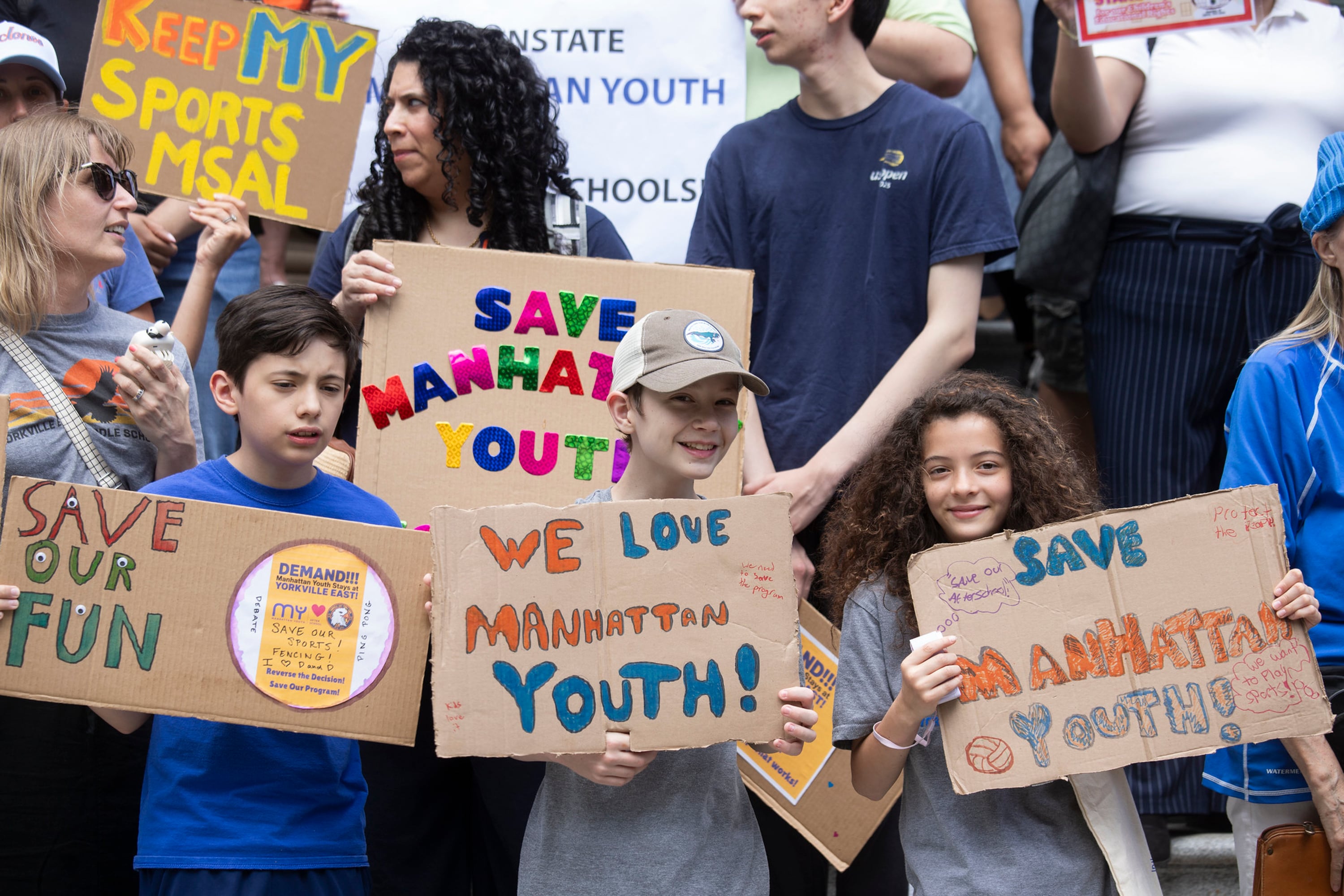
Parents at several schools across New York City last spring were outraged when they lost beloved after-school providers in a contract overhaul overseen by the Department of Youth and Community Development.
Many families asked: Why mess with programs their communities liked? Parents rallied, wrote letters, and submitted petitions to keep the after-school programs they had come to rely on. Those efforts went nowhere.
Now, some parents say their warnings have come to bear, as some of the new after-school programs have struggled to hire staff and get off the ground several weeks into the school year, leaving parents exasperated and children with few options when the school day ends.
The situation was so bad at two Upper West Side middle schools that their new provider, the YMCA of Greater New York, is already out less than a month into the school year, and their longtime partner, Manhattan Youth, is returning on Oct. 19 to relaunch their sports, musical theater, and arts programs, Chalkbeat has learned. District 3 Superintendent Reginald Higgins wrote this week to families at the Computer School and West End Secondary School, both on the Upper West Side, letting them know that the YMCA was withdrawing its program.
City officials said that YMCA-run programs elsewhere were operating at full capacity this week with support from school staffers to plug gaps overseeing teams and other activities.
“Our priority is making sure young people are served, families have clear information, and these school communities have strong, stable after-school programs. It is what families deserve and what we will deliver,” said Mark Zustovich, spokesperson for the Department of Youth and Community Development.
A first after-school overhaul in years
It was the first time in years the city re-bid contracts for community-based organizations providing after-school programs for more than 100,000 elementary and middle school students. The new contracts, which run through 2032, in some cases pushed out providers who had been working with schools for more than a decade.
By re-bidding the contracts, city officials said it allowed them to add 10,000 seats and update providers’ pay rates, which now come out to around $4,000 to $7,000 per student depending on age, city officials and providers have said.
Principals were asked to rank their top three choices, but several schools said they were not awarded their top choices.
In some cases, the changes seemed like a game of musical chairs. Last school year, the YMCA operated 33 city-funded after-school sites, representatives from the organization said. In the contract overhaul, it lost 13 of those sites but gained 15 new ones — two of which the organization is dropping. So in total, it will now operate 32 sites.
“We were asked to provide comprehensive, multi-faceted programs that included leadership development, academic supports, arts, sports and more – not a singular competitive sports program or a musical theater program, but a comprehensive program,” Matt Ferraguto, a spokesperson for the YMCA of Greater New York, said in an email. “That is what we will continue to provide at all of our afterschool sites across all 5 boroughs.”
Staffing shortages and disrupted communities
Michael Kimmel, a parent of a seventh grader at Yorkville East Middle School on the Upper East Side, remains frustrated by his school’s switch to the YMCA from Manhattan Youth, whose sports league offerings have been a particular draw for many families at its various schools. But more than acting as coaches, Manhattan Youth staffers also served as school aides during the school day and were “woven into the community,” Kimmel said.
“I watched these people help to parent my kid in a very thoughtful and caring manner,” Kimmel said.
As of this week, YMCA had still failed to fully staff Yorkville East’s program, Kimmel said, noting that about 70% of his school’s roughly 250 students used the after-school program last year.
Meanwhile, he added, the school’s principal stepped in to coach the school’s soccer team, and she’s paying for additional staff with a grant that runs out mid-October. (The principal declined to respond to questions, referring them to the Education Department’s press office, which directed questions to DYCD.)
Kimmel claimed that the YMCA tried to hire the site director who had worked at the school under Manhattan Youth, but they offered her less money, so she did not take the job. The YMCA did not comment on that.
Things worked out differently at Wagner Middle School, another Upper East Side school that lost Manhattan Youth. Its new provider, New York Junior Tennis & Learning, was able to retain the woman who had been the director under Manhattan Youth and worked with the school for nearly 10 years.
“She has worked tirelessly this summer to make this transition as seamless as possible for our students and families,” Sharon Abramzon D’Agostino, the school’s parent association president said. But she echoed that it wasn’t easy to staff up the programs for the start of school, “leaving many families to deal with no coverage for their teens, work scheduling conflicts and lots of uncertainty.”
Manhattan Youth now is in 14 middle schools, according to its website — before the two additional programs it was awarded this week. That’s about half of the middle school programs it ran last year, its Executive Director Bob Townley said.
“Parents want their kids to have good programs, and I don’t blame them,” Townley said.
Amy Zimmer is the bureau chief for Chalkbeat New York. Contact Amy at azimmer@chalkbeat.org.