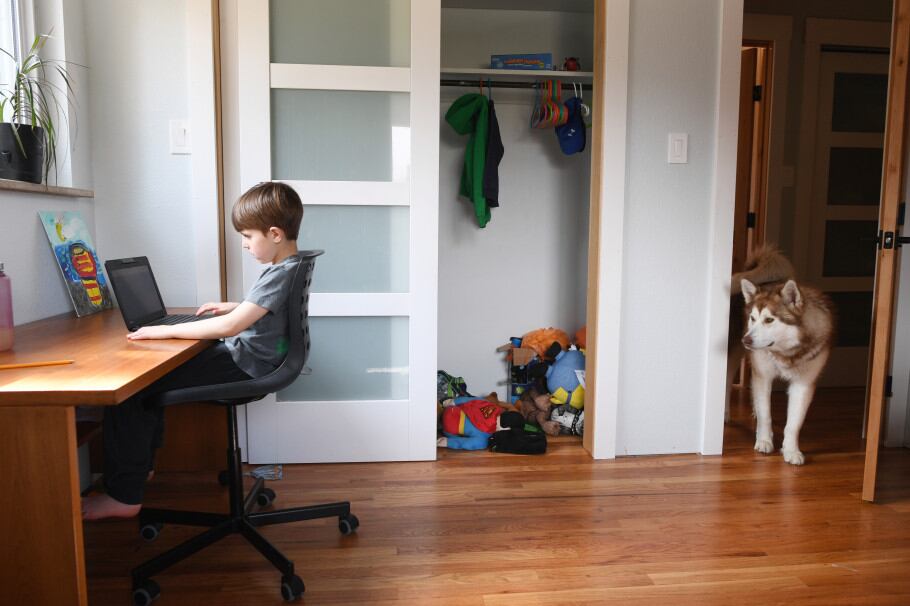
Learning from home is more difficult for families than for students, teachers are connecting with students through assignments more than for social and emotional needs, and students said their biggest challenge is worrying about non-school problems.
Those were just some of the takeaways from a Jeffco Public Schools survey of students, parents, and educators in the first week of April after starting remote learning. Results of the survey, taken from April 3-10, were presented to the Jeffco school board Thursday night.
The results have been used to inform teacher training, school outreach, and now plans for the fall.
Superintendent Jason Glass did not offer details about fall plans Thursday but told the board the district is planning for some in-person instruction as well as remote learning He expects that students may have to move from one form of learning to the other.
Continuing surveys will help the district determine what is working and what is not.
“We should continue this sort of ongoing analysis to see how we’re doing and how we could improve,” Glass said.
On Thursday, officials reminded the board that the survey responses weren’t completely representative of the district. For example, the survey was only provided online, though it was mobile friendly, so could have excluded some families without that access.
Of the parents who responded, just 12% indicated their children qualified for subsidized lunches, a measure of poverty, while the district has about 31% of such students.
In general, most of the respondents had positive things to say about remote learning, and a large majority of families, students and educators said remote learning should continue.
The district has used the survey to reach out immediately to students who indicated that they were struggling and wanted to talk to someone.
Of 11,259 students who responded — most of whom were high school students — 390 or about 4% were flagged after responding that they were struggling and wanted to talk to someone, in response to a question about how they were feeling that week.
District officials sent those names to their respective principals and asked them to reach out.
Dan Cohen, one of the district’s community superintendents, said many principals found that the data validated how they were already tracking students at the school level.
“They were already on track with trying to engage these students who were recorded as really struggling with the remote learning environment,” Cohen said. “They were already working to engage those students.”
In some cases, reaching out to those students required community partners such as law enforcement, Cohen said. The schools have now been in contact with nearly all students.
Schools are tracking contacts with students each week, Glass said, and districtwide engagement is improving.
“Sometimes it’s been a struggle,” Cohen said. “At least they’re able to get kids engaged. Students may not be 100% engaged but at least now we are in contact with that student.”
A second survey, with the same questions, closed Sunday and district officials are analyzing that data to see how it compares with the first wave of results. In the next batch of data, officials will also break down responses by demographic subgroups.
The district initially planned for a third distribution of the survey, but is considering whether or not it is necessary, or if it would need to change.