Access to high-quality schools varies significantly across Colorado, a new report has found, with low-income families and people in rural areas less likely to have a school with high test scores within reasonable driving distance.
The report from Ready Colorado, a conservative education advocacy group that supports school choice, puts numbers to education disparities and aims to give parents another tool to navigate the school-choice process. Many parents are currently in the process of choosing schools for the 2021-22 school year after a year of disrupted learning.
The report found high-quality options in every part of the state, including in rural communities and in low-income ZIP codes. However, families living in high-income ZIP codes are seven times as likely to have excellent access to a top high school than families living in low-income ZIP codes and four times as likely to have excellent access to high-quality elementary schools, according to Ready Colorado’s analysis.
The group considers schools in the top 20% of the state’s school performance framework, which is largely based on standardized test scores, as “high-quality.” The analysis couples that information with estimated drive times and the likelihood that schools would have open seats to generate an access score between 1 and 5.
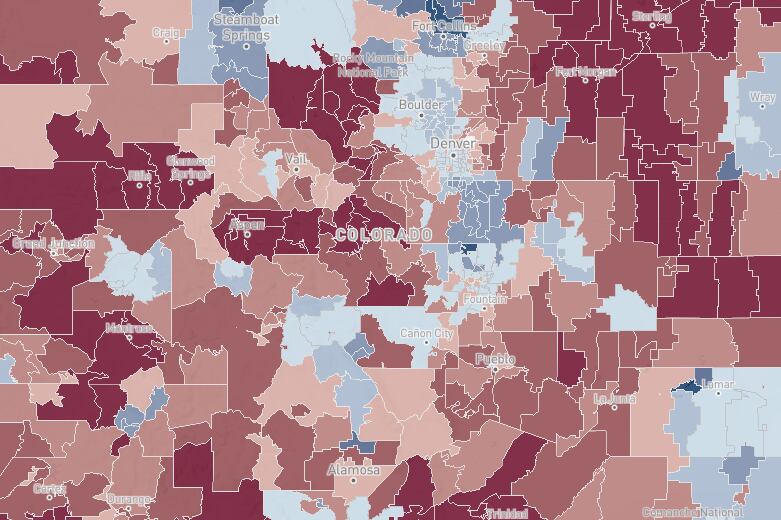
The analysis includes an interactive map showing users highly rated schools in their area and how long it would take to get there. Parents can search by grade level as well, with some areas having good access to high-quality elementary schools but poor access to high-quality high schools or vice versa.
“Citizens in the state of Colorado do not have equitable access to the state’s top schools,” Ready Colorado President Luke Ragland said in an interview. “I hope people see this checkerboard map and understand that we have a lot of work to do.”
Ragland called the correlation between income and high-quality school access “shocking.”
There is also a strong correlation between income and the standardized test scores on which Colorado school ratings rely, though the state rating also considers a “growth score” that measures how much progress students make compared to their peers, not just their absolute score on the test. Many experts consider growth scores a better reflection of the work schools do.
Ragland acknowledged that test scores are not the only factor determining school quality but said that academic outcomes are an important consideration.
“We know that low-income ZIP codes can have good schools,” Ragland said. “It drives me crazy when we act like it’s a fait accompli.”
A previous study from Ready Colorado found that transportation remains a barrier for many families who would prefer to send their children to schools outside their neighborhoods or districts. Ragland said that drive time is a critical factor for families making school choice decisions, but it’s rarely talked about in education circles. In Ready Colorado’s composite access score, driving time gets 40% of the weight, while likelihood of open seats contributes 60% of the score.
The relationship between geography and access was not as strong as the relationship between income and access. The report found that families in rural Colorado were more likely to have excellent access or poor access to high-quality schools than families in the Denver and Colorado Springs metro areas whose access fell in the middle ranges. But overall, families in small isolated towns fared worse than people in populated areas when it came to accessing a quality education.
The analysis also found that charter schools contributed to better access. In Denver in particular, charter schools accounted for two-thirds of the schools deemed high quality. Statewide, removing charter schools would reduce access to top schools in 18% to 43% of ZIP codes depending on grade level, Ready Colorado found.
Read the full report here.