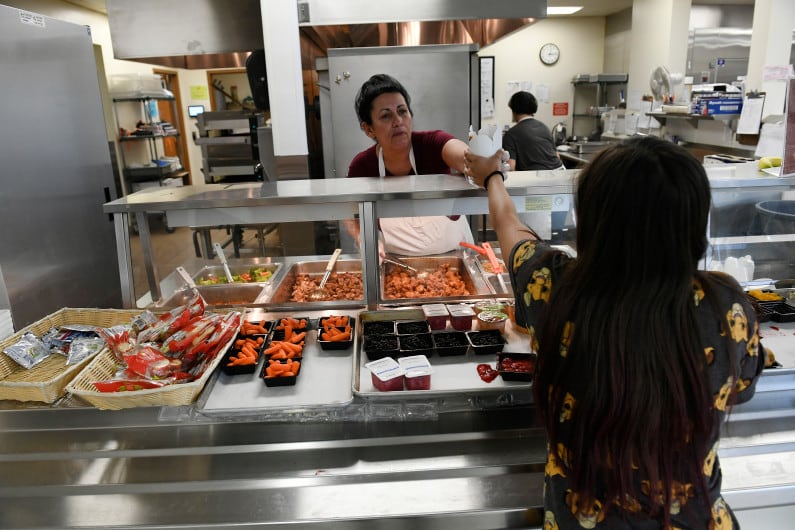
Most Colorado school districts, including the state’s 10 largest, plan to offer free meals to all students next year through a new state program approved by voters last November.
Three large districts — Denver, Douglas County, and Academy 20 — that were undecided in early December have since reported to Chalkbeat that they’ll participate in the program, called Healthy School Meals For All.
The new program, funded with a tax on high earners, will make Colorado one of only a handful of states to offer free school meals to all students, a move advocates say will feed more hungry kids and take away the stigma currently associated with receiving free school meals.
California and Maine both launched permanent universal meal programs this school year and a few other states, including Nevada, Vermont, and Massachusetts, are offering such programs at least till the end of the current school year.
The growing push for free school meals comes after two school years where the federal government waived income eligibility requirements for subsidized meals, allowing schools nationwide to offer free breakfast and lunch to all students for much of the pandemic. Those waivers ended last summer.
While Colorado’s universal meals program is voluntary for school districts, most have reported they’ll opt in. A Chalkbeat survey of two dozen mostly large and medium districts found that 21 plan to participate, and one — Colorado Springs 11 — plans to offer free school meals next year through a different funding mechanism. Two districts, Mesa County Valley 51, based in Grand Junction, and District 49, based in Peyton, remain undecided.
Another recent survey of the state’s 178 school districts by the Colorado School Nutrition Association found that about 130 of around 140 responding districts plan to offer free meals next year.
“Truly, there’s about 10 that have said they were unsure out of all of those,” said Erika Edwards, the association’s public policy and legislative chair. “I do think we are very much moving closer to the vast majority saying yes.”
In November, Colorado voters easily approved Proposition FF, a new tax measure that will raise more than $100 million a year to pay for free school meals by reducing income tax deductions available to households earning $300,000 or more.
To participate in the universal free meals program, Colorado school districts will have to maximize the amount of federal meal dollars they get by applying for a program called Community Eligibility Provision. The national program helps cover the cost of universal free meals at schools with large proportions of students whose families receive certain government benefits such as food assistance or Temporary Assistance to Needy Families. Families at those schools don’t have to fill out applications for free or reduced-price meals.
But even Colorado schools that don’t qualify for the Community Eligibility Provision program will be able to offer free meals to all students by tapping into proceeds from Proposition FF. Families at those schools will still have to fill out applications for subsidized meals.
Edwards said school districts that are undecided about offering free meals next year tend to fall into one of two categories. Smaller rural districts have questions about the logistics of the Community Eligibility program while larger metro districts have questions about how Colorado plans to dole out extra funding for schools with large populations of students from low-income households, she said.
Known as at-risk funding, the money has been distributed based on how many students fill out forms for federal subsidized meals. Colorado is moving toward other measures, but until the change is complete, districts are worried about losing money if fewer families fill out the forms once lunch is free for all students.
Edwards said the nutrition association supports the new program and plans to offer training and other assistance to help districts that want to participate.
“I think it’s the culmination of everything that a school food professional wants to see happen,” she said.
Ann Schimke is a senior reporter at Chalkbeat, covering early childhood issues and early literacy. Contact Ann at aschimke@chalkbeat.org.