When teacher Cindy Haralson would point at her preschool class with a stuffed owl named Baby Echo, most children quickly repeated the letter, word, and sound they’d just heard her say. Think “B, bat, b.”
But one little girl — a good listener and natural problem-solver — stared blankly at her teacher day after day last year, unable to reproduce what she was hearing and seeing. Haralson recalled the girl looking at her classmates, as if to say, “How do you guys do that? How do you know that?”
The girl’s struggle with alphabet lessons was the kind of red flag that can signal problems learning to read, problems that Haralson believes too often go unaddressed for years.
“It seems like we always wait till kindergarten or first grade, and sometimes second grade,” said Haralson, who teaches in the tiny La Veta School District in southern Colorado. “I think we wait too long to figure these things out.”
So Haralson was thrilled when her district joined a regional pilot program last year to screen students in preschool through first grade for signs of dyslexia, a common learning disability that makes it hard to identify speech sounds, decode words, and spell them. Other participating districts include Cotopaxi, Aguilar, Manzanola, Primero, and Huerfano. This year, two more districts — Crowley and Fowler — will join, and participating schools will start screening second-graders as well.
The screening program, which is run by the South Central Board of Cooperative Educational Services, or BOCES, comes amid a yearslong push by Colorado leaders to improve early reading instruction through better curriculum, more teacher training, and timely help for struggling readers. While state lawmakers have stopped short of requiring schools to screen students for dyslexia, more districts are spearheading such efforts on their own, including large ones like Boulder Valley and Denver.
But educators say dyslexia screening is doable in small rural districts, too.
Rachel Arnold, literacy coordinator for the South Central BOCES and the leader of the pilot program, said extending dyslexia screening to all Colorado children is a matter of equity.
“Depending on your area code, ZIP code, where you live, not everyone has access to that,” she said.
Arnold believes the state should mandate and fund dyslexia screening statewide.
Southern Colorado pilot uses new dyslexia screening tool
About 200 children were screened for signs of dyslexia through the BOCES pilot program last year. That number could double as the program expands in 2024-25.
The pilot relies on a relatively new dyslexia screener called EarlyBird that was developed by researchers from Harvard University and the Florida Center for Reading Research. Arnold, who’s using part of an $86,000 state grant to help pay for the two-year pilot, estimates EarlyBird screening costs about $7 per student per year.
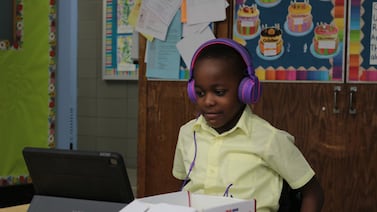
The screener is administered three times a year, with students answering questions on an iPad while a teacher looks on. Typically, each screening takes about an hour, but it’s often administered in 15- to 20-minute chunks over a couple weeks.
Arnold said she was initially leery about an online assessment, but said kids enjoy the game-like format and the cartoon bird that leads them through it. EarlyBird assesses a variety of early reading skills, such as rhyming, vocabulary knowledge, making connections between letters and sounds, and retrieving information quickly and automatically.
While Colorado’s flagship reading law — known as the READ Act — already requires elementary school teachers to evaluate students’ reading skills in kindergarten through third grade, some parents and educators say the assessments used for that can miss students with dyslexia.
“The READ Act has many wonderful things, but it is not dyslexia legislation,” said Arnold.
Holly Massarotti, a kindergarten teacher and elementary dean of students in the Primero district, said the READ Act assessment her district uses — IStation — isn’t as sensitive as EarlyBird in flagging children with signs of dyslexia.
Some kids who were “on the bubble” on the IStation assessment were caught by EarlyBird, she said.
“As we dug deeper into what their data showed, it was evident that they had a problem,” she said.
While dyslexia can interfere with the ability to read and learn for a lifetime, with the right instruction, students can do as well as their peers.
In Haralson’s preschool classroom, 13 students ages 4 and 5 were assessed with EarlyBird. Six were flagged for extra help during short sessions twice a week, including the little girl who’d previously looked confused during alphabet lessons.
She made “astounding progress,” Haralson said. “What a gift to catch it early.”
Screening takes time, but pleases parents
Arnold said the biggest pushback to the dyslexia screening was over the extra time it would take to administer.
Massarotti admitted she was hesitant when Arnold proposed the idea. But her school adjusted the reading assessment schedule, and teachers and aides worked together to administer the screener as efficiently as possible, she said.
“It can be done, and I think the data is worth the challenge that it takes,” she said.
In many cases, parents were notified about the results of the EarlyBird screening at parent-teacher conferences. Often, the results confirmed suspicions families already had that something wasn’t quite right — say, their child wasn’t picking up the ABCs, or couldn’t find the right words to express themselves.
Haralson said parents appreciated seeing the screening results and learning how they could shore up their children’s weak areas with early reading activities at home.
“They were so psyched,” she said. “They thought it was brilliant that we were even looking this early to see if there was any type of issue.”
Ann Schimke is a senior reporter at Chalkbeat, covering early childhood issues and early literacy. Contact Ann at aschimke@chalkbeat.org.