Sign up for our free monthly newsletter Beyond High School to get the latest news about college and career paths for Colorado’s high school grads.
A plan from Colorado’s governor would end Colorado’s higher education department in its current form and create a new agency that would merge the functions of the state’s higher education, labor, and other departments in a bid to strengthen workforce development.
A report commissioned by Democratic Gov. Jared Polis and released Wednesday recommends that Colorado create a new Department of Higher Education and Workforce Development. The department would take over certain programs and responsibilities from seven different state departments with the goal to boost economic development and education beyond high school.
The merger is similar to what several Republican governors have done in their states. The new department would include the higher education department, the state’s workforce development council, the state apprenticeship agency, and adult education. At the federal level, President Donald Trump has moved some functions of the U.S. Department of Education dealing with career and technical education and K-12 to the U.S. Department of Labor.
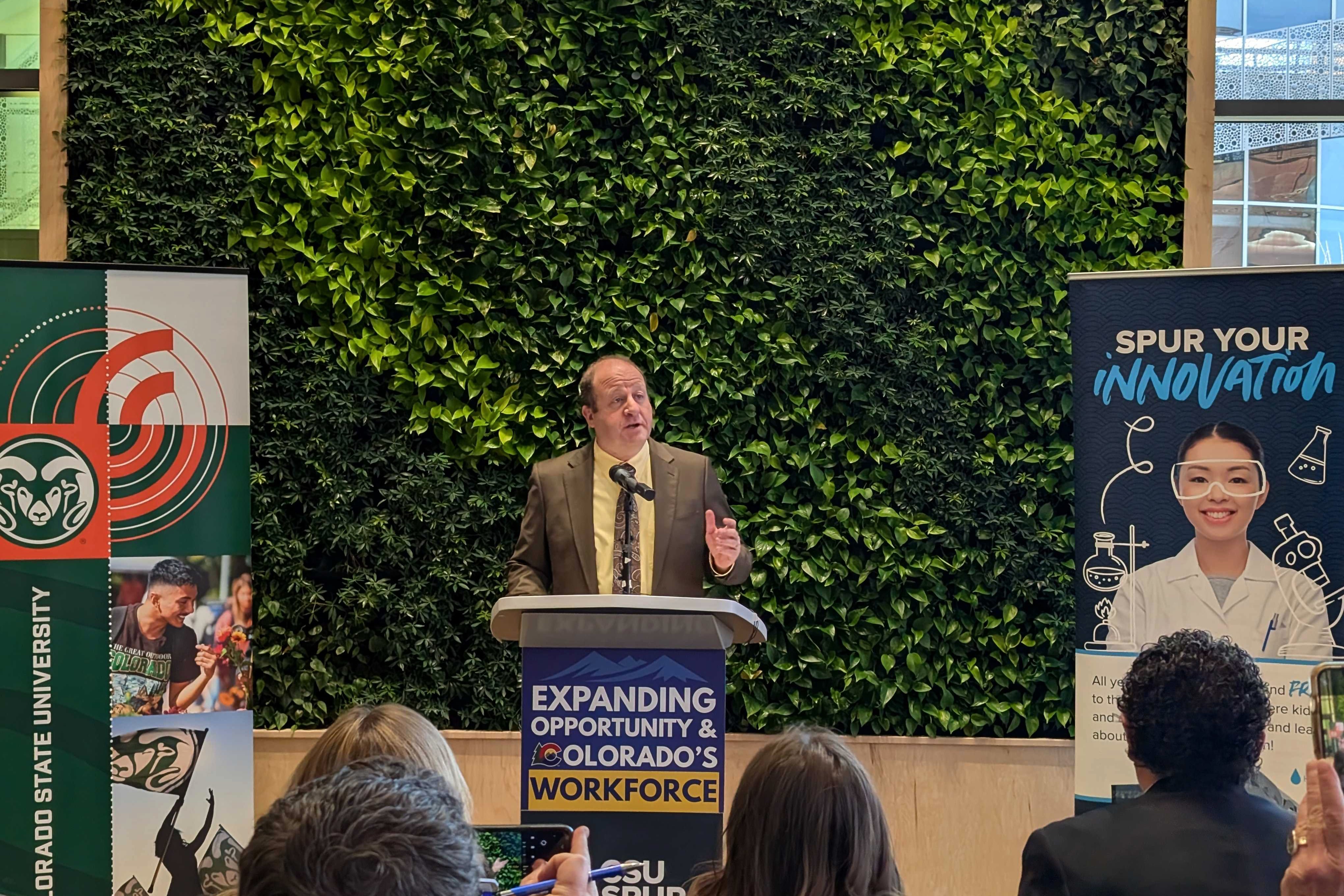
The announcement, marked by a press event at the Colorado State University Spur, comes a week after Colorado Department of Higher Education Executive Director Angie Paccione said she was leaving her post after seven years. Paccione, who attended the event, said family matters contributed to her decision to leave the position in January.
Polis, whose term as governor will end next year, said he wants lawmakers to file a bill in the upcoming legislative session to begin a process that he said will likely finish with the state’s next governor in 2027. Lawmakers will need to approve moving programs under the consolidated department’s purview.
“This kind of consolidation drives better efficiency, better results, and is more consumer friendly to learners,” Polis said Wednesday.
Colorado House Speaker Julie McCluskie, a Dillon Democrat, said lawmakers will focus on how to build this new department.
“We want to make sure the folks that are the experts in running these programs and services, and certainly the leaders of these departments, have an opportunity to weigh in and how we move different pieces to a brand new department,” McCluskie said.
Polis signed an executive order in May tasking various state agencies, including the higher education, education, labor, and economic development departments, with producing the report that analyzes the current system of talent development and to find ways to improve Coloradans’ access to employment, education, and training opportunities.
Polis has pushed to improve workforce education years, and state lawmakers have commissioned other reports that say the state can do more to help residents get an education and then into the workforce.
Polis said the proposal crosses political boundaries and would help propel Colorado to the top in terms of economic competitiveness.
“I think that it’s an idea that good governors from either side of the aisle can get behind working with their legislature,” he said. “It’s fundamentally about streamlining. It’s about more efficiency. It’s about driving better results for learners.”
Several other states have taken similar approaches.
For example, South Carolina passed a state law in 2023 to develop a statewide plan to get industry and education partners working under one set of standards to improve the educational and workforce connections in the state.
And Virginia created an Office of Education Economics in 2021 that seeks to use data to help improve educational programming, policy, and workforce partnerships.
However, the Colorado report’s recommendations are very similar to what’s been done in Missouri, which began to merge its higher education and workforce development offices in 2018 into a Department of Higher Education and Workforce Development.
The Missouri department’s Commissioner Bennett Boggs said the change helped employers and colleges and universities work together in a more comprehensive way. But it also came with challenges, he said. State leaders have needed to think through how to adjust traditional structures, like semester schedules, to be more flexible to employers’ demands, he said.
“It’s a healthier conversation in terms of economic development, workforce development, and helping Missourians,” said Boggs, who previously worked as the higher education department’s deputy executive director in Colorado. “Our mission is putting Missourians on a pathway to learn, work, and prosper.”
The report Polis released Wednesday says too few Coloradans are getting the education they need to get higher-paying jobs.
Currently, only half of all Colorado high school graduates make it to college, the report says. Even fewer graduate college or get the training they need for higher skilled jobs. Older adults also have needed more help navigating training or retraining options.
The report says automation and artificial intelligence has driven the need for employees to gain new skills, and the state’s workforce has started to age. These realities mean Colorado will need even more trained workers to fill key jobs. Over 73% of jobs require education after high school, and the report says Colorado is highly educated due to in-migration, but “can no longer rely on importing talent from other states.”
The report says Colorado’s education and workforce system lacks coordination, shared data, and clear accountability. State agencies also have varying grants and inconsistent policies and procedures, the report says, which can create inefficiencies and confusion for administrators.
Educational options beyond just a high school diploma are plentiful across the state, the report says. Coloradans can choose between over 300 apprenticeships and 4,500 training programs, as well as over 10,000 degree options.
However, residents have difficulty understanding which programs might fit their goals because of the complexity of the system. Business leaders run into similar issues when trying to navigate the system, the report says.
Polis said the confusing system was created over numerous years as the result of “inertia” as economic development offices, state agencies, universities, and colleges have reacted to workforce trends. The new department would unify programs to also make the system easier for residents to understand, he said.
Correction: Dec. 10, 2025: Colorado’s higher education department will end in its current form, not close.
Jason Gonzales is a reporter covering higher education and the Colorado legislature. Chalkbeat Colorado partners with Open Campus on higher education coverage. Contact Jason at jgonzales@chalkbeat.org.