Sign up for Chalkbeat Colorado’s free daily newsletter to get the latest reporting from us, plus curated news from other Colorado outlets, delivered to your inbox.
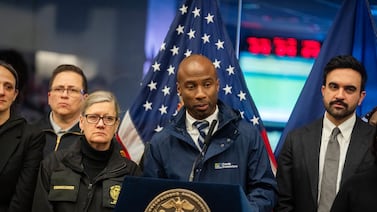
As part of a wide-ranging executive order Thursday aimed at shielding Denver from a federal immigration enforcement surge, Mayor Mike Johnston emphasized that public schools should be “protected spaces” alongside churches, libraries, courthouses, and other public buildings.
“We’ve seen communities terrorized, we’ve seen schoolchildren taken, we’ve seen Americans like Renee Good and Alex Pretti killed for peacefully raising their voices,” Johnston said at a news conference, referencing two people shot in Minnesota by federal agents. “And Denverites ask me every day, ‘What will we do if that chaos comes to Denver?’”
Denver Public Schools Superintendent Alex Marrero and school board member Marlene De La Rosa stood behind Johnston at the news conference. A district spokesperson declined to comment on the executive order. So did school board President Xóchitl Gaytán.
De La Rosa said she attended to hear what Johnston had to say because the school board is considering adopting its own policy that would bar federal Immigration and Customs Enforcement agents from school property without a valid warrant, among other actions. The board is set to discuss the policy at its March 5 meeting.
“We want to take a deeper look into what this executive order is and how it impacts our schools and our students,” De La Rosa said.
Denver Public Schools has long been vocal in its support of immigrant students. DPS already directs its employees to forward any requests from ICE to the district’s attorney. A policy put in place by the superintendent says the attorney won’t allow ICE on district property “unless required by law” and “will do everything in the District’s lawful power” to protect students’ rights.
The policy under consideration by the board would strengthen that commitment.
“The desire is to possibly codify it in policy in a public way so we can take an official stance,” Marrero said at a board meeting last week.
The district sued the Trump administration a year ago to try to reinstate a federal policy that treated schools as sensitive locations that were generally off limits to immigration enforcement. It dropped the lawsuit in June after a judge found there was little practical difference between that policy and Trump administration guidance for ICE agents to use discretion.
Schools were only briefly mentioned in Johnston’s executive order. The order directs Denver police to protect peaceful protestors, use their body-worn cameras to document the activity of federal immigration agents, and provide aid to anyone harmed by them.
Melanie Asmar is the bureau chief for Chalkbeat Colorado. Contact Melanie at masmar@chalkbeat.org.