Sign up for Chalkbeat Colorado’s free daily newsletter to get the latest reporting from us, plus curated news from other Colorado outlets, delivered to your inbox.
Many of the prohibitions in a proposed policy meant to protect Denver students from immigration enforcement are already on the school district’s books, scattered across a handful of rules put in place by the superintendent.
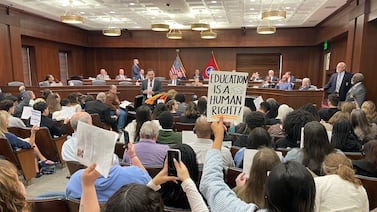
But backers of the proposal say it’s important for the school board to adopt the policy, even if it is duplicative. Doing so would send a clear message of support to immigrant families at a time when the Trump administration has ramped up arrests across the country, they said.
“Our biggest concern is that children are afraid, and parents are afraid to send their children to school, and we need the board to come out and tell them, ‘We’re creating the safest learning environment we can for you and this is what we’re putting in place,’” said Milo Marquez, chair of the Latino Education Coalition, a local advocacy group.
The school board is set to discuss the proposed policy at a meeting Thursday. The proposal would designate all school buildings, buses, and bus stops as “safe zones” and bar staff from cooperating with federal immigration agents without a judicial warrant, among other provisions.
But some proposed provisions go further than the current rules and may test the limits of the school district’s authority. At a meeting last month, several board members pushed for a legal review.
“I don’t want to give any false hope or false protection,” said board member Marlene De La Rosa, “because that is also very, very harmful for our students and our families when they believe something and it’s not possible to have it.”
The proposed policy was written by advocacy groups including the Latino Education Coalition and Movimiento Poder. The latter group has for years raised concerns about how students getting ticketed or arrested at school could lead to their deportation.
“We want to be proactive and ensure that doesn’t happen,” said Berenice Aguirre, the organization’s interim executive director.
DPS has consistently backed immigrant students
Denver Public Schools has long been supportive of immigrant students, even suing the Trump administration to try to reinstate a federal policy that previously treated schools as generally off limits to immigration enforcement. DPS dropped that lawsuit in June after a judge found there was little practical difference between that policy and the Trump administration’s guidance.
After the school district experienced an influx of immigrant students from Venezuela and other South American countries in 2023 and 2024, Superintendent Alex Marrero put in place a new administrative policy detailing how staff should respond to federal immigration officials.
The policy, known as Administrative Policy KLG, complemented prior administrative policies that barred U.S. Immigration and Customs Enforcement agents from district property unless they had a search warrant, for example.
The policy also prohibits the district from collecting information about a student’s place of birth or citizenship status. It says the district won’t share student records unless required by law. And if an ICE agent shows up at a school, the policy directs staff to collect the agent’s name, badge number, and copies of any warrants and subpoenas, and then contact the district’s lawyer.
All of those provisions are also in the policy being considered by the school board. But advocates and district staff said there’s a key difference between the superintendent’s policies and policies passed by the board. The latter, they said, are harder to change.
Whereas a superintendent has the sole authority to write and rewrite administrative policies whenever they want, changing a board policy requires a public discussion and a majority vote by board members, who must ultimately answer to Denver voters.
“In this sense, redundancy is not necessarily a bad thing,” DPS General Counsel Aaron Thompson wrote in an email to Chalkbeat. “It can be an intentional governance decision.”
Marquez, of the Latino Education Coalition, also said the policies should be in place regardless of who the superintendent is.
“If the superintendent has these policies, that’s great,” Marquez said. “If the superintendent leaves tomorrow and a new superintendent comes in, then those policies could be gone. But if the board puts them into place, then they’re protected.”
He pointed to an executive order from Denver Mayor Mike Johnston last week that declared schools “protected spaces” from ICE as an example of a high-profile move that signaled support for the immigrant community, even if not all of the provisions were new.
Proposal could require DPS to renegotiate deal with police
The proposal would be an addition to an existing school board policy called Executive Limitation 10. Executive limitations are rules for the superintendent, who answers to the school board.
But as written by the advocacy groups, the proposal says school-based police officers and independent charter schools would have to follow the rules too. That could require the superintendent to revise the district’s contracts and agreements with the Denver Police Department and each charter school, Thompson said.
For instance, the proposed policy says the superintendent should not allow school resource officers, who are Denver police officers assigned to work in DPS schools, to arrest or ticket a student if doing so would put them at risk of deportation.
It also says the superintendent should not allow school resource officers to share student information with ICE agents or “any law enforcement officers not assigned to the school.”
The school board doesn’t supervise school resource officers, Thompson said, and “cannot direct (Denver Police Department) arrest decisions in real time through board policy.” But the board can direct the superintendent to negotiate and enforce expectations for the officers through the district’s written agreement with the police department. That agreement already says officers should not get involved in routine school discipline.
The board can also ban school resource officers altogether, as it did in 2020 after the murder of George Floyd and concerns about racist policing before reinstating them in 2023.
A spokesperson for the Denver Police Department said its officers do not help enforce civil federal immigration law but declined to answer specific questions about the proposed policy. Thompson said DPS school resource officers “generally will not know a student’s immigration status, and DPS does not want an SRO attempting to determine it.”
Aguirre, of Movimiento Poder, said the board’s 2020 decision to remove school resource officers shows it has authority over the officers’ presence and scope. She said her organization believes officers should only get involved in situations involving weapons or violence.
“We don’t think we’re asking for anything radical or that hasn’t been done before,” Aguirre said.
The proposed policy also seeks to add a new provision prohibiting DPS from cooperating or complying with ICE detainer requests. Such requests are usually made by ICE to jails to hold someone who has been arrested so that ICE may take custody of them. Thompson said that to his knowledge, DPS has never received an ICE detainer request.
Melanie Asmar is the bureau chief for Chalkbeat Colorado. Contact Melanie at masmar@chalkbeat.org.