Sign up for Chalkbeat Colorado’s free daily newsletter to get the latest reporting from us, plus curated news from other Colorado outlets, delivered to your inbox.
Outdated textbooks, large class sizes, and not enough counselors: Colorado education spending has created a situation where there aren’t enough resources, said teacher Wendy Bergman.
“We are constantly stretching supplies, time, and energy,” said Bergman, who teaches social studies at Rocky Mountain High School in Fort Collins. “Talented, dedicated educators are leaving because of our salaries and our working conditions.”
Educators like Bergman have shared the same message about underfunding for years. Studies show Colorado’s near the bottom in state education funding as a share of total personal income. And state studies released last year show Colorado needs about $3.5 billion to $4.1 billion more annually to adequately resource schools.
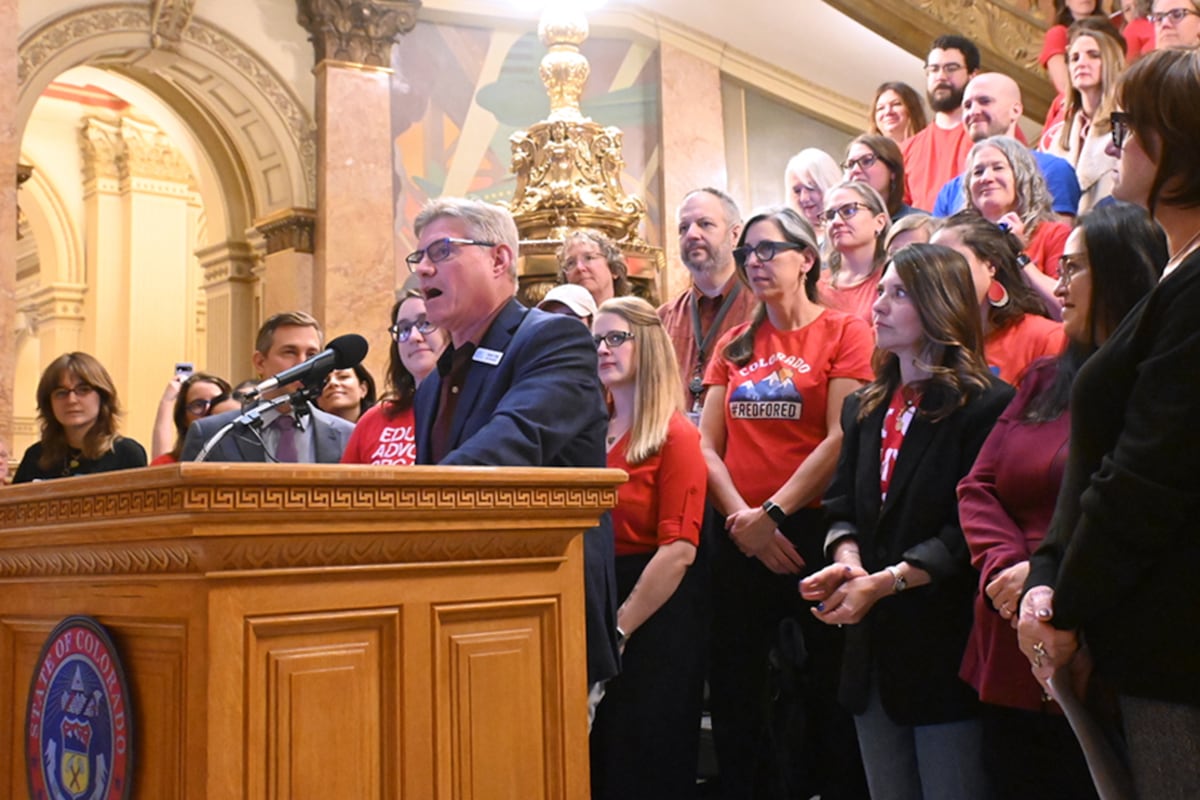
On Thursday, a group of Democratic lawmakers announced during a news conference at the Capitol rotunda they’ve filed Senate Bill 135 to help solve that problem.
Joined by Bergman and other Colorado Education Association union members, lawmakers said the bill would ask voters to approve a November ballot measure to increase state spending on K-12 education by 2% each year for the next 10 years.
“For too long, we have asked our schools to do more with less,” said bill sponsor Sen. Jeff Bridges, a Greenwood Village Democrat who is vice chair of the state’s Joint Budget Committee. “Now is the time to do something different. It is time to fund our schools.”
But history shows getting voters to approve that kind of change might be difficult.
The ballot measure would effectively retool the cap in the Taxpayer Bill of Rights, or TABOR, that mandates how much the state can spend each year. The cap is based on a formula that accounts for inflation and population growth, and the state must return any excess tax revenue above the cap to taxpayers.
The proposed change wouldn’t raise taxes on residents. Instead, the bill would reduce the size of taxpayer refunds.
Lawmakers estimate the state would keep about $200 million more a year to pay for K-12 education, or about $2 billion over the next 10 years. And the money would not only help pay for statewide education expenses, but free up state money to pay for other priorities, lawmakers said.
The bill calls the new funds the Positive Factor — a nod to a mechanism known as the Negative Factor that lawmakers used for nearly 15 years to pull education funding away from schools to balance the budget. (It was also called the Budget Stabilization Factor.)
Lawmakers celebrated their elimination of the factor in the 2024-25 budget during a Taylor Swift-themed rally where they declared the state would never get “back together” with the Negative Factor.
But that jubilation may have been premature. Bridges said the state is in a difficult budget situation this year that’s only going to get worse. And lawmakers might need to use the Negative Factor once again and withhold money from schools starting in the 2026-27 budget year due to an $850 million budget hole, he said.
Despite Colorado’s overall budget increasing, TABOR only allows the state budget to grow so large, and state lawmakers face higher costs in programs like Medicaid, he said.
“I think legislators are starting to understand how dire this is,” Bridges said. “It’s a bad year.”
House Assistant Majority Leader Jennifer Bacon, a Denver Democrat and bill sponsor, said she wants voters to know that the revenue cap on state government was created in 1992, when classroom instruction looked a lot different.
“2026 is not 1992,” she said. “And costs have gone up more than inflation.”
Republicans have questioned the need for the bill. In January, Sen. Barbara Kirkmeyer, a Weld County Republican who also sits on the state’s Joint Budget Committee, said she wouldn’t support the proposal and that Democrats should work within the TABOR cap.
“We’re not in a recession,” she said at the time. “It’s not like we have less revenues coming in.”
Voters have rejected several efforts to alter TABOR since a 2005 revision.
Colorado Education Association President Kevin Vick said the teachers union has extensively researched whether voters would support such a measure.
“What voters are telling us again and again is they’re sick and tired of seeing their kids’ favorite teachers not being able to make it in education in Colorado,” he said. “And they understand that that is largely due to just a complete lack of resources in our system right now.”
Vick said the bill already has support from the Colorado Children’s Campaign, the Colorado Rural Schools Alliance, Colorado Association of School Boards, and Stand for Children.
About 40 Democratic House and Senate lawmakers have also signed on in support of the bill.
Jason Gonzales is a reporter covering higher education and the Colorado legislature. Chalkbeat Colorado partners with Open Campus on higher education coverage. Contact Jason at jgonzales@chalkbeat.org.