Did you know search engines like Google are changing the way you see news? Keep Chalkbeat’s valuable education coverage at the top of your feeds by clicking here and checking the box next to our name.
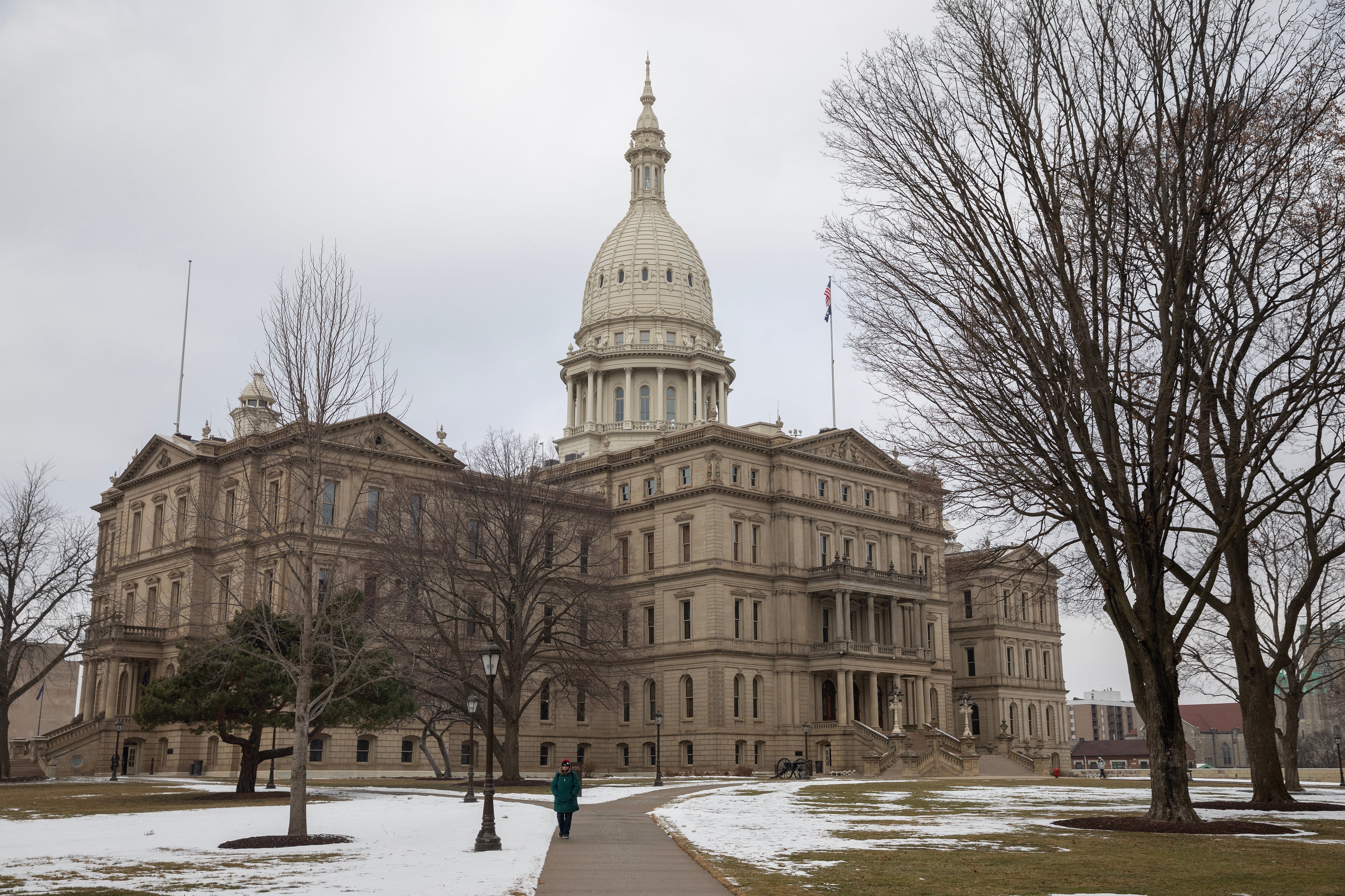
Michigan’s gubernatorial candidates want to turn around the state’s education crisis but have vastly different approaches to doing so, including on how Michigan schools are funded
Republican John James, who represents Michigan’s 10th Congressional district, has set out a K-12 education platform strongly centered on parental rights and accountability.
He sees eliminating overhead costs at the district level as a way to unlock money to fund skilled trades and arts education. James would immediately sign on to President Donald Trump’s Federal Scholarship Tax Credit program, which would provide dollar-for-dollar tax credit, up to $1,700, for taxpayers who donate to scholarship-granting organizations. Those organizations can then use those donations to provide money to families for things such as private school tuition, tutoring, and other educational expenses.
“If you give parents a choice, you give children a chance,” James told the Free Press in June.
Benson said the Trump administration’s program fails to show how it would improve education for Michigan students and would be a reckless use of money. Meanwhile, Gov. Gretchen Whitmer is among four Democratic governors who are seeking additional information about the program.
More broadly, Benson, Michigan’s Secretary of State, has called for K-12 education that is more data-driven and results-focused. Her education plan includes extending free early education to 3- and 4-year-olds, increasing the base salary for teachers to $60,000, finding more money for education, and continuing the weighted funding model that Whitmer started. Weighted school funding is generally designed to allocate funding to districts based on student needs that require additional resources.
“We’ve not fully restored the funding that has been cut over the last 30 years,” Benson said in June.
Education funding doesn’t keep up with inflation
Whoever wins the governor’s seat will inherit a K-12 education budget that has made headlines for record funding under the Whitmer administration, but the increases have not kept up with rising costs. An analysis by the House Fiscal Agency says that both the minimum per-pupil allowance and the overall school aid budget have decreased under Whitmer, once adjusted for inflation.
“We’re further from adequacy today than we were in 2018,” said Robert McCann, executive director of the K-12 Alliance of Michigan, responding to the House Fiscal Agency numbers.
“That’s what I think is so frustrating, because you have the governor and legislators putting statements out every time they pass a budget saying, ‘We’ve given schools record funding,’” McCann said in an Oct. 27 interview.
In an Oct. 27 statement, Whitmer spokesperson Kaylie Hanson reaffirmed that the governor has made record investments in K-12 education, but also did not dispute that inflation has offset some of those increases.
“Unfortunately no one, not even Michigan students, are immune from the cost increases caused by D.C. Republicans’ agenda that has made everything much more expensive, from gas prices to classroom materials and more,” Hanson said in an email. “That’s why our next governor must keep investing in public education and ensure every student has a world class education from preschool to postsecondary.”
The minimum per-pupil foundation allowance, sometimes referred to as the foundation grant, was pegged at $10,300 for the 2027 budget year. That’s a record high. Still, numbers crunched by the fiscal agency show the grant has not kept pace with inflation under Whitmer, who took office in 2019.
Whitmer’s budgets froze the foundation grant on two occasions, providing no increase for the 2021 fiscal year or the 2025 fiscal year. But both times the grant was frozen, Whitmer emphasized that overall K-12 spending — which includes separate allocations for items such as school meals, students with special needs, and transportation costs — had still risen to a record level.
When adjusted for inflation using the Detroit Consumer Price Index, the $10,300 per-pupil grant represents a 2.9% decrease from 2019, the last budget signed by Republican former Gov. Rick Snyder, according to an analysis provided to the Detroit Free Press Oct. 26 by Jacqueline Mullen, a senior analyst with the Michigan House Fiscal Agency. The foundation grant approved for the 2019 fiscal year — $7,871 — equates to $10,604 in 2027 dollars, according to HFA calculations.
Data showing that overall K-12 spending, when adjusted for inflation, has also decreased under Whitmer is much more contentious. That’s because it is based on a spending number for 2027 that has been criticized for baking in an estimated $2 billion cut in federal support that is unlikely to materialize.
Looking at overall K-12 funding, the $19.8 billion approved for 2027 represents a 0.7% decrease from 2019, when adjusted for inflation, according to the analysis. The $14.8 billion school aid budget approved for 2019 is equivalent to $19.95 billion in 2027 dollars, according to HFA calculations.
But again, the school spending number in the 2027 budget, though endorsed by lawmakers in both parties through their affirmative votes in the Legislature and signed into law by Whitmer, has been criticized as artificially low by analysts such as the Citizens Research Council of Michigan. In the news release she issued when she signed the 2027 education budget into law in July, Whitmer still cited “record investments in K-12 education.”
He said the per-pupil grant amount is more important than the overall spending number, because it is provided to school districts with no strings attached and can be spent according to local needs, while many other items in the overall school aid budget can only be spent for specific purposes.
McCann said he wants to credit Whitmer and the Legislature for moving in 2027 toward a weighted funding formula for K-12 schools, under which school districts that have, for example, more students with learning disabilities or more students who need help with their ability to speak English, will receive higher allocations. The problem, McCann said, is that the extra payments under the weighted formula are calculated as a percentage of the foundation grant. So if the basic per-pupil funding is lower than it should be, all the payments under the weighted formula will be too low as well, he said.
With all the talk of record funding, “it becomes hard for school districts to explain to parents why certain programs can’t be funded anymore, why they’re not filling a teacher position, why they’re not filling a reading coach,” McCann said.
Detroit Free Press politics writer Paul Egan contributed to this report.
This story is part of a collaboration between Chalkbeat Detroit and the Detroit Free Press to cover key issues in Michigan’s gubernatorial contest.