Did you know search engines like Google are changing the way you see news? Keep Chalkbeat’s valuable education coverage at the top of your feeds by clicking here and checking the box next to our name.
Parents and other community members are criticizing Indianapolis Public Schools’ recent proposals to close schools and revamp its Innovation Network, saying the district has failed to act transparently and seek sufficient public input before making big decisions.
Confronting acute financial troubles and a steep drop in enrollment in the last several years, the district says the plan to close six schools that it unveiled Tuesday would save $4 million. Superintendent Aleesia Johnson indicated IPS prioritized stability in the proposal.
All students at closing schools would be moved to others within the same enrollment zone as their current school, IPS said. At Thursday’s school board meeting, Johnson said the proposal — which the board is expected to take action on at its Dec. 8 meeting — would allow all the students in a closing school to relocate to a new school together, to maintain friendships and community bonds.
But it remains to be seen if closing those schools would help put the district on a path to long-term stability without fundamentally breaking the trust of school staff, parents, and the general public, especially given the growth of charter schools in the area and the availability of private school vouchers to all Indiana families.
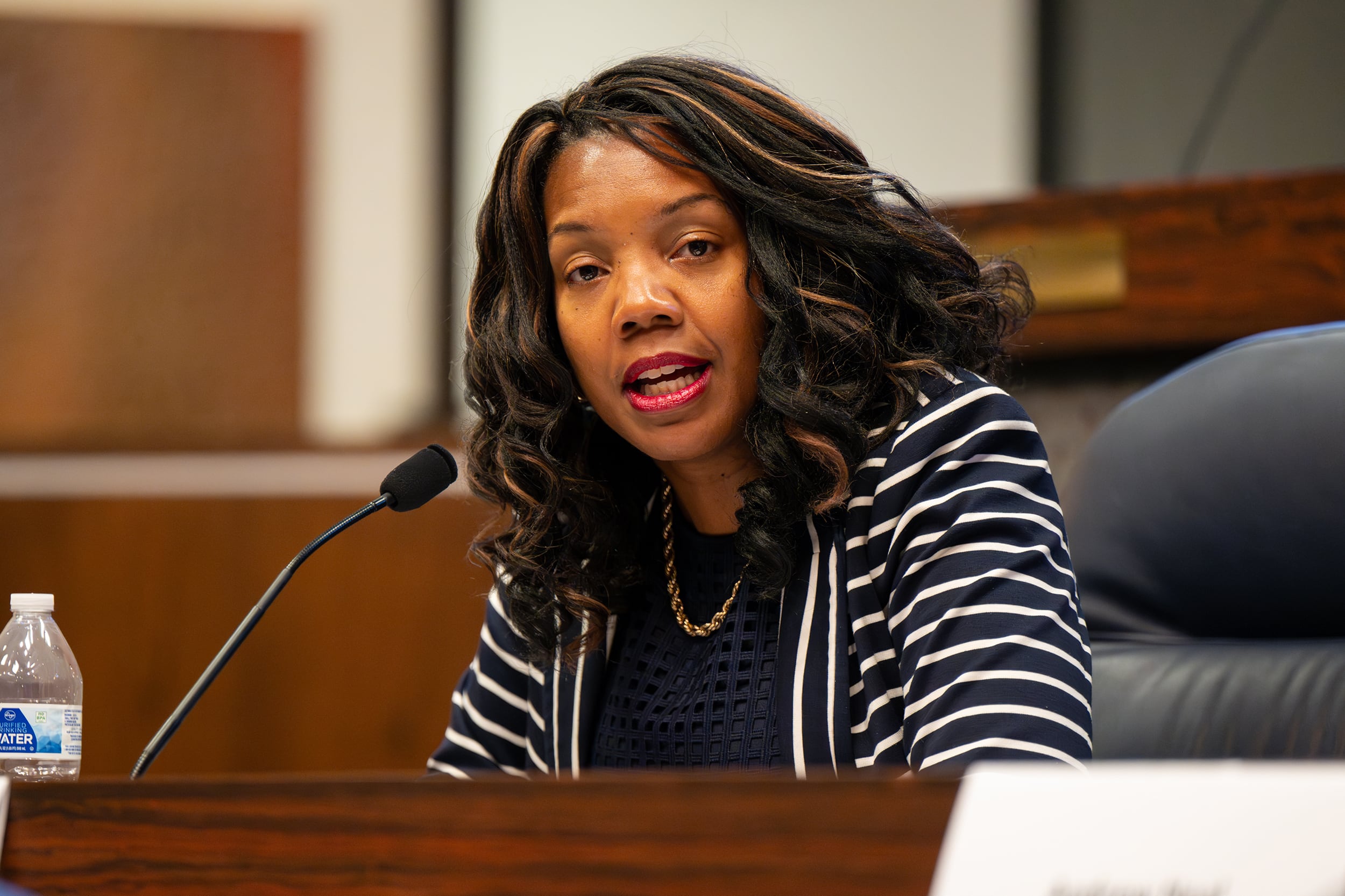
Katharine Harris, whose child attends one of the schools IPS has proposed closing, Benjamin Harrison School 2 Center for Inquiry, or CFI 2, asked the district to reconsider the plan at Thursday’s meeting.
“CFI 2 is a stably enrolled, healthy community,” she said at the board meeting.
She said she believed closing CFI 2 will cause even greater enrollment drops and exacerbate the district’s problems.
The schools IPS has proposed closing after this school year tend to be smaller and losing students faster than other schools run by the district as well as charters. In addition, a Chalkbeat analysis found that the six schools tend to perform slightly worse than their peers on state standardized tests. The schools have a slightly greater share of non-white students and students who qualify for subsidized meals based on their household income.
The IPS proposal would require nearly 2,000 students — roughly 10% of district enrollment — to move to new schools and programs.
The students from the closed schools would be automatically enrolled in new schools, ranging from half a mile to about 3.5 miles away from their current school. Families who do not want their children to go to their new assigned school would need to complete a School Choice Application, the district said, but would get priority for enrollment in other district schools.
The closure and mergers would affect about 450 staff members. They will have priority for open roles at receiving schools. But an IPS spokesperson said the district will not know until June how many positions they would need filled, meaning it’s unclear if the closures would leave some current staff without positions.
IPS said the closures would save an estimated $4 million. There would also be additional revenue if IPS were to sell closed school buildings. The district will lose power over its school buildings starting in the 2028-29 school year, when the Indianapolis Public Education Corporation will assume control over them.
Voters passed a $95 million referendum earlier this month that will benefit both IPS and charters within district borders. But IPS warned before the election that even if the measure passed, it would have to make about $20 million in cuts.
IPS said state-mandated reductions in property taxes, and a requirement to share that revenue with charter schools within district borders, means “the pie is getting smaller and is being cut into many more pieces.”
In a separate move designed to give the district more financial breathing room, the board also voted Thursday to move forward with canceling the district’s existing contracts with Innovation Network schools in order to renegotiate them.
Innovation Network schools are independently run but receive services such as transportation, food service, and facilities support from the district. There are 30 Innovation schools, and most are charters.
IPS said it wants to continue its partnership with Innovation Network schools, but only if it can charge those schools more for the services it provides. Most Innovation Network schools are charters.
Current Indiana law limits the district to charging no more than the amount the Innovation school receives in property taxes. The district said it often receives less than the actual cost of providing services. IPS said it will seek changes to that law during the legislative session.
The resolution adopted by the board described the move as procedural and would not lead to the actual termination of Innovation Network contracts before next June at the earliest. But the move has created unease in the network.
Franka Sears has four children, three of whom attend Innovation schools.
“What would this mean for my daughter, who was finally thriving academically in her Innovation school?” she asked the board Thursday. “What about my children in special ed where changing the environment can be detrimental? I want you to think about families like mine, kids like mine, and understand that all decisions being made have families and faces behind it.”