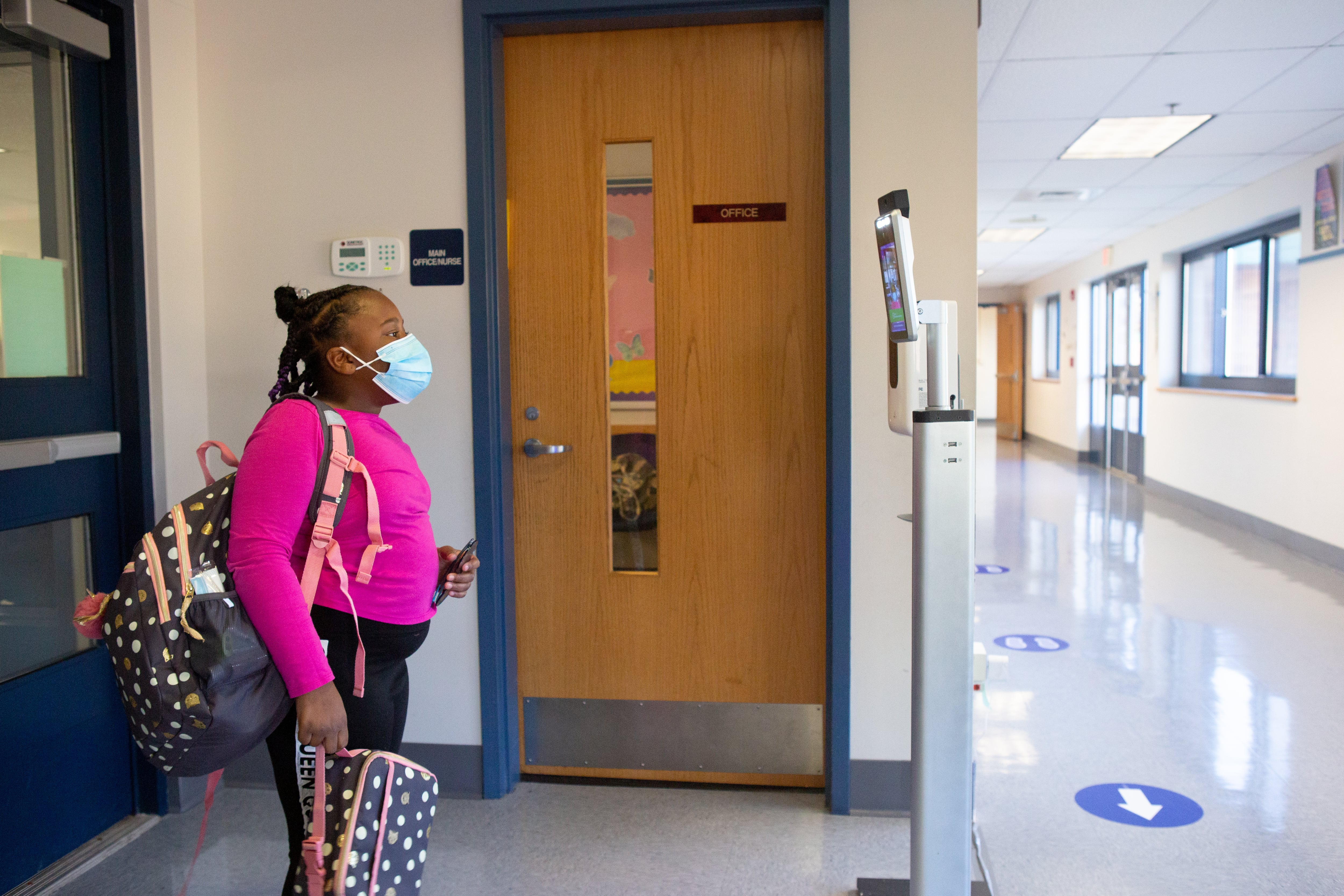
Indianapolis Public Schools will add new COVID-19 protocols to its campuses beginning Sept. 8, as the district reports nearly 600 students and staff in quarantine.
In a Monday video announcing the changes, Superintendent Aleesia Johnson said the new policies aim to strengthen existing protocols, which already included mandatory masks for all.
Though the district was one of the first to require masks before the beginning of the school year, it has placed nearly 600 students and staff in quarantine and recorded 81 positive cases in just one month of school, Johnson said.
“The unfortunate reality is that these are numbers that will only continue to grow if we, the collective we, don’t increase the actions we’re taking,” she said.
One of the most notable additions to the district’s protocols is an exception to mandatory quarantining after a COVID-19 exposure for anyone who has recovered from the illness in the previous three months and remains asymptomatic. The policy is in line with CDC guidance.
The district has also defined close contact with a COVID-19 case as being “within 3 feet of a person who tested positive for COVID-19 for 15 minutes or more within a classroom setting.”
In any other areas such as cafeterias, hallways, and gyms, close contact is defined as 6 feet for 15 minutes or more, Public Information Manager Alpha Garrett said.
Other new policies include a ban on in-person field trips through Oct. 8, as well as a mask requirement for choir students while they’re singing or vocalizing.
The district also seeks to reduce the number of people gathering in campus cafeterias, and will utilize classrooms, gyms and outdoor spaces for lunchtime in K-8 schools. In high schools, students may continue to eat in the cafeteria with mandatory assigned seating.
The district will permit parents and other visitors on campus by appointment only, with limited classroom interactions.
Johnson said that although she had hoped to start the new school year with less worry about coronavirus cases and quarantines, the pandemic has caused disruptions in districts throughout the state, with individual and whole classroom quarantines.
On Monday, Indiana reported more than 6,100 new positive cases in schools last week. More than 5,500 of those were students.
The state Department of Education did not have information available Tuesday about which schools have switched to virtual or hybrid instruction since the beginning of the year.
Johnson said IPS is also encouraging more testing and vaccinations at its sites by hosting more vaccine clinics and offering a one-time $300 cash incentive to employees who submit proof of vaccination by Sept. 30.
“As much as I wish this was not the conversation that was happening, in many ways it feels harder and sadder to navigate a second time around when it felt like the time was changing,” Johnson said.
“But I also know continuing to be responsive and put additional safety measures in place is the right thing.”