Sign up for Chalkbeat Newark’s free newsletter to get the latest news about the city’s public school system delivered to your inbox.
American Federation of Teachers President Randi Weingarten said recently that her visit to Newark’s Park Elementary School reinforced her worry about screens and AI in schools.
The day after her Newark trip, she proceeded with a high-profile call for a ban on student-facing AI in elementary schools.
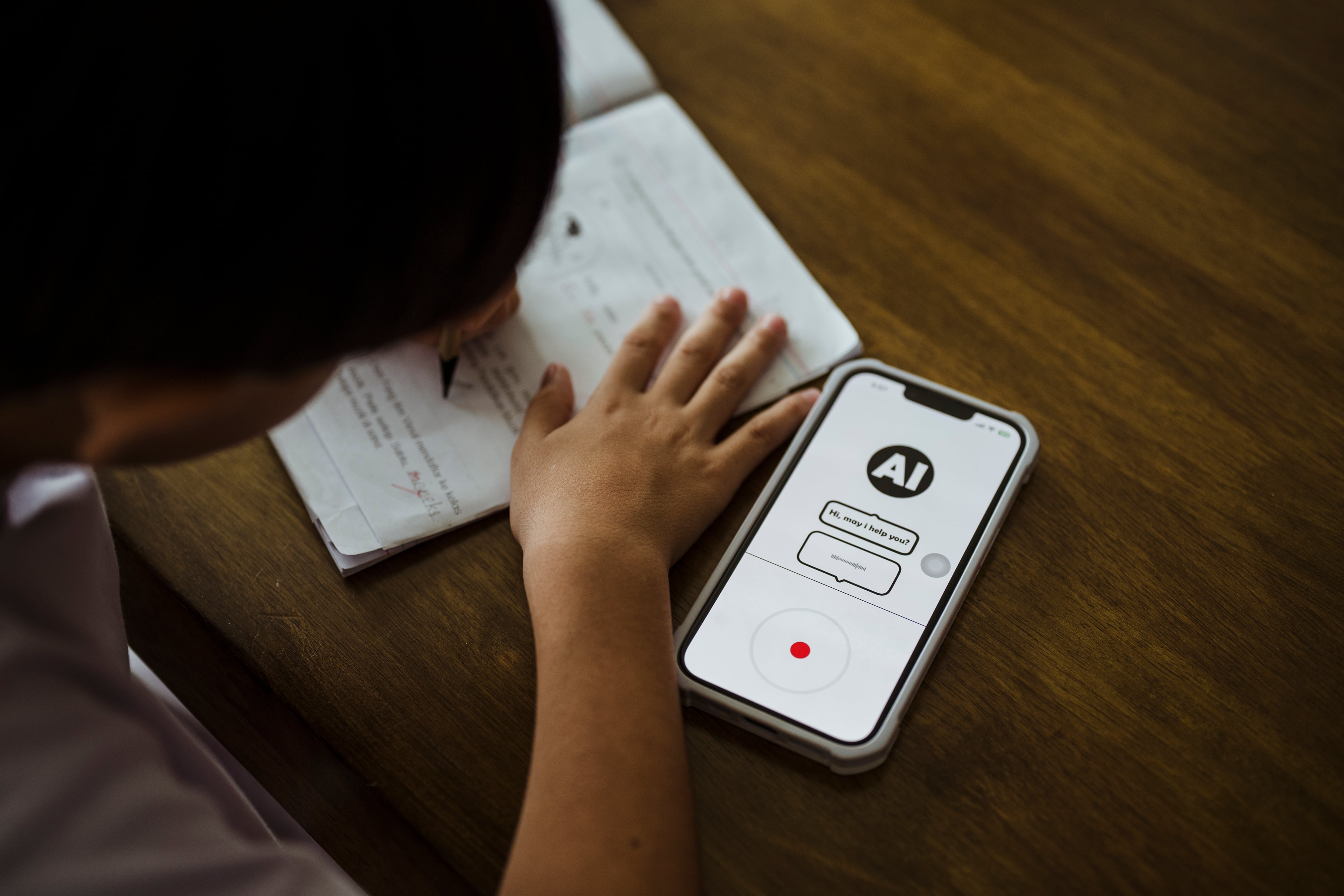
“The classroom is very quiet, and it’s basically a super duper tutoring center,” Weingarten said in June, recalling her visit to see Khanmigo, an AI chatbot created by Khan Academy, in action.
The comments followed an awkward juxtaposition for Weingarten, who leads the country’s second-largest teachers union. The AFT partnered with OpenAI and Microsoft last year to provide AI training to its members and has also promoted the use of Khanmigo.
But following her May visit, Weingarten called for classroom screen time limits and a tax on big tech as she unveiled a 10-point plan that calls for no screens for students in pre-K through second grade, a ban on AI chatbots through age 16, and project-based, experiential learning.
Weingarten isn’t alone in her skepticism of AI in schools and echoes broader concerns from researchers. Experts are also concerned that there is little research on whether AI tools like Khanmigo are actually helping students refine key skills in math and reading, even as Newark has pointed to its own data as evidence of student progress.
During her visit to Park Elementary, Weingarten said she was upfront with Superintendent Roger León about what she was about to say publicly. She spoke with teachers about her concerns directly and saw how they were using Khanmigo to teach students new skills in small groups rather than as a class. Afterwards, she spoke with students about their use of the tool, and they told her Khanmigo reinforced their skills instead of teaching them anything new.
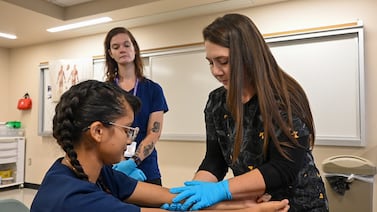
There was one moment when students got excited, and it had nothing to do with Khanmigo. Students lit up only when a teacher pulled a few students aside to do a science experiment, Weingarten said in June, a contrast to the quiet screen-based instruction happening in the room.
Paul Brubaker, the district’s communications director, did not respond to comment.
In the fall of 2024, the district said students who used the AI tool during the pilot phase showed improvements in their math scores. But that data is self-reported by the district and has not been released publicly. During an interview with León in 2024, the superintendent said Khan Academy is helping the district analyze state testing data to determine the impact Khanmigo is having on student progress. The district is also using the tool to support tutoring efforts and help teachers “influence the academic program” in schools, León added.
Khan Academy’s founder, Sal Khan, has praised the district’s use of Khanmigo and awarded them the first-ever Khan Academy Award for Excellence and Innovation in April. But that same month, Khan had expressed disappointment with the chatbot’s performance in schools.
Newark, New Jersey’s largest school district, was among the first in the country to test Khanmigo at First Avenue School on students in grades 5-8 during the 2023-24 school year. At that time, the district said the tool was primarily used to support students in math, reading, and writing.
Among district schools, First Avenue had the second-highest math proficiency rate in spring 2024 state test scores, but it’s unclear how much of Newark’s use of Khanmigo actually impacted student progress.
That uncertainty hasn’t slowed its expansion across Newark. The district expanded Khanmigo to 13 other schools and grades 3-8 in the 2024-25 school year after receiving a $25,000 grant from the Bill and Melinda Gates Foundation. Newark has also adopted other AI technologies in school, including Amira Learning, an AI literacy screener tool, and installed thousands of AI cameras districtwide.
The aggressive expansion of AI in schools comes as New Jersey prepares for the first year of phone-free schools this fall and Gov. Mikie Sherrill’s concerns about students’ safety online.
León, in a press release about Weingarten’s visit, said Newark’s approach to Khanmigo shows “how AI can strengthen teaching and learning when implemented thoughtfully and collaboratively.”
Chalkbeat Ideas Editor Matt Barnum contributed to this story.
Jessie Gómez is a reporter for Chalkbeat Newark, covering public education in the city. Contact Jessie at jgomez@chalkbeat.org.