Sign up for Chalkbeat New York’s free daily newsletter to get essential news about NYC’s public schools delivered to your inbox.
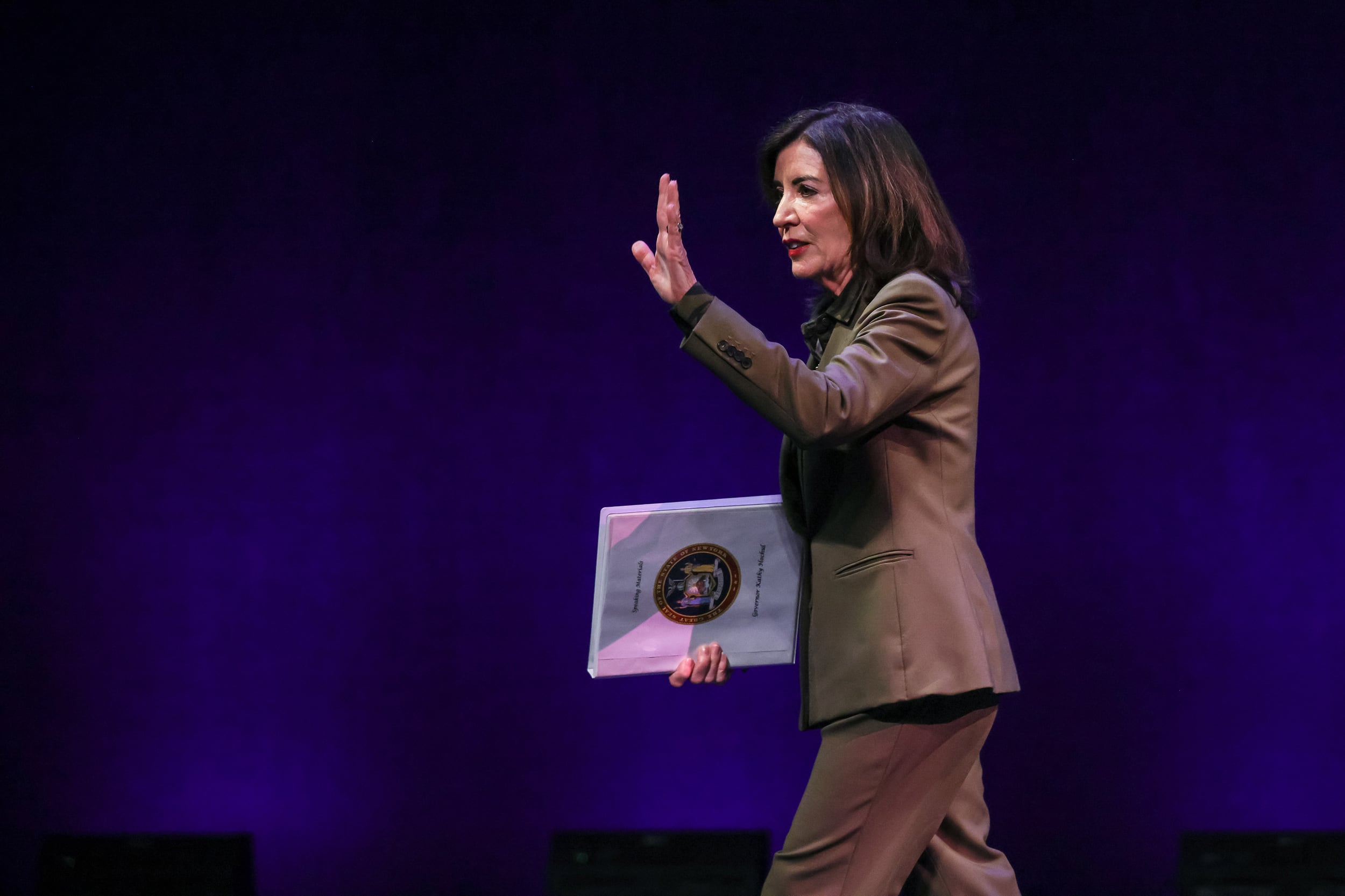
Gov. Kathy Hochul proposed to extend mayoral control of New York City’s public school system, boost funding for public schools across the state, and pay for child care for 2-year-olds in the five boroughs — a major campaign promise of Mayor Zohran Mamdani.
Those proposals came as part of Hochul’s executive budget plan on Tuesday, which drew some criticism from school funding advocates who raised fresh concerns that the state’s main funding formula is shortchanging New York City.
The governor acknowledged the challenges confronting the state in the face of significant cuts from the federal government and pledged her budget would be responsible but not “austere.” Overall, public schools across the state would get about $39.3 billion of the proposed $260 billion budget. The governor plans to increase school funding by $1.6 billion, or 4.3%.
“This budget invests in the next generation with nearly $40 billion in school aid, and we’re continuing to ensure that high need districts are funded appropriately,” Hochul said during her Tuesday budget address.
The governor’s proposal kicks off negotiations with lawmakers about how the state will allocate its budget for the next fiscal year, which begins in April.
Mamdani said in a statement that the governor’s proposal “makes meaningful investments that move us closer to an affordable and livable New York — especially through critical advancements in early childhood education.”
And while he noted that the state may be on “solid financial footing,” the city is not, he said, pointing a finger at his predecessor, Mayor Eric Adams. Mamdani is expected to release the city’s executive budget in April.
Here’s what you should know about the governor’s budget proposal and the reaction to it.
New York City schools stand to get more money, but no big changes to ‘sorely outdated’ formula
The Foundation Aid formula, which represents the bulk of state education spending, would send $15.1 billion to New York City under the governor’s plan. That’s 2.5% more than last year — or about $371 million — according to state budget documents.
The formula is designed to funnel more money to high-need districts, and Hochul tweaked it last year by updating a metric for student poverty. As a result of the governor’s changes, New York City schools last year received $314 million less than they would have under the original formula.
Experts, advocates, and state lawmakers are pushing for further changes to the two-decade-old formula to account for differences in costs like salaries in different parts of the state and adding additional weights for homeless students and those in foster care.
The formula “relies on outdated and incomplete measures of student need, and has not evolved to reflect rising costs, particularly in large urban districts,” the Coalition for Equitable Education Funding, a constellation of more than 100 education groups, wrote in a statement. “We are concerned that the budget proposal released today fails to address these shortcomings.”
A Hochul spokesperson noted that funding for the city’s schools has increased on the governor’s watch and blamed some of the funding fluctuations on enrollment declines.
Expanding access to child care
As the governor has pledged in recent months, her budget plan includes a push to significantly expand access to free and affordable child care and early education. Hochul proposed to increase state child care spending by $1.7 billion, bringing the total to $4.5 billion.
That spending would include $73 million this year for New York City to roll out a new 2-Care program, with a commitment to invest $500 million over two years. 2-Care is expected to create 2,000 new child care seats for 2-year-olds in high-need areas of the city in the fall, and then grow to 8,000 seats next year. Mamdani said he will make the program available to all of the city’s 2-year-olds by the end of his first term.
However, many early childhood teachers and advocates say that the expansion will fail unless the city fixes problems in its existing early education system. Currently, large disparities in teacher pay make it difficult for community-based child care centers to hire and keep staff, and there is a severe shortage of seats for kids with developmental delays and disabilities.
Both Hochul and Mamdani have promised to make programs available to students with disabilities, “but past expansions of early childhood education have shown that good intentions are no guarantee of equity,” wrote Maria Odom, the executive director of Advocates for Children of New York, in a statement.
“3-K is not ‘for all’ if three-year-olds with autism are sitting at home because there are no classes that can meet their needs,” Odom continued.
Statewide, Hochul has said she wants to make Pre-K available to every 4-year-old in the state by the 2028-29 school year. To that end, her budget proposes increasing per-seat funding to a minimum of $10,000 this year.
The executive budget also proposes a 40% increase to funding for child care vouchers, which are available to families below earning 85%of the state median income. Total funding this year would come to $3 billion.
A 4-year extension of mayoral control
Hochul is pushing for a four-year extension of mayoral control, which would give Mamdani authority over the nation’s largest school system for his entire first term, Blake Washington, the governor’s budget director, told reporters in a Tuesday briefing.
In 2024, Hochul proposed a four-year extension of mayoral control, which grants the mayor power to appoint a majority of the city’s school board, appoint the schools chancellor, and generally set the district’s policy direction. The final budget included a two-year extension.
Mamdani campaigned on ending mayoral control to give families and educators more of a say over the education system, but he recently reversed course. He must now persuade lawmakers in Albany to extend that power to him.
Overhauling math, training teachers, and tutoring students
The budget proposal includes $4 million to train teachers in evidence-based math instruction and support districts that perform poorly in math — both part of Hochul’s initiative to get “back to basics” in math instruction — and $9 million to support individualized tutoring in high-need schools.
In an effort to recruit and retain teachers, Hochul also proposed $2 million for an accelerated teacher preparation program and $2 million for high school students interested in entering the teaching profession to earn college credit in relevant subjects.
Alex Zimmerman is a reporter for Chalkbeat New York, covering NYC public schools. Contact Alex at azimmerman@chalkbeat.org.
Abigail Kramer is a reporter in New York City. Contact Abigail atakramer@chalkbeat.org.