This article was initially published by Healthbeat on April 30. Sign up to receive Healthbeat’s free New York City newsletter here.
The New York City Council on Thursday passed a package of bills seeking to do more to educate parents about the safety and effectiveness of vaccines as immunization rates show signs of starting to dip.
The five bills aim to make it easier for schools to disseminate accurate information about vaccines to parents, as well as to require the Department of Health and Mental Hygiene to develop a plan by year’s end that will educate New Yorkers about the importance of childhood and adolescent vaccinations.
The package will be sent to Mayor Zohran Mamdani, who has 30 days to sign, veto, or let the bills lapse into law.
The action comes as the federal government led by Health and Human Services Secretary Robert F. Kennedy Jr. and followers of his Make America Healthy Again movement are working to sow doubt and confusion about vaccines, which are scientifically proven to be safe and effective. As a result, state and local governments are taking a greater role in educating the public.
New York state has long had some of the highest vaccination rates in the country, but that record may be faltering.
In New York City, new data suggest parents are delaying routine vaccinations for their children. In March, the city reported that about 1 in 3 2-year-olds had not received all doses of seven vaccines – DTap (diptheria, tetanus, and acellular pertussis); polio; measles, mumps, and rubella; hib; hepatitis B; varicella (chickenpox); and pcv (pneumococcus).
This prompted city health officials to launch a $1 million campaign over four weeks encouraging parents to vaccinate their children. Officials say the campaign ran in multiple languages and on TV, radio, print news, kiosks, and transportation hubs in neighborhoods with low vaccination rates.
“The new life that Kennedy is giving to the movement has clearly given new life to the diseases themselves,” City Council Speaker Julie Menin said at the council meeting, before the bills were introduced. “The erosion of public trust in science doesn’t just increase health risks for his own band of followers, it also puts our wider community in jeopardy. As lawmakers and as leaders, we cannot sit back and let that happen.”
The United States has seen more measles cases over the past year than it has in decades. An outbreak in South Carolina reached nearly 1,000 cases. Most of those infected were unvaccinated.
James Alwine, a virologist, professor emeritus at the University of Pennsylvania, and visiting professor at the University of Arizona, is a member of Defend Public Health, a nationwide network of public health leaders and advocates. He applauded the legislation and offered this advice for the health department on vaccine messaging: Keep it simple and straightforward while highlighting the harm that these preventable diseases can inflict on children.
“Stay out of the real science and data — that just doesn’t work,” Alwine told Healthbeat. “You can’t fight against what they’re saying by trying to tell people, ‘Well, here’s the science, here’s the data, here’s the study.’ It just falls on deaf ears, mainly because it’s hard to explain in lay terms.”
Here is a rundown of the bills:
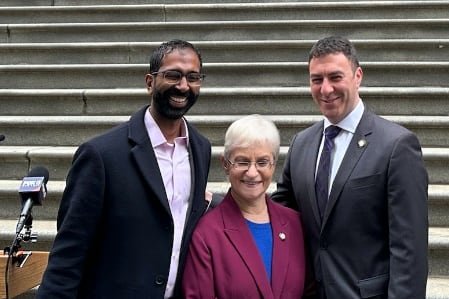
- Educating parents: Sponsored by Council Member Shekar Krishnan, Introduction 260-A requires the health department, in collaboration with the Department of Education, to develop informational material about vaccines. DOE is also required to distribute the materials to parents of all New York City public school students, including those enrolled in early childhood programs such as 3-K and Pre-K. The material must include general information on how vaccines work, their public health benefits, their safety, and where to access vaccines required for school attendance.
- Educating the public: Sponsored by Council Member Eric Dinowitz, Introduction 693-A requires the health department, in collaboration with relevant agencies, to develop and implement a plan by no later than Jan. 1, 2027, to educate the public about the benefits and importance of childhood and adolescent vaccinations. In developing the plan, the health department is required to consider recommendations adopted by major medical organizations, including the American Academy of Pediatrics.
- Authorizing dentists to immunize: Sponsored by Council Member and Health Committee Chair Lynn Schulman, Resolution 273 calls on the New York State Legislature to pass, and the governor to sign legislation authorizing dentists to administer flu shots, Covid vaccines, human papillomavirus vaccines, or a vaccine related to a public health emergency.
- Recommending vaccines: Also sponsored by Schulman, Resolution 425 calls on the legislature to pass, and for the governor to sign state legislation requiring vaccines to be regulated, recommended, administered, and insured based on the recommendations of various nationally and internationally recognized health care organizations.
- Reimbursing costs for providers: Also sponsored by Schulman, a preconsidered resolution calls on the legislature to pass, and the governor to sign a bill requiring insurance to reimburse the total direct and indirect expenses for providers administering vaccines.
In a written statement attributed to city Health Commissioner Dr. Alister Martin, the health department said it looks “forward to continuing our partnership with Chair Schulman and City Council on this issue.”
Trenton Daniel is a reporter covering public health in New York for Healthbeat. Contact Trenton at tdaniel@healthbeat.org or on the messaging app Signal at trentondaniel.88.